
3,474 views ·
9 replies
3k views
9 replies
How to repair a wall of natural stone
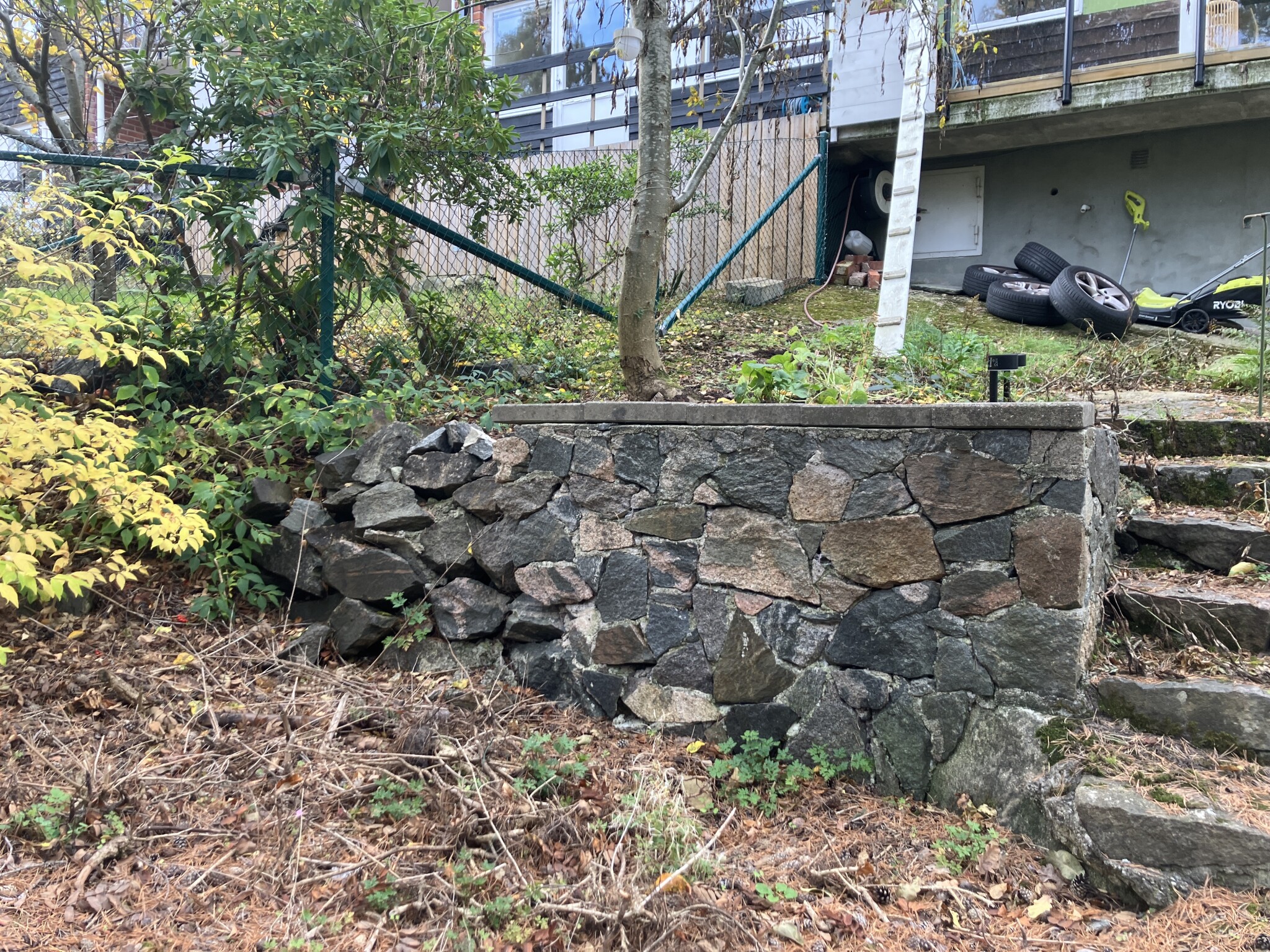
I have a wall of natural stone (see image) that has partially fallen and that I am going to try to repair/rebuild. The wall has some supporting function for the underlying ground. How do I proceed and what type of mortar should I use? I would like to build it all in one go so I can avoid mixing mortar in several batches.
I would say that it is almost impossible to avoid several mixtures unless you are incredibly skilled at building walls.
You need to dig away the material at the back so that the wall becomes freestanding, then you have to disassemble it and build it up again. Make sure there's a good foundation while you're at it.
You need to dig away the material at the back so that the wall becomes freestanding, then you have to disassemble it and build it up again. Make sure there's a good foundation while you're at it.
P Prodigys said:I would say it is almost impossible to avoid multiple mixes unless you are incredibly skilled at laying walls.
You need to dig away the material on the backside so that the wall becomes freestanding, then you have to dismantle it and build it up again. Make sure there's a good foundation while you're at it.
P Prodigys said:I would say it is almost impossible to avoid multiple mixes unless you are incredibly skilled at laying walls.
You need to dig away the material on the backside so that the wall becomes freestanding, then you have to dismantle it and build it up again. Make sure there's a good foundation while you're at it.
The thing is, the wall doesn't have to be perfect since it is in a corner of the plot. It doesn't matter if it gets a bit "uneven". But maybe it's not possible anyway with one mix? Is cement mortar A the right choice?P Prodigys said:I would say it is almost impossible to avoid multiple mixes unless you are incredibly skilled at laying walls.
You need to dig away the material on the backside so that the wall becomes freestanding, then you have to dismantle it and build it up again. Make sure there's a good foundation while you're at it.
The mortar will set before you've patched the wall unless you just throw it in place. Very small amounts of mortar are needed, and getting the wall reasonably even and straight without large gaps is difficult.J johanlund77 said:
I don't quite understand why you're fixated on the mixture of the mortar; it might take two bags, so there's no need for a mixer or even a whisk. A bucket and a trowel will do just fine.
Ok, but which mortar should I use? Is it possible to do this at just a few degrees above zero, or does it need to be warmer?P Prodigys said:The mortar will dry before you've patched the wall unless you just throw it in place. Very small amounts of mortar are needed, and getting the wall somewhat even and straight without large gaps is difficult.
I don't really understand why you're so focused on the mixing of the mortar. It might only require two bags, so you don't need a brocka or even a mixer—a bucket and a trowel will do just fine.
Weber writes this on his page: The suitable product for masonry of natural stone is Weber Cementbruk A.
Yes, it's possible to do masonry work at above freezing temperatures, but it must not freeze.
Yes, it's possible to do masonry work at above freezing temperatures, but it must not freeze.
Ok! Does it have to be frost-free for the entire curing time or is it okay to lay in plus temperatures even if there is night frost?J Jan_G said:
It has to have time to burn, otherwise you won't get the strength you're looking for. So night frost is a BIG NO-NO. You can usually manage light night frost (a couple of degrees) with a tarp over the wall. But DON'T take any chances.
Ok. I see that the nearest 10-day forecast is predicted to be between 2-7 degrees. Do you have any idea about the curing time under such conditions? And if I lay the wall in stages - does it need to cure for a long time between each new layer, or can I do a layer per day?J Jan_G said:

Glad you're interested in saving the beautiful wall!
Instead of just repairing, I would try to think a step further. What is causing the damage?
The tree behind it is a likely cause with strong roots pushing it out. Did the neighbor also have a tree?
Then there's the usual soil pressure that few consider. If you want the wall to stand for a long time, it should be excavated clean behind, gravel added for drainage. Ideally, you would install reinforcement with plastic mesh, available in stores, which is buried horizontally in the soil behind and anchored to the wall to keep it stable.
If building entirely new, the ground underneath should also be drained.
Good luck, you've received great tips before!
Instead of just repairing, I would try to think a step further. What is causing the damage?
The tree behind it is a likely cause with strong roots pushing it out. Did the neighbor also have a tree?
Then there's the usual soil pressure that few consider. If you want the wall to stand for a long time, it should be excavated clean behind, gravel added for drainage. Ideally, you would install reinforcement with plastic mesh, available in stores, which is buried horizontally in the soil behind and anchored to the wall to keep it stable.
If building entirely new, the ground underneath should also be drained.
Good luck, you've received great tips before!
Click here to reply