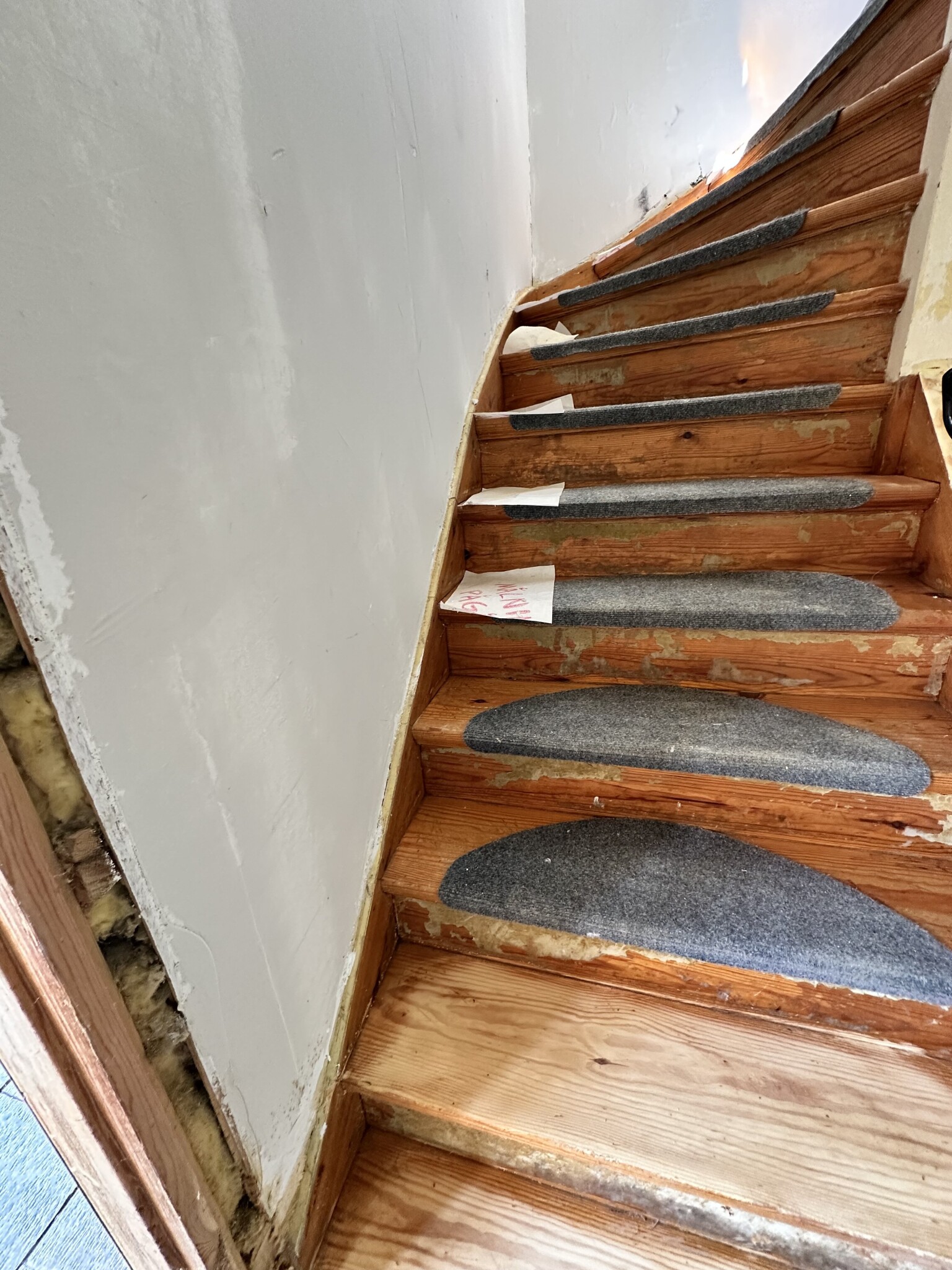
OK it probably depends on the fact that the staircase is tight, there is a board inside it that is supposed to reinforce the step, and that prevents the foot from going in too far. It might be possible to add a piece that makes the step itself extend further out, but it could look strange. There are staircase companies that make custom staircases. It's kind of a half L-shaped staircase that turns a bit. Otherwise, it will probably be difficult to remodel it without tearing it down completely.
There is no simple answer to the question.
One sub-question is to describe what a staircase should look like.
There is a staircase formula that I was taught in vocational school around 1980. *New rules may have been added that I'm not aware of.
The step length plus the step height times two should be somewhere between sixty and sixty-three centimeters. It is desirable that the step height is not higher than 17 cm. Maximum height of the step 20. Not clearly stated in what I learned. But I have interpreted it as that a staircase should not have a slope greater than 45 degrees unless it is impossible to install a staircase in another way.
All steps in a staircase should have the same length and height. The aim is for it to be comfortable and safe to walk on.
There are more rules that I don't see relevant here.
Your question was whether the staircase can be remodeled.
In my experience, that possibility is more theoretical than practical. It is probably more work than tearing down the existing staircase and building a new one.
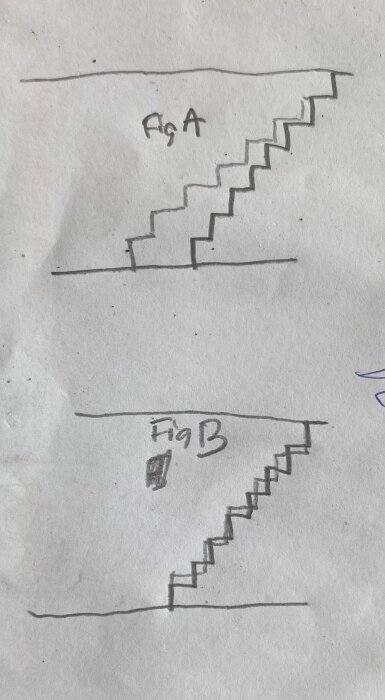
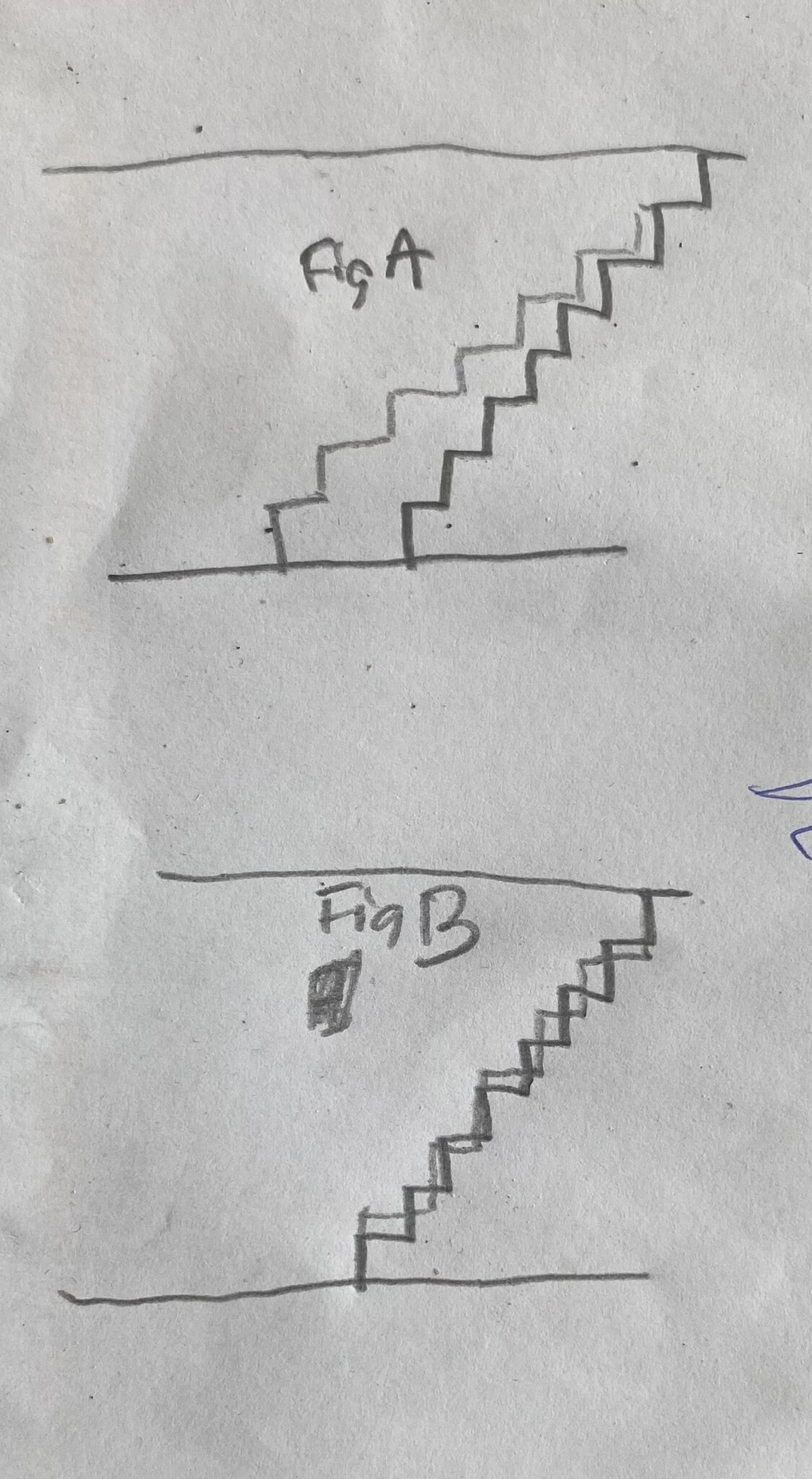
The staircase is probably as it is. If you could extend the staircase by a meter or so, you could theoretically keep the same step height and, so to speak, build a comfortable staircase with the old one as a base. See figA. Your extension then does not encroach on your existing staircase.
FigB shows how your existing staircase is in the way when you try to alter the staircase in the same location. The only step you can just build on is the lowest. All others have to be removed. It is more work than making a completely new one.
Best regards, Findus
*Outside ICA Maxi in Moraberg. Up to Feltemas parking lot, there is a concrete staircase that does not comply with the staircase formula. Uncomfortable to walk on with steps that are too short and low. It bothers me and I wonder how such a staircase got through the eye of the needle in such a large project.
OK it probably depends on the fact that the staircase is dense, there is a board inside it that is supposed to reinforce the step and then the foot doesn't go in as far. It might be possible to add a piece that makes the actual step extend further out, but it could look strange. There are staircase companies that make stairs to measure.
It's like a half L-staircase that bends slightly. Otherwise, it would probably be difficult to remodel without tearing it down completely.
There is no simple answer to the question.
One sub-question is to describe how a staircase should look.
There is a staircase formula that I learned in vocational school around 1980. *New rules may have been added that I’m not aware of.
The step length plus the step height times two should be somewhere between sixty and sixty-three centimeters. Ideally, the step height should not be higher than 17cm. Maximum height of the step is 20. Not explicitly stated in what I was taught. But I have interpreted it as a staircase should not exceed a 45-degree incline if it is not impossible to fit a staircase in another way.
All steps in a staircase should have the same length and height. The purpose is for it to be comfortable and safe to walk on.
There are more rules that I do not see any relevance for here.
Your question was whether the staircase can be rebuilt.
In my experience, this possibility is more theoretical than practical. It is probably more work than tearing down the existing staircase and building a new one.
The stair flight is probably as it is. If you could extend the staircase by a meter or so, you could theoretically keep the same step height and, so to speak, build a comfortable staircase using the old one as a base. See figA. Your extension then does not encroach on your existing staircase.
[image]
FigB shows how your existing staircase is in the way when you try to modify it in the same location. The only step you can extend is the lowest. All others must be removed. It’s more work than making a completely new one.
Best regards, Findus
*Outside ICA Maxi in Moraberg. There is a concrete staircase up to Feltemas parking lot that does not meet the staircase formula. Uncomfortable to walk on with just too short and low steps. It bothers me and I wonder how such a staircase has passed the needle's eye in such a big project.
It's so cramped before the staircase, the front door is right there so nothing can be done there. So it means tearing down and buying a new one.
Shoe size 52? Seriously though: What's the height and depth of the rectangular steps? How many are there? How big is the toe? And maybe draw a freehand floor plan of the first floor with the dimensions of the stairwell. Is it possible to enlarge it?
The question is whether the new staircase can be built in a U-shape to get more steps with a reasonable step length.
Unfortunately, probably not. You get about the same number of steps per unit area in a curved staircase as in a straight one.
It might be possible to cheat with the walking line to get a larger radius towards the spindle.
Whether the staircase is L or U is more determined by the floor plan. Where you want to exit the staircase.
Of course, it's conceivable that the stair run can be extended at the top by turning. For several reasons, I personally don't think it's simple. It can be difficult to offset the load in an old house when cutting into the floor joists to reroute a staircase.
Of course, it may still be worth investigating. I only know as much as I've seen in the thread.
Best regards, Findus
Click here to reply
Vi vill skicka notiser för ämnen du bevakar och händelser som berör dig.


findus42 said:
There is no simple answer to the question.