
Hello!
I was thinking of reinforcing an H-beam that is supposed to support a load-bearing wall. It is dimensioned for the purpose, but I still thought of welding on some reinforcement...
how should I do it best, should the reinforcement of flat iron be along the beam's both "open" sides or should they be from the outside to the middle...?
check the drawing
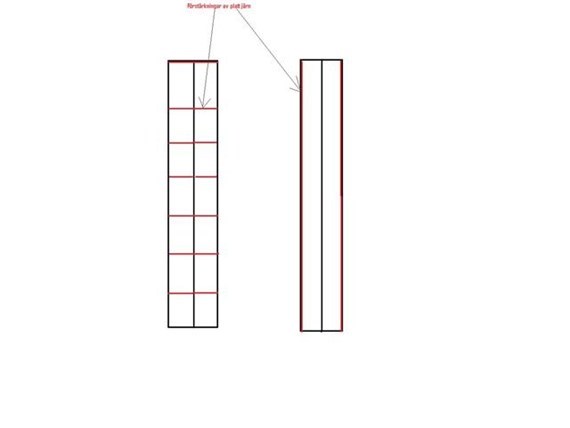
I was thinking of reinforcing an H-beam that is supposed to support a load-bearing wall. It is dimensioned for the purpose, but I still thought of welding on some reinforcement...
how should I do it best, should the reinforcement of flat iron be along the beam's both "open" sides or should they be from the outside to the middle...?
check the drawing

You increase the load-bearing capacity the most and reduce the deflection the most if you reinforce the flanges.
If it is a simply supported beam, reinforcement in the middle of the beam has the greatest effect.
Reinforcement of the web is usually only done if there are very large point loads.
If it is a simply supported beam, reinforcement in the middle of the beam has the greatest effect.
Reinforcement of the web is usually only done if there are very large point loads.
ok!
Yes, there will be pillars at each end of the beam, supporting it against the intermediate floor...
so if I weld flat bar onto the vertical part, instead as I tried to show at the outer edge of the opening in the H-beam (the image on the right), it strengthens mostly against deflection, have I understood you correctly then?
Yes, there will be pillars at each end of the beam, supporting it against the intermediate floor...
so if I weld flat bar onto the vertical part, instead as I tried to show at the outer edge of the opening in the H-beam (the image on the right), it strengthens mostly against deflection, have I understood you correctly then?
Don't quite understand what you mean...nikke said:ok!
Yes, there will be columns at each end of the beam, supporting it against the intermediate floor...
so if I weld flat bar into the vertical part, instead of as I tried to show at the outer edge of the opening in the H-beam (the picture to the right), it strengthens mostly against deflection, do I understand you correctly then?
But: To reinforce the beam, you should weld longitudinal horizontal plates/bands on both the top and bottom flanges.
That is, you should make both the upper and lower flanges stronger. Reinforcements on the outside of the flanges are more effective than reinforcements on the inside. Exactly how much better the beam becomes can be calculated using Steiner's theorem.
Hmm!
I feel more confused than when I asked the question, made a new nice picture in the eminent program Paint...
To reinforce the bending that may occur, how should I proceed A, B, or C, or are all of these wrong??
I thought A. but maybe that's not the case...? is it C you mean?
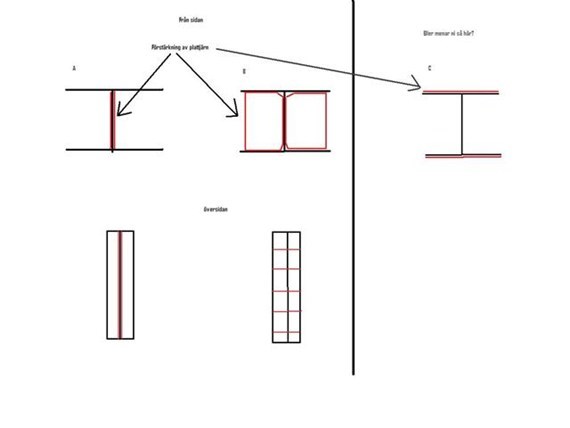
I feel more confused than when I asked the question, made a new nice picture in the eminent program Paint...
To reinforce the bending that may occur, how should I proceed A, B, or C, or are all of these wrong??
I thought A. but maybe that's not the case...? is it C you mean?
anaitis said:
Now, isn't it point loads you have?
However, it was a long time ago since I worked with beams, so I'll gladly defer...
The material in a beam provides greater benefit the further it is from the center of the beam.
Adding material in the middle basically has no effect at all, whereas doubling the thickness in the outer flanges gives a significant impact.
Try bending a ruler in the two different directions and you'll see the difference.
Adding material in the middle basically has no effect at all, whereas doubling the thickness in the outer flanges gives a significant impact.
Try bending a ruler in the two different directions and you'll see the difference.
I think it seems insane to reinforce the beam IF it has been dimensioned by a structural engineer. A small note regarding method C, there is a risk of crevice corrosion between the plates if the beam can be exposed to moisture. Now I don't think that's the case, but I just wanted to raise a small thought that the final result could actually be worse instead of better with an "unnecessary" action. Also warping and residual stresses after welding as previously mentioned.
Click here to reply