
34,672 views ·
25 replies
35k views
25 replies
How to offset a truss that is in the way of a chimney?
Hello!
I am going to install a stove in my vacation home. The desired placement means that the chimney goes directly through a roof truss. That is, I need to cut both the lower horizontal beam and one of the upper slanted beams in the truss.
Bending the chimney is not an option because the house is so flat that it would reduce the chimney draft too much.
The trusses are spaced at a distance of c-c 60 cm.
I am now gratefully accepting tips on how I can offset the truss.
Since I am short on money for my cottage project, I would like to do the work myself even though I probably shouldn't.
Best regards,
Glada torparen
I am going to install a stove in my vacation home. The desired placement means that the chimney goes directly through a roof truss. That is, I need to cut both the lower horizontal beam and one of the upper slanted beams in the truss.
Bending the chimney is not an option because the house is so flat that it would reduce the chimney draft too much.
The trusses are spaced at a distance of c-c 60 cm.
I am now gratefully accepting tips on how I can offset the truss.
Since I am short on money for my cottage project, I would like to do the work myself even though I probably shouldn't.
Best regards,
Glada torparen

It seems like the safest solution to build a new truss on each side. I was hoping there was a simpler solution, but it might involve unnecessary risks.
The chimney probably won't be exactly in the middle of the truss, so if I build a new truss on the chimney side where the distance to the next full truss is longest, then I get a maximum of about 800 mm between two full trusses.
Then I can reinforce with some noggins between the trusses.
I think that should work, but I'm inexperienced in this area.
Maybe it's being penny wise and pound foolish.
Sometimes trusses are cut when installing roof windows, how is that solved?
Best regards,
Glada torparen
The chimney probably won't be exactly in the middle of the truss, so if I build a new truss on the chimney side where the distance to the next full truss is longest, then I get a maximum of about 800 mm between two full trusses.
Then I can reinforce with some noggins between the trusses.
I think that should work, but I'm inexperienced in this area.
Maybe it's being penny wise and pound foolish.
Sometimes trusses are cut when installing roof windows, how is that solved?
Best regards,
Glada torparen


No. Unfortunately, I'm not joking. However, I have no expertise in the area, so it might be completely foolish to do as my picture shows.
Is there a simple solution besides building two entirely new roof trusses on either side of the chimney?
Is there a simple solution besides building two entirely new roof trusses on either side of the chimney?
Yes, it is precisely because they are so close together that I hope to be able to switch in some way without it involving too much risk.
I am unfortunately not entirely sure about the dimension, I will have to check that this weekend, but I seem to remember it is 145x45.
I am unfortunately not entirely sure about the dimension, I will have to check that this weekend, but I seem to remember it is 145x45.
Place a support beam (e.g., 195x45) on each side of the chimney perpendicular to the rafters. Make the support beam long enough to extend under two rafters on each side, and attach it with 45x45 battens from top to bottom to the ceiling joist for each rafter (similar to the "new support" in your image). Now you can cut the rafter as it rests on the support beams. The 45x45 also supports the bottom batten. But it might need a support beam here too, although it's difficult to say since it doesn't specify what the space is used for (assuming it's a cold attic with a truss rafter).
That's how I've done similar interpolations, and I've seen various versions of this, but it holds.
That's how I've done similar interpolations, and I've seen various versions of this, but it holds.


I'm going to conjure up some images for you. Did this operation a year ago.
Handling vertical forces in the truss is easy. What's difficult are the tension/compression forces in the upper and lower arms. No engineer has calculated my solution, but the house of cards I live in has yet to fall (despite several mathias-dimensioneringar of this type).
Handling vertical forces in the truss is easy. What's difficult are the tension/compression forces in the upper and lower arms. No engineer has calculated my solution, but the house of cards I live in has yet to fall (despite several mathias-dimensioneringar of this type).
Thank you for your constructive responses!
Now I'm starting to feel hopeful again. I would really appreciate some pictures, Mathias.
The attic space is unheated and unused, so aesthetics are not a problem.
Now I'm starting to feel hopeful again. I would really appreciate some pictures, Mathias.
The attic space is unheated and unused, so aesthetics are not a problem.
Okay, this is how I did it. As usual, anyone trying these building tips takes full responsibility if something goes wrong. What works here may not be a good solution elsewhere.
This is how it looks when the bracing is finished but before the chimney is in place. The chimney pipe hit the beam EXACTLY in the middle and thus will come up between the two cross beams.
As I write now, I realize that the situation here is slightly different from TS's - I have left the top cord intact and am making a relatively long sideways offset of the pipe towards the ridge.
I would recommend the thread creator to do the same, i.e., side-shift instead of cutting the top cord. To side-shift equivalent to a beam, it is sufficient with two 45-degree fully insulated pipe bends, these shift 15cm sideways and you can leave the top cord intact. The bottom cord must, however, be cut, and in the following pictures, you can see how I did it:
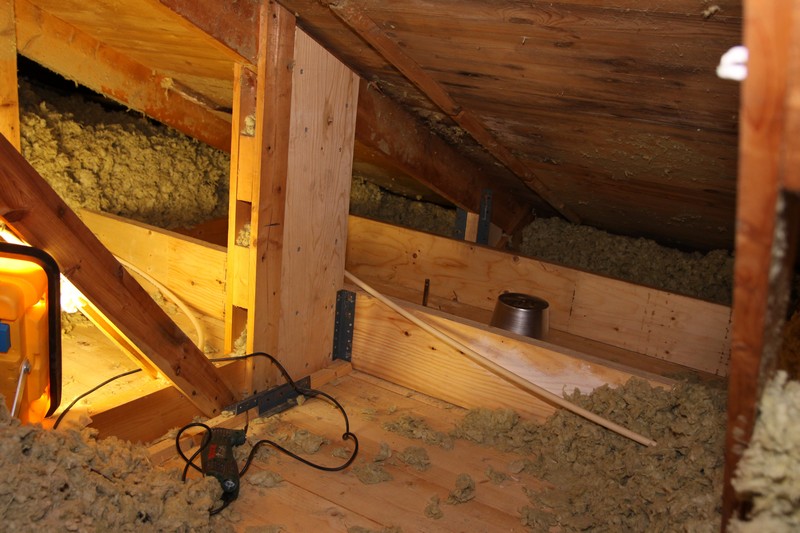
I wanted something a bit more stable than regular beam material and bought Kerto beams on Blocket for this purpose at a good price. Here it is 120cm between each truss - if I only had 60cm between each, I would probably use regular beam material - select those without large knots (poor man's structural timber). Another alternative is some glued laminated timber from Blocket, which costs very little, but you may have to wait a while before finding what you want.

The standing brace just in front of the Kerto beam was reinforced partly with a beam (Kerto) that was placed on the bottom chord, and cut with the roof angle for perfect support against the top chord. After that, it's 19-20mm construction plywood nailed on both sides of this standing beam. My thought was that this also stiffens the construction horizontally, i.e., absorbs some tensile/shear forces - this is, of course, limited but better than nothing. It could be complemented with braces, but I didn't think it needed it.
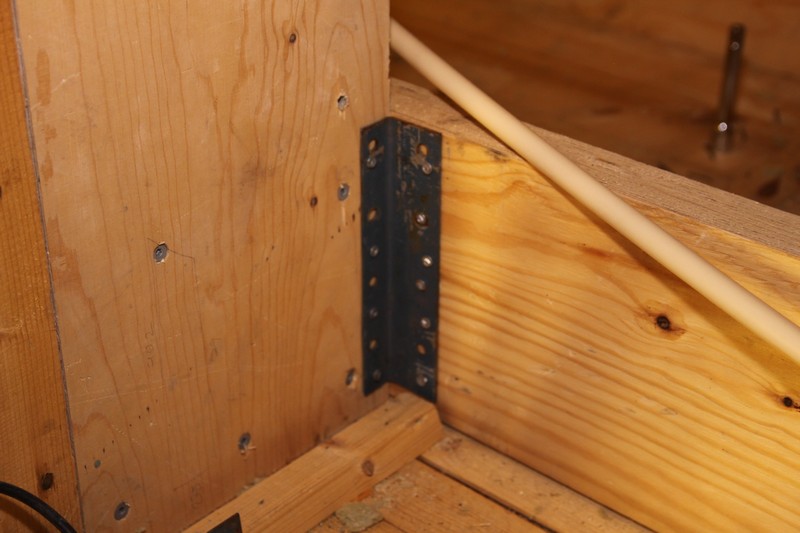
The cross beam was fixed with angle plates in the vertical support post.
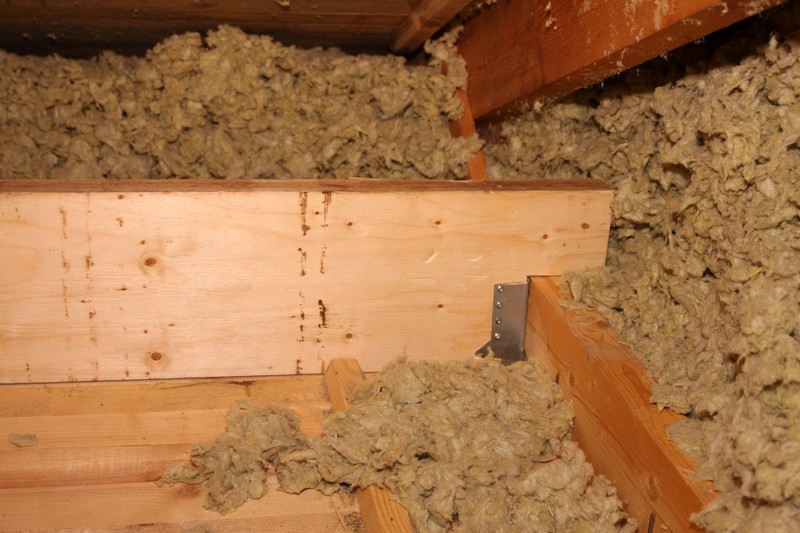
The Kerto beams are attached to the trusses on either side of the cut truss using both beam shoes and a notch according to the picture.
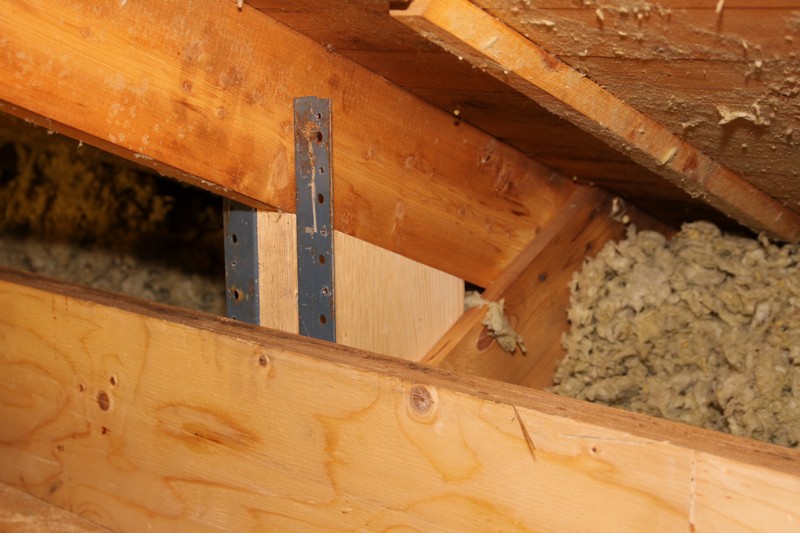
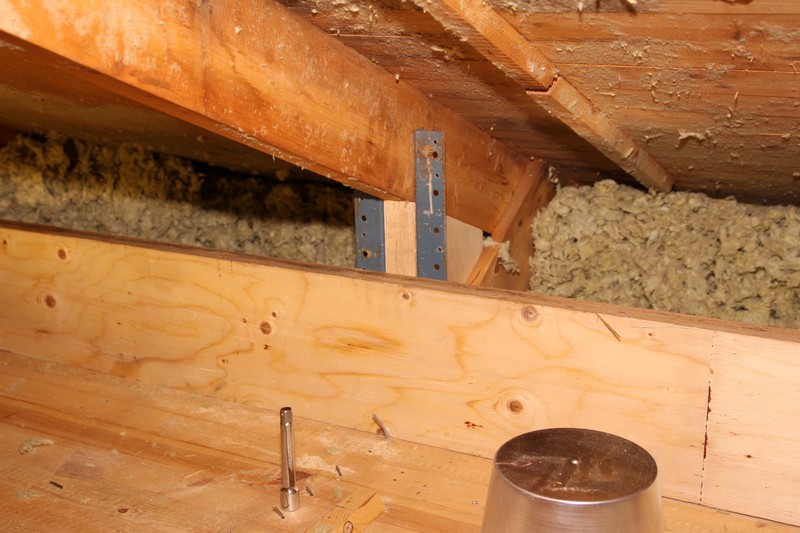
Support posts, as described earlier, were also mounted outside the cross beams. This is very far out towards the eave (=> a hell of a hassle to mount beams and chimney), so the standing beam is short and fixed only with angle brackets.
I suggest, as mentioned, that the truss's top cord is left untouched. There is no good way to replace the part you cut off. You could do similar bracing "in the ceiling" as well, but it's much easier to buy two 45-degree bends for the modular chimney instead.
This is how it looks when the bracing is finished but before the chimney is in place. The chimney pipe hit the beam EXACTLY in the middle and thus will come up between the two cross beams.
As I write now, I realize that the situation here is slightly different from TS's - I have left the top cord intact and am making a relatively long sideways offset of the pipe towards the ridge.
I would recommend the thread creator to do the same, i.e., side-shift instead of cutting the top cord. To side-shift equivalent to a beam, it is sufficient with two 45-degree fully insulated pipe bends, these shift 15cm sideways and you can leave the top cord intact. The bottom cord must, however, be cut, and in the following pictures, you can see how I did it:
I wanted something a bit more stable than regular beam material and bought Kerto beams on Blocket for this purpose at a good price. Here it is 120cm between each truss - if I only had 60cm between each, I would probably use regular beam material - select those without large knots (poor man's structural timber). Another alternative is some glued laminated timber from Blocket, which costs very little, but you may have to wait a while before finding what you want.
The standing brace just in front of the Kerto beam was reinforced partly with a beam (Kerto) that was placed on the bottom chord, and cut with the roof angle for perfect support against the top chord. After that, it's 19-20mm construction plywood nailed on both sides of this standing beam. My thought was that this also stiffens the construction horizontally, i.e., absorbs some tensile/shear forces - this is, of course, limited but better than nothing. It could be complemented with braces, but I didn't think it needed it.
The cross beam was fixed with angle plates in the vertical support post.
The Kerto beams are attached to the trusses on either side of the cut truss using both beam shoes and a notch according to the picture.
Support posts, as described earlier, were also mounted outside the cross beams. This is very far out towards the eave (=> a hell of a hassle to mount beams and chimney), so the standing beam is short and fixed only with angle brackets.
I suggest, as mentioned, that the truss's top cord is left untouched. There is no good way to replace the part you cut off. You could do similar bracing "in the ceiling" as well, but it's much easier to buy two 45-degree bends for the modular chimney instead.

Hmm, you're suggesting cutting the bottom frame (the floor structure, type) without arranging to accommodate the tensile stresses in it.pbengtsson said:Place a load-bearing beam (e.g., 195x45) on each side of the chimney perpendicular to the rafters. Make the beam long enough so that it goes under two rafters on each side, secure it with 45x45 studs from above down to the inner ceiling beam for each rafter (similar to the "new support" in your picture). You can now cut the rafter as it rests on the load-bearing beams.
The 45x45 also supports the bottom beam, but an additional beam might be needed here as well, though it's hard to tell as it's not clear what the space is used for (assuming it's a cold attic with a trussed rafter).
That's how I've done similar reinforcements, although I've seen various methods, but it works.
There are really strong tensile forces in the bottom frame; if you remove or cut the bottom frame, the outer walls will bulge out when it starts to snow.
I would recommend building two additional rafters.
Jag gjorde ovanstående operation med snö på taket. Ärligt talat hände det inte ett skit när jag kapade av underarmen. Man kunde tänka sig att det skulle åka isär lite, sjunka lite etc. Men icke.Mikael_L said:
Så länge man bara ger sig på EN takstol är det nog lugnt.