
In the picture, you can see what I mean. It's a thin gypsum wall that ends with a curve. How do I make the curve itself? I'm having trouble wording the question, but you'll probably understand if you look at the picture.
Also, how do I make the curve of the edge strip after the floor? Could it be a plastic strip?
Also, how do I make the curve of the edge strip after the floor? Could it be a plastic strip?
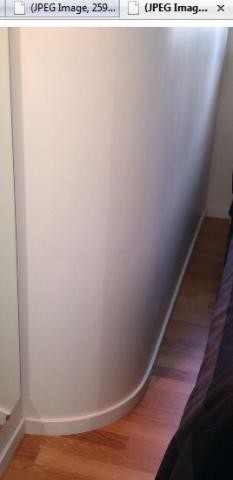

Ok, yes maybe that's how they did it, but the rule behind must also be curved, maybe a cut-out piece.. well, if the curved wall itself is made of plaster I don't know, but the straight wall is. I guess it's some kind of plastic material, I don't know. If anyone knows how to do it, I'd be grateful. Material?


Well, that's great! That could actually work.
https://www.byggmax.se/badrum/tätskikt/våtrumsskiva-böjbar-p660023
It says:
30 mm can be bent to an external diameter of 520 mm.
50 mm can be bent to an external diameter of 1060 mm.
That is, I interpret it as the smallest radius I can get is 520/2 = 260mm. It's perhaps a bit larger than I initially thought, but not entirely off.
https://www.byggmax.se/badrum/tätskikt/våtrumsskiva-böjbar-p660023
It says:
30 mm can be bent to an external diameter of 520 mm.
50 mm can be bent to an external diameter of 1060 mm.
That is, I interpret it as the smallest radius I can get is 520/2 = 260mm. It's perhaps a bit larger than I initially thought, but not entirely off.
Click here to reply