
2,603 views ·
8 replies
3k views
8 replies
How to glue plywood back to MDF shelf?
Hello, built a bookshelf in 16mm, and need to mount the back panel which is 4mm pine plywood.
I was thinking of gluing the plywood sheet and holding it in place with 35mm brads. But I just tested with the brad nailer, and every nail splits the MDF. I understood it could be difficult since MDF is sensitive on the "end grain." What should I do then? Clamps won't work with these dimensions.
I've previously screwed (pre-drilled) and glued when making boxes in plywood, but 4mm ply is not much to set a screw with a countersunk head. Can you glue and then use construction screws with a large flat head while the glue dries, and then remove the screw?
Or just use construction adhesive that doesn't require pressure in the same way as regular wood glue?
This should be a common problem...
I was thinking of gluing the plywood sheet and holding it in place with 35mm brads. But I just tested with the brad nailer, and every nail splits the MDF. I understood it could be difficult since MDF is sensitive on the "end grain." What should I do then? Clamps won't work with these dimensions.
I've previously screwed (pre-drilled) and glued when making boxes in plywood, but 4mm ply is not much to set a screw with a countersunk head. Can you glue and then use construction screws with a large flat head while the glue dries, and then remove the screw?
Or just use construction adhesive that doesn't require pressure in the same way as regular wood glue?
This should be a common problem...
Incidentally, I tried hand-nailing "regular" 1.2x20 nails into the end grain which went excellently. Maybe skip the glue and just hand-nail the back? With the drawback that you lose load-bearing capacity in the shelves when they're only attached to the sides.
Or get 15-20 mm nails for the nail gun and use wood glue then nails, as it hardly cracks the MDF like the 35 mm nails do.
Or get 15-20 mm nails for the nail gun and use wood glue then nails, as it hardly cracks the MDF like the 35 mm nails do.
Last edited:
Tried 15mm nails directly into the end grain, and it can still crack a little, probably less if the nail first goes through the plywood but still annoying.
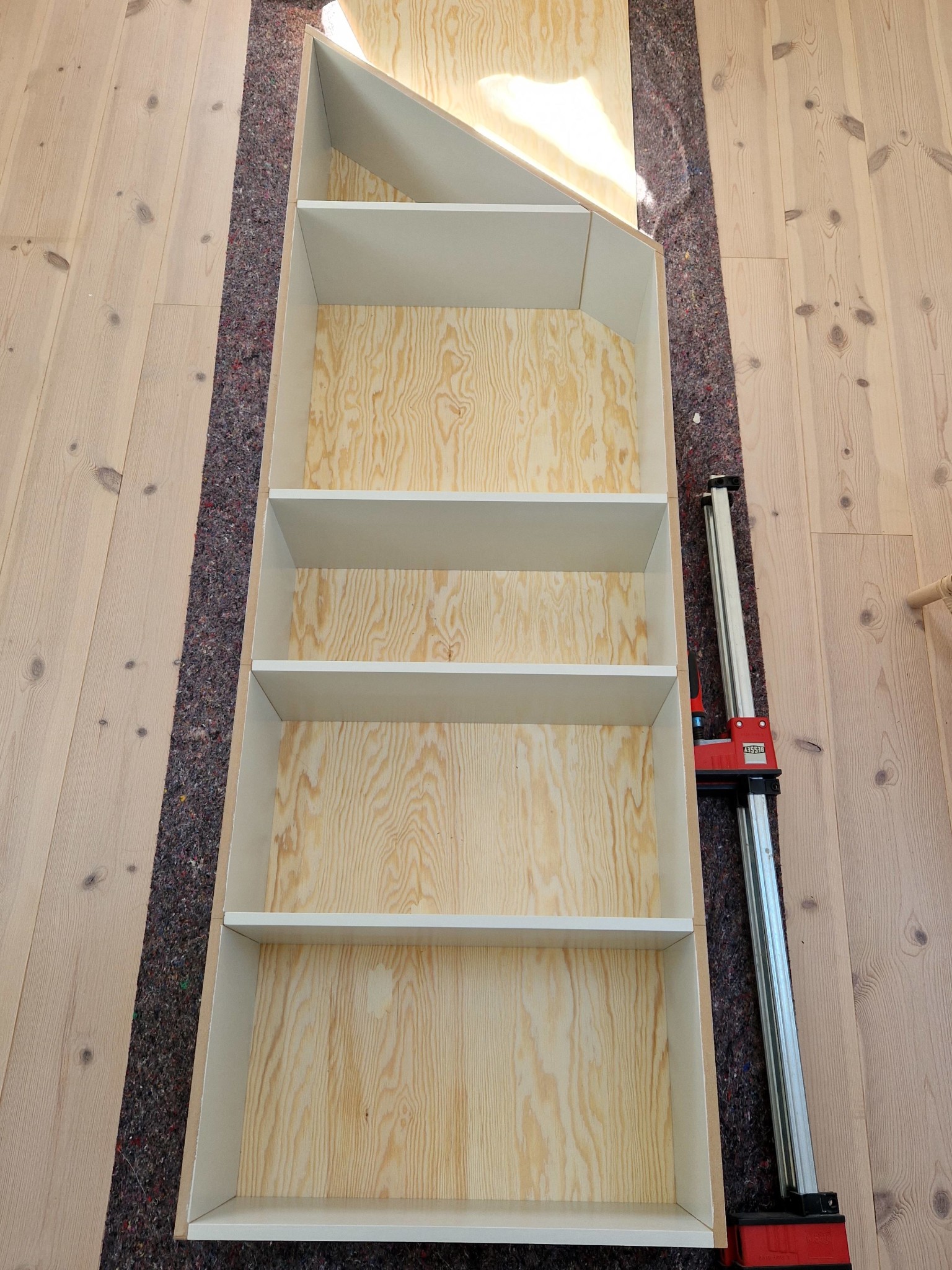
This is what it looks like. Now that I've placed the shelf on the back panel, I'm tempted to just turn it, glue the back, then lay it on the back panel again; the shelf is heavy, but not enough to provide good pressure just with gravity.
This is what it looks like. Now that I've placed the shelf on the back panel, I'm tempted to just turn it, glue the back, then lay it on the back panel again; the shelf is heavy, but not enough to provide good pressure just with gravity.
I would have used a clamp or superglue. Clamp with padding and a jig that makes it straight. Superglue with a few drops that bond with hand pressure and then let the wood glue have time to dry. After the glue has dried, you can pre-drill for other fastening methods, although I'm not sure if it makes any difference once the glue has dried?

gravity should be enough if the surface is flat and the shelf is straight. If you feel it's not enough, you could put the winter tires on top.A Alko said:Tried 15mm brad nails directly into the end grain, and it can still crack a bit, probably less if the brad nail first passes through the plywood but still annoying.
This is what it looks like. Now that I've placed the shelf on the back piece, I'm tempted to just turn it, glue the backside, then place it back on the back piece again. The shelf is heavy, but not enough to apply good pressure just with gravity.
Thanks for all the tips. I had a good stapler lying around, so I ended up gluing and stapling. 4mm plywood isn't very strong, so it was easy to hold down the slightly bending sheet. The staples are only 8mm, but they hold really well while the glue dries. Feels very rigid and good.
Click here to reply