
7,821 views ·
22 replies
8k views
22 replies
How to deal with these roof trusses
Member
· Västra Götaland
· 1 849 posts
I say why truss when beam is simpleR Relaxia said:Story of my life
But why does it have to be so complicated then?
I say - does it matter?
- I want a bunch of trusses c-c 1200.
- There are truss manufacturers who both calculate and manufacture.
- The manufacturer nearby has timber for trusses c-c 600. He suggests setting them in pairs to achieve c-c 1200 where I want, but doesn't know the distance at which they should be nailed together...
You say - don't make it complicated!
But you can also use double trusses, I would get a price for both and choose accordingly.
Good luck! No problems

Since I haven't seen any drawings, it's difficult to give specific comments, but there are some general aspects that might interest more than just TS. If a consultant, such as a structural engineer, has been hired to provide technical documentation for a building, it is very common in professional contexts for the specified component to be replaced with another considered equivalent or better. Such assessments should be handled by a KA. The point is that there is a design calculation in place that is tailored to the local conditions. If a supplier is to be used for calculations as well, there must be an agreement with the supplier that obliges them to take responsibility for their calculations.
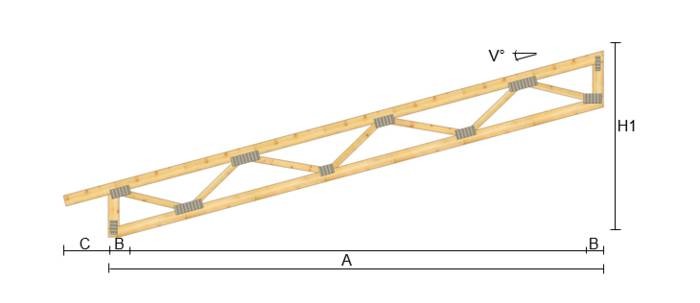
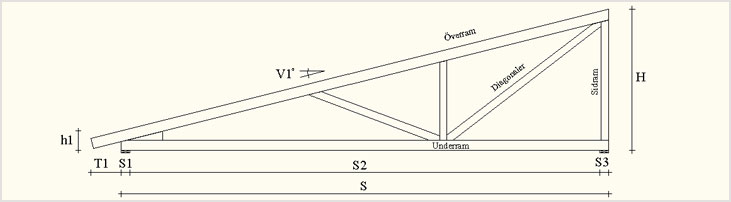
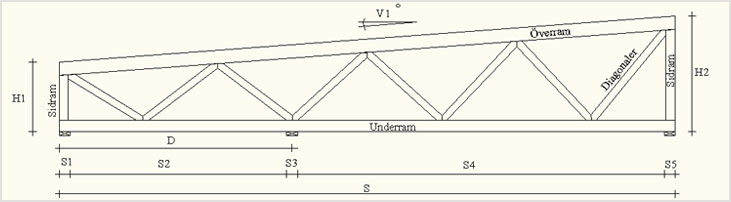
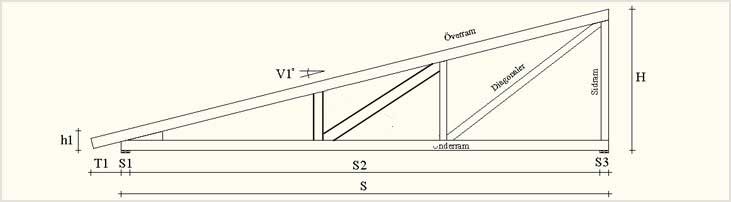
Looking at the span, a shed roof truss with common construction wood is fully possible. What complicates it a bit is that it should cantilever 80 cm beyond the outer support, thereby incurring a small torsional moment that requires a certain beam height over the support. This consideration plus the desire for a 7-degree roof pitch results in a relatively high height at the innermost point. An alternative to a truss is a shed-shaped glulam beam. I don't know which will be the cheapest in the end. Glulam tends to be about three times as expensive as regular wood in terms of volume, but here there's quite a bit of labor involved. Then there are some other aspects that could also influence the choice.
Exactly sofahlis said:
Now I've got an answer on how they should be nailed together. Upper and lower frame two nails c-c 200, diagonals c-c 300.
But does it have to be nails? And due to nail plates they won't be flush.
Say you happen to place a sheet of suitable material (plywood?) between the beams before screwing them together. Would that be negative in any way?
Click here to reply