
24,016 views ·
17 replies
24k views
17 replies
How to cut MDF for kitchen doors?

It's getting close to tackling the kitchen and I'm considering various solutions. We have a plan that involves making our own drawer fronts for Ikea’s drawer system. For simplicity's sake, we're thinking of making them in MDF. Simplified, the idea is to cut out a rectangle and then glue a thinner MDF on it as a frame.
Now to my considerations. Could an alternative to my construction be to instead cut out the mirror itself from the MDF piece? On the back, route out a rabbet and then glue a thinner MDF as the mirror on the back?
I would like to cut everything myself if it's going to cost the same as having a carpenter do it plus I still have the machines. Do I need to invest in a table saw or which tools would also work?
Thankful for some tips and advice.
Now to my considerations. Could an alternative to my construction be to instead cut out the mirror itself from the MDF piece? On the back, route out a rabbet and then glue a thinner MDF as the mirror on the back?
I would like to cut everything myself if it's going to cost the same as having a carpenter do it plus I still have the machines. Do I need to invest in a table saw or which tools would also work?
Thankful for some tips and advice.

I would think that both variants work. The first variant is probably easier since you can then cut straight pieces. It's always more difficult to cut out a frame with internal straight corners, if you know what I mean.
A table saw is maybe easiest but a good circular saw should work too.
/Erik
A table saw is maybe easiest but a good circular saw should work too.
/Erik

The first option is clearly the simplest, and you can make your doors quite efficiently. I assume that your fronts have the same width, or in any case, that you have several fronts with the same width. That's usually the case...
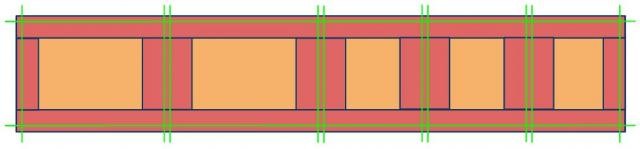
If so, start by cutting your panels to the "frame" of the drawer front lengthwise so that they are about 10 mm wider than the front. Then cut strips for the frames measuring "frame + 5 mm" and "2*frame + 10 mm", cut them to size, and glue them onto the long panel to the frame according to the principle sketch below (you'll fit significantly more drawer fronts than in the picture, I just didn't have the energy to draw them all). Once the glue has dried, cut your fronts (the green lines).
The advantage of doing it this way is that you don't have to stand and glue the frames door by door. Furthermore, the joint on the edge of the drawer front will be completely perfect since you cut through both the panel and the frame in one go - saving some finishing work (unfortunately, they still need to be prepared for painting...).
The additional dimensions I mentioned above can be seen as benchmarks; you can reduce waste if you keep your focus. But MDF is quite cheap, so don't waste bullets on a mosquito...
Also, think about how you will handle the rounding on the inner edges of the frame before gluing them in place. If you want a front that can withstand knocks, you should break the edge with a rounding router bit, and you need to do this before you attach the frame since you can't reach with the ball-bearing router when they are in place - the bit with the ball bearing is simply too deep. It also sneaks into the corners on the inside of the frame - the bit doesn't reach into the corner. If you want visible parts in the frame, just cut off the entire sides with a rounding router bit before gluing them (easiest). If you don't want them visible, just route part of the middle of the frame's parts (a bit fiddlier, but solvable). For the outer edges of the front, route them when the door is cut and ready.
Regarding the choice of saw, I would go for a (plunge) saw with a good quality guide rail. Handling full-size MDF sheets on a small table saw is not ideal. A large "table saw" (sliding table saw or format saw) not only costs a lot, but they also take up a (double) garage. Personally, I have a Festool TS55 with guide rails in a few different lengths, and I can recommend it. There are, of course, other alternatives (e.g., Makita and Mafell) - check the tool forum where it has been frequently discussed...
If so, start by cutting your panels to the "frame" of the drawer front lengthwise so that they are about 10 mm wider than the front. Then cut strips for the frames measuring "frame + 5 mm" and "2*frame + 10 mm", cut them to size, and glue them onto the long panel to the frame according to the principle sketch below (you'll fit significantly more drawer fronts than in the picture, I just didn't have the energy to draw them all). Once the glue has dried, cut your fronts (the green lines).
The advantage of doing it this way is that you don't have to stand and glue the frames door by door. Furthermore, the joint on the edge of the drawer front will be completely perfect since you cut through both the panel and the frame in one go - saving some finishing work (unfortunately, they still need to be prepared for painting...).
The additional dimensions I mentioned above can be seen as benchmarks; you can reduce waste if you keep your focus. But MDF is quite cheap, so don't waste bullets on a mosquito...
Also, think about how you will handle the rounding on the inner edges of the frame before gluing them in place. If you want a front that can withstand knocks, you should break the edge with a rounding router bit, and you need to do this before you attach the frame since you can't reach with the ball-bearing router when they are in place - the bit with the ball bearing is simply too deep. It also sneaks into the corners on the inside of the frame - the bit doesn't reach into the corner. If you want visible parts in the frame, just cut off the entire sides with a rounding router bit before gluing them (easiest). If you don't want them visible, just route part of the middle of the frame's parts (a bit fiddlier, but solvable). For the outer edges of the front, route them when the door is cut and ready.
Regarding the choice of saw, I would go for a (plunge) saw with a good quality guide rail. Handling full-size MDF sheets on a small table saw is not ideal. A large "table saw" (sliding table saw or format saw) not only costs a lot, but they also take up a (double) garage. Personally, I have a Festool TS55 with guide rails in a few different lengths, and I can recommend it. There are, of course, other alternatives (e.g., Makita and Mafell) - check the tool forum where it has been frequently discussed...
bygga_bo: a big thank you for your valuable post. It's quite ingenious to follow your sketch. That's how it will be. I'm still eager for a plunge saw. 
Great tip also about them handling impacts better if I round off the edges. The original doors we are going to keep have a panel with a profile milled on the inside. We'll see if we do something similar or just round off. The thing is we are going to keep a serving passage as well as a pantry and cleaning closet where the doors have this appearance. But in the rest of the kitchen, we're going to replace all the old stuff and try to create a built-in feel. We will only have drawers as well. The question then is whether it looks better with sharp edges or if it can work with a milled profiled edge. We will have to experiment.
Great tip also about them handling impacts better if I round off the edges. The original doors we are going to keep have a panel with a profile milled on the inside. We'll see if we do something similar or just round off. The thing is we are going to keep a serving passage as well as a pantry and cleaning closet where the doors have this appearance. But in the rest of the kitchen, we're going to replace all the old stuff and try to create a built-in feel. We will only have drawers as well. The question then is whether it looks better with sharp edges or if it can work with a milled profiled edge. We will have to experiment.
It was nothing...
Personally, I would aim to replicate the existing gaps to achieve a uniform appearance. But depending on the kitchen layout, it might be possible to take some shortcuts... and of course, it also depends on how much effort you're willing to put into it, which only you can decide.
MDF is good in many ways, but the edges become brittle if not treated in some way. Personally, I like straight lines and sharp edges, but I would never dare leave an MDF edge completely untouched. A fairly small rounding is enough to counter the greatest risk.
I agree with eriobe that a 45-degree bevel can look really nice. If you choose to create a frame with visible parts (i.e., beveled edges even at the joints), go for it. But if you choose a frame with invisible parts (i.e., no beveled edges at the joints), a rounded edge is slightly easier. In practice, you'll need to do some filling in the inner corners if you want it "perfect," and it's easier to get a visually acceptable result with a round edge when sanding because it's not as "well-defined" as a 45-degree edge. Just a practical aspect, really...
Personally, I would aim to replicate the existing gaps to achieve a uniform appearance. But depending on the kitchen layout, it might be possible to take some shortcuts... and of course, it also depends on how much effort you're willing to put into it, which only you can decide.
MDF is good in many ways, but the edges become brittle if not treated in some way. Personally, I like straight lines and sharp edges, but I would never dare leave an MDF edge completely untouched. A fairly small rounding is enough to counter the greatest risk.
I agree with eriobe that a 45-degree bevel can look really nice. If you choose to create a frame with visible parts (i.e., beveled edges even at the joints), go for it. But if you choose a frame with invisible parts (i.e., no beveled edges at the joints), a rounded edge is slightly easier. In practice, you'll need to do some filling in the inner corners if you want it "perfect," and it's easier to get a visually acceptable result with a round edge when sanding because it's not as "well-defined" as a 45-degree edge. Just a practical aspect, really...
Ok, here a bit of thought is required together with the wife, I notice. In the cabinets and doors we want to keep, the frame parts are not visible. And I had probably imagined something similar for the drawer fronts. But filling to a "perfect" edge doesn't sound like something for either me or the wife. Worth pondering.

I am continuing my thread. We are soon at the stage in the kitchen project of setting up the frames and building our own "frame" and fronts. We got our inspiration here. Scroll down a bit to find the construction of the kitchen.
My partner started talking about birch plywood for the fronts instead of MDF. We have already decided that the frame, which forms the panel, should be pine, not MDF, considering the sensitivity to edge damage. We have no experience working with either MDF or plywood and hope to get some input from you.
For the framework, that is, what surrounds all the fronts, we thought of using some standard list, that is, planed timber. At Bauhaus, they have 15 and 22 mm thick. Krauta probably has 21 mm as well. But the thicknesses we found in MDF do not quite match 21 mm. Since we will have a part that constitutes the front itself and another that forms the frame, they should together be as thick as the "framework." But maybe it shouldn't be too flimsy either.
What do you experts say? What dimensions are reasonable to build with? Is plywood preferable to MDF for building your own fronts? Everything will be painted with linseed oil paint, which should also be mentioned.
Then another thing: does it have to be birch plywood, or is another type okay? The most important thing is that it does not have an ugly structure.
Very grateful for help and tips.
My partner started talking about birch plywood for the fronts instead of MDF. We have already decided that the frame, which forms the panel, should be pine, not MDF, considering the sensitivity to edge damage. We have no experience working with either MDF or plywood and hope to get some input from you.
For the framework, that is, what surrounds all the fronts, we thought of using some standard list, that is, planed timber. At Bauhaus, they have 15 and 22 mm thick. Krauta probably has 21 mm as well. But the thicknesses we found in MDF do not quite match 21 mm. Since we will have a part that constitutes the front itself and another that forms the frame, they should together be as thick as the "framework." But maybe it shouldn't be too flimsy either.
What do you experts say? What dimensions are reasonable to build with? Is plywood preferable to MDF for building your own fronts? Everything will be painted with linseed oil paint, which should also be mentioned.
Then another thing: does it have to be birch plywood, or is another type okay? The most important thing is that it does not have an ugly structure.
Very grateful for help and tips.
Last edited:
No friendly soul who can provide input on the matter?
Hello
I also built a custom kitchen that resembles the one you linked to. I chose to use planed pine as frames for the kitchen cabinets. I then beveled these with a hand router and joined them with biscuits and glue. It turned out great. I cut the pieces to the same thickness as the drawer fronts on the table saw. If you don't have such a saw, maybe you can buy a slightly thinner strip and use suitable spacers. It will surely hold up anyway.
As for plywood, it's great in all respects, except possibly on the edges. It's layered, which will show when you paint. There might be someone here who can give more tips on sealing edges with glue or filler. I'm not very good at that.
MDF is sensitive, sure. But it's not super sensitive after all. It can withstand some wear, normal usage without any issues.
Hope that gave you something
Regarding linseed oil paint on MDF, it should work fine. But I assume you're looking for a wood texture, which MDF completely lacks. You probably have to choose here. Either a simpler solution with MDF without wood texture - or plywood with linseed oil paint that gives texture, but issues with neat edges.
Best regards, Erik
I also built a custom kitchen that resembles the one you linked to. I chose to use planed pine as frames for the kitchen cabinets. I then beveled these with a hand router and joined them with biscuits and glue. It turned out great. I cut the pieces to the same thickness as the drawer fronts on the table saw. If you don't have such a saw, maybe you can buy a slightly thinner strip and use suitable spacers. It will surely hold up anyway.
As for plywood, it's great in all respects, except possibly on the edges. It's layered, which will show when you paint. There might be someone here who can give more tips on sealing edges with glue or filler. I'm not very good at that.
MDF is sensitive, sure. But it's not super sensitive after all. It can withstand some wear, normal usage without any issues.
Hope that gave you something
Regarding linseed oil paint on MDF, it should work fine. But I assume you're looking for a wood texture, which MDF completely lacks. You probably have to choose here. Either a simpler solution with MDF without wood texture - or plywood with linseed oil paint that gives texture, but issues with neat edges.
Best regards, Erik
Last edited:
Thank you Erik for the great information. I'm leaning towards living with the 1 mm difference in level between the frame and the front itself. They won't be super tight together, so I don't think that mm will be very noticeable.
I hadn't thought about the edge of the ply at all, but you have a point. On the other hand, the edge is really only visible when open, which doesn't matter much to me. But maybe I can seal it with shellac, we have plenty at home. As it feels now, the wood grain is more important. Did you bevel the edges of the frame that sits on the front (if you even have a frame on the fronts)?
Is it really necessary to biscuit join the frame? Can't you just glue and fill the joints and paint over? What did you mean by beveling off? At the joints or along the edges?
Best regards
I hadn't thought about the edge of the ply at all, but you have a point. On the other hand, the edge is really only visible when open, which doesn't matter much to me. But maybe I can seal it with shellac, we have plenty at home. As it feels now, the wood grain is more important. Did you bevel the edges of the frame that sits on the front (if you even have a frame on the fronts)?
Is it really necessary to biscuit join the frame? Can't you just glue and fill the joints and paint over? What did you mean by beveling off? At the joints or along the edges?
Best regards
I built the cabinet sides out of particle board and used planed pine for a nice outer edge. To avoid screwing and filling, I chose to use biscuits.
The edges of the pine were beveled—partly because I think it looks nicer but mainly because it matches the old cabinets.
Regarding the edge of the plywood, I don't think you need shellac.
The edges of the pine were beveled—partly because I think it looks nicer but mainly because it matches the old cabinets.
Regarding the edge of the plywood, I don't think you need shellac.
Okay, good. How did you attach the planed wood to your "frames"? As mentioned, we're using Ikea's which are 18 mm thick. We were thinking of planed wood 43 mm, but that doesn't leave much to fix between the frames as support. Could it be enough to glue the planed wood to the frames?
We are thinking of fronts with a panel. If we follow how the old doors look, we should mill a rounding in the frame that forms the panel. But I'm not sure how well that will actually turn out. We'll see how we do it.
We are thinking of fronts with a panel. If we follow how the old doors look, we should mill a rounding in the frame that forms the panel. But I'm not sure how well that will actually turn out. We'll see how we do it.