I am going to build a conservatory at a corner of the house. At the back (under the eaves), I know how to do it, with metal under the façade and out over the polycarbonate. If any rain gets in under the polycarbonate, it will at worst reach the aluminum profile at the back.
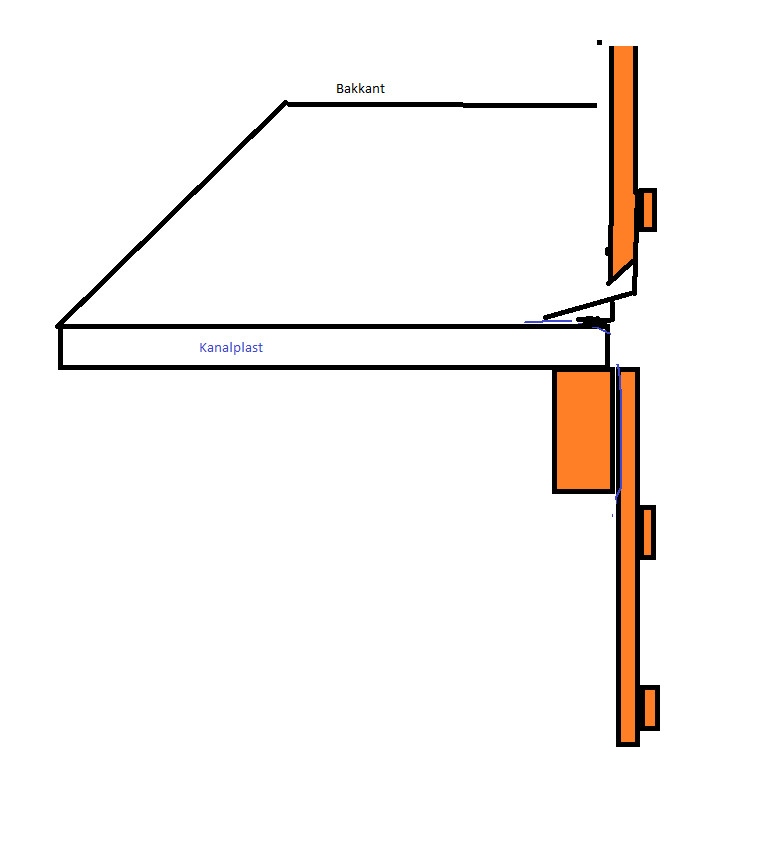
BUT how do you do it on a side that connects to the house wall? Here you could of course also put a metal behind the panel, as my nice figure shows, which sticks out onto the roof in the same way as at the back, but it feels like water is guaranteed to find its way in. There might well be a small profile on the polycarbonate under the metal, but there is no edge that goes up.
A solid strip of silicone at the end of the channel plastic perhaps? So that what runs in under the sheet metal is stopped by the silicone and runs downwards along it.
the sheet under the kanaplast? do you mean an extra sheet or what? That would protect the wall but then the water would still find its way into the conservatory.
a substantial bead might work but feels a bit budget... there must be some standard solution for this
You must have enough slope on the channel plastic for the water to run off. This is especially true at the back edge of the channel plastic; you shouldn't have a sheet up on the plastic. Think of it this way, where would you rather have the water? Inside the wall or inside the sunroom (where you can see it)?
When I read your question again, I realize you mean the side of the channel plastic, i.e., where it doesn't "slope downward" all the time. I would screw an aluminum L-profile on the wall and then place the channel plastic on it and seal with silicone.
Why would you open the wall on the side? It seems very risky.
I have a 10cm EPDM pond liner strip, which is attached with isovers butyl tape on the metal sheet and on the channel plastic.
I wouldn't rely solely on silicone, both the metal and the plastic move quite a bit over the seasons.
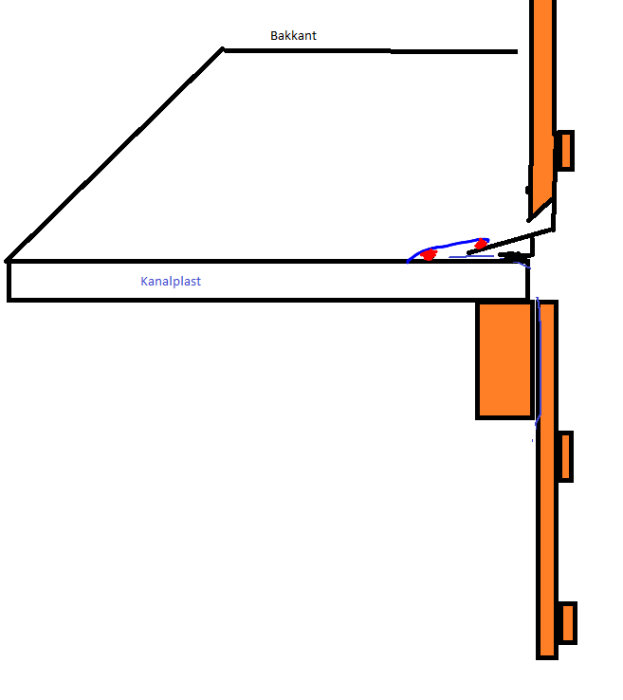
Now I am even more confused... So it's the circled area I'm wondering about. The panel is a vertical panel with battens.
The slope will be 6 degrees.
I need a flashing that attaches to the wall and extends over the roof (in the same way at the back...), and it must be sealed against the wall. If everything were done from scratch, you would certainly do as my figure shows, i.e., let a flashing go up behind the panel.
The question still remains about what to do about water that finds its way under the flashing; it has "free rein" to run over the edge and into the conservatory. Admittedly, the channel plastic sits with a profile on the last beam against the house (under the flashing, that is) and creates a small barrier, but it doesn't feel 100% secure.
Putting the flashing on the outside of the façade doesn't feel right.
Peter2400: The strip you're talking about, is it clamped under the flashing in the aluminum profile?
I could imagine the variant where you put an L profile under the rail under the flashing to prevent the water.
Under no circumstances would I "open" the panel to insert a sheet; if it is a lock, one could potentially cut these and fit a flashing under the locks, as is usually done with windows/doors.
I also trimmed the tops of the panel and inserted a metal sheet, I don't understand how it could be sealed otherwise?
My rubber membrane (blue) is attached with butyl (red) and prevents water from being pressed in under the metal sheet.
I only have a 4-degree slope and with a bit of snow, there is standing water, but in my case, it hasn't leaked.
I initially used Sikaflex 291i to attach the rubber membrane, it crumbled and came loose after a year, the butyl is more durable and protected by the membrane.
It's very easy to work with, adheres incredibly well to both the roof and the rubber.
You can't cut the covering and place a sheet underneath without folding it into the panel. It will definitely leak where the covering has been cut in that case. Water runs along the panel and behind the sheet.
I still claim that cutting the panel is the best option because that's how you would have done it if everything was built from the start, right?
There are two things you want to prevent. One is the water coming from the wall/panel and the other is the water running on the roof.
I would probably say that the thing you most want to avoid is water seeping into the wall. A little water entering the sunroom is a significantly smaller problem.
I completely agree, better to have water on the panel in the sunroom than inside the wall.. ..but the question remains. Installing a sheet metal on the facade will allow water to seep behind the sheet metal into the gaps between the boards (the cover strips are gone)
Water that runs over the edge of the channel plastic could also run into the facade if there's no sheet metal directing the water into the sunroom, but yes, I would also like to avoid water in the sunroom.
You must cut the lockläkten to be able to screw the last ceiling beam flush against the panel. It is suggested that you also seal it against the panel. The channel plastic mounting list seals the roof and you seal the list against the panel with a suitable compound. A metal sheet on the panel under the läkten sealed with something like butyl provides extra security, belt and suspenders..
Of course, I'll cut the battens where the beam is supposed to be. Do you mean that I should just let a sheet stick up behind the battens without folding in an edge in the panel? I don't buy that version. Even if it works for x number of years, it probably won't be considered a "professional solution". It's not very nice-looking either, for that matter.
Sure, I'm cutting the trim boards where the beam is going to sit. Do you mean I should just let a sheet stick up behind the trim boards without folding in an edge into the panel? I don't agree with that option. Even if it works for a number of years, it surely wouldn't be considered a "professional solution." It isn't that aesthetically pleasing either, for that matter.
Can't you loosen the trim, groove the panel, and fold the sheet in then? As mentioned, it's "by the book."
Against the roof, I would probably seal it with silicone; it often gets criticized, but when done correctly, it's a great product that does an excellent job!
Vi vill skicka notiser för ämnen du bevakar och händelser som berör dig.







 As mentioned, it's "by the book."