
3,864 views ·
12 replies
4k views
12 replies
How to choose posts? for 150x150
I am going to build a screen roof and use 150x150 posts. I am considering which foundation blocks are suitable? One option is to buy 4-inch ones and notch the post? because I don't think there are ready-made ones that take 150 mm? maybe I should cast them myself, but I'd rather not...

Instead of casting, maybe build your own..
Plinth for adjustable post shoes, anchor adhesive, post shoe 150.
https://www.bauhaus.se/betongplint-benders-700-justerbar-m16-185x185x700mm
https://www.proffsmagasinet.se/bygg...MIisPgscGWhQMVG0GRBR0hFwe0EAQYCiABEgIqPfD_BwE
Plinth for adjustable post shoes, anchor adhesive, post shoe 150.
https://www.bauhaus.se/betongplint-benders-700-justerbar-m16-185x185x700mm
https://www.proffsmagasinet.se/bygg...MIisPgscGWhQMVG0GRBR0hFwe0EAQYCiABEgIqPfD_BwE

I'm leaning more towards a 700 mm plinth from Bauhaus with an adjustable shoe? And if so, I'd rather knock in a couple of bags of concrete around the plinth...lateral forces shouldn't be too large but mostly from above, so it should work with an adjustable shoe...F fribygg said:
An alternative to U-shoe (provides a more concealed installation)
https://www.strongtie.se/sv-SE/produkter/justerbar-stolpsko-aprn100150
https://www.essve.com/sv/produkter/byggbeslag/stolphallare/stolpsko/justerbar-stolpsko-typ-b2-fzv
https://www.strongtie.se/sv-SE/produkter/justerbar-stolpsko-aprn100150
https://www.essve.com/sv/produkter/byggbeslag/stolphallare/stolpsko/justerbar-stolpsko-typ-b2-fzv
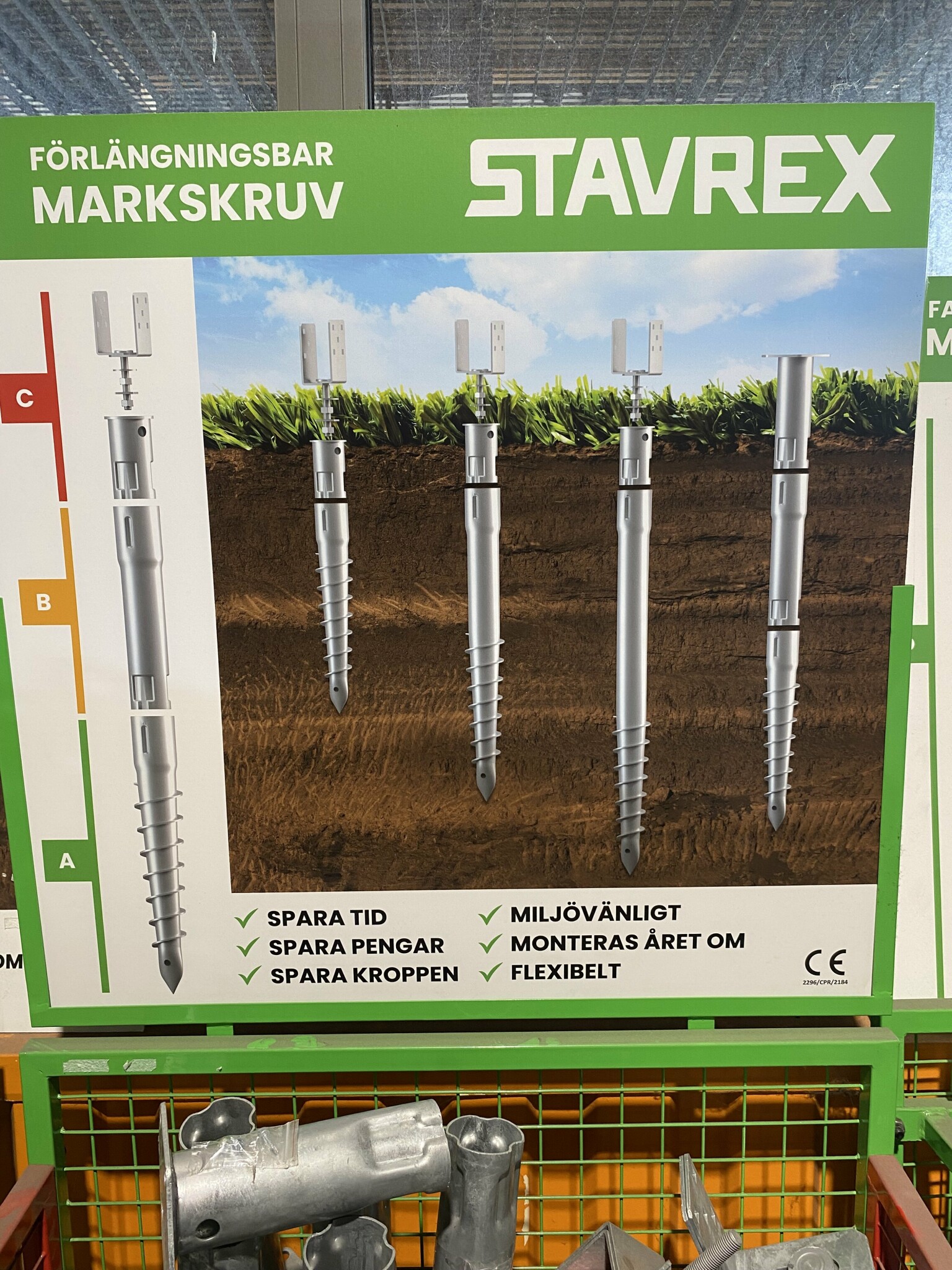
Now I think I've found the best (?) alternative…? Hornbach sells ground screws of a slightly coarser type in lengths up to 900 mm. Brand Stavrex. Post shoe is available 120-160mm. My only hesitation is if it will be sufficiently stable? I understand that it partly depends on the soil type, but does anyone have experience with these? I am thinking of reinforcing around the top with some casting just in case.S sepani said:


If you're going to place them, you should make a hole about 200 mm around with a depth for them. Set them down and fill with concrete and all sorts of stones of various sizes as filling around. This will create a larger base to stand on and greater lateral resistance.S sepani said:
Ok but then it feels better to dig regular plinths…? And not drill with sravrexJ jonaserik said:
If you have good soil that doesn't collapse, no formwork is needed in the hole, and if you don't need a foundation that extends above the ground level, it's perfect. The tricky thing can be getting them in a straight line, but you can use a string between the outermost ones. It's possible to attach a long beam to the brackets and align/orient them correctly so they are set up. If the foundations are at different heights, you can use djutrör. A splash at the bottom of the hole and rub the pipe down a bit and pour a splash in the pipe. Wait until the next day, backfill with lots of mass around the pipe, and they will be stable for the casting. Then they should be cut to the correct height, which can be done with a saw, and when the foundation is filled, the bracket is rubbed down. Don't forget the string so they align.S sepani said:
Yes. But I'm not sure why it's a problem (?) for the foundations to go above ground level? I was planning on that since I want my posts not to stand in water? My idea is to buy 700 mm foundations where I'll attach the bracket? That way I can adjust the height a bit if needed, and I also have the option to attach something to the posts for the pergola. If a 700 mm foundation is too weak, I can pour a sack around it.J jonaserik said:If you have good soil that doesn't collapse, you don't need any form in the hole, and if you don't need a foundation that goes above ground level, then it's perfect. The tricky part can be aligning them, but you can use a string between the outermost ones, attach a long beam to the ground brackets and adjust them to the right direction, and support them. If the foundations are at different heights, you can use a tube for the pouring. Pour a little at the bottom of the hole, insert the tube, and add a bit more into it. Wait until the next day, fill around the tube with soil, and they stay in place for pouring, then cut them to the correct height with a saw. When the foundation is filled, insert the bracket. Remember the string so they line up.
Click here to reply