As I found an old water damage under and around a window on the north gable (caused by an incorrect window sill), I had to tear down part of the wall in that room. Since there was some mold in the insulation between the fiberboard (Hultsfred house 1970) and the brickwork, and since the room was going to be completely renovated anyway, I tore down the entire inner wall. Not much work to build it back up again, I just need some help thinking it through to do it right.
The wall was previously constructed like this:
(From the inside) Wallpaper, tretex, plastic vapor barrier, fiberboard, 45mm fiberglass with paper facing, and finally brick.
The paper on the fiberglass lay directly against the mortar that was pressed out when the bricks were laid, so there was no clear air gap there, just the space created by the bulging mortar on the inside. There are also no air holes in the head joints and no natural ventilation at the top between the inner wall and the brickwork.
Despite this, there were no signs of damage or decay on the outside of the paper, but there was a dark gray/black area about a decimeter from a horizontal gap in the fiberglass (on the side towards the fiberboard), which I assumed was mold.
It seems that moisture penetrated through the joints, which I understand is quite normal and the reason for having ventilation behind the bricks, but it worked where the paper was intact.
Now that there's an opportunity to do it according to all advocated methods with ventilation holes in the head joints and a gap behind the brick, it feels like this alternative must be explored, but with help to avoid making any mistakes.
Some problems I see with introducing ventilation are that there doesn't seem to be anything protecting the sill plate down at the basement wall. There is tar paper between the basement wall and the sill but nothing against the brick. If moist air blows in through the ventilation holes, isn't there a risk that it might condense inside and run down to rest against the wood? I definitely don't want more moisture damage... Any good tips on how to solve that? The bottom of the wall is very uneven due to fallen mortar.
Additionally, ventilation is needed at the top as well. It's possible to make holes in the brick joints at the top, but I'm worried that water could instead leak in from the gable peaks.
Directly above, there's wood in the way, and it should be part of the framework for the gable peaks. I could drill up there, but it feels better to guide the air directly out.
If I manage to create effective ventilation in the gap, the inner wall must also be protected against incoming moisture. What's really the best to use against the air gap? I've seen alternatives like asphalt board, windproof paper, windproof fabric, sheathing board, façade board, exterior gypsum, etc.
I'm not keen on having wood directly against the air gap and wonder if windproof fabric is sufficient to create a barrier between moisture and wood? Even though it works in regular exterior walls with wood paneling.
And how thick insulation can you use? Isn't it heat from both the outside and inside that sets the air in the air gap in motion? And how does that affect the dew point and moisture in the air gap? Or is it okay to build with modern insulation measures since it works with modern houses with essentially the same sheathing construction?
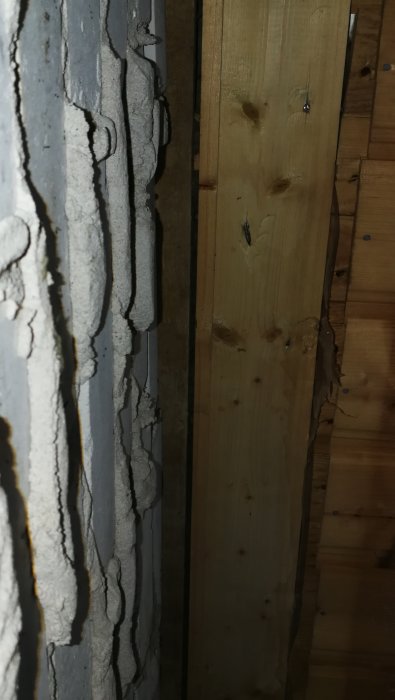
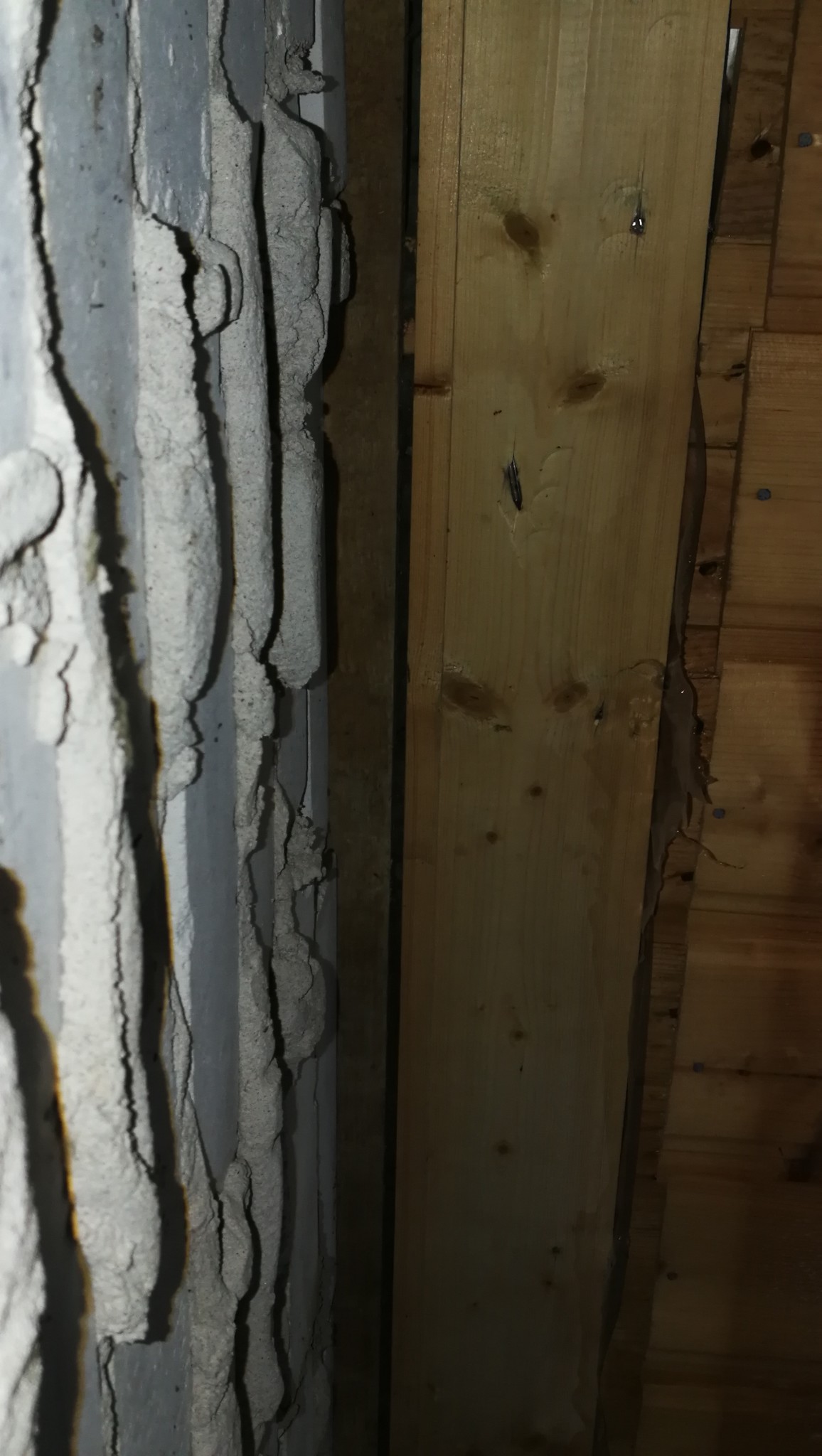
Is it just the brick wall now so everything else is gone, the brick supports the gable's woodwork as is customary, take a photo and show how it looks now,
In the picture, you can see the beam for the previous inner wall, which is the lighter wood. The slightly darker rough wood between the beam and brick is nailed on as a sort of cover for the space between the inner wall and the brick, and the gap you see between these leads up to the attic. The framework for the roof peak seems to be a self-supporting truss and, as far as I can see, has no contact with the brick.
It feels foolish to channel air into the bottom of the wall to vent moisture in the gap, only to then lead it up to the attic through the gap.
So my own thought right now is whether I should make holes in the head joints at the top of the wall as well, but behind the drip edge on the gable peak's wood. There is a space there that is protected from rain.
Then I seal up against the attic with some kind of soft sealant.
A lot of scrolling there, you don't have any special eave on the gable then, maybe remove the scrolling (a lot of work) and put some pressure-treated boards 12MM against the brick + outdoor gypsum, then there will be an air gap, make holes in the joints below, I seem to remember they have about 4 bricks in between and in a row, but don't forget insect netting, aluminum or copper on the back of the brick, can be glued with silicone or something else, otherwise you might get tenants. As for leading it up to the attic, it's probably not a problem, it's not a tornado with the ventilation, you have a vent there as well, right?
Yes, a lot of mess on the inside. I've removed the most protruding parts.
Yes, there is ventilation in the attic, but since the wall was completely unventilated before, I'm a bit afraid of changing the conditions up there if I now create an airflow leading up.
Is there any risk in channeling the air out through the head joints at the top of the wall?
For the inner wall, I'll probably build with facade board against the cavity, then wind barrier, insulation/frames, and then plastic before OSB and gypsum.
I was thinking of building a frame on the floor to which I attach the wind barrier and facade board, then raise it up and knock it into place. After that, I'll insulate the sections and apply plastic.
Facade board and windbreaker have the same function, so skip one of them, there is no problem with the vent behind and up, most of the moisture that may come is on the surface of the brick and blows away, it takes a lot of water to go through the brick to the inside, like a monsoon rain.
Isover, who makes the facade boards, suggests using the membrane. It also functions as moisture protection if I understand correctly, so just to be safe, I'll use the facade board 30 and the membrane. That way, at least I am following the instructions.
Otherwise, you are probably right that the ventilation will surely be sufficient. Previously, when it was completely sealed, the paper was on the fiberglass mat against the scroll and had no visible issues with it. It probably worked as a kind of moisture barrier. However, there was a spot where there was a gap in the fiberglass mat, with gray/black discolorations about 10cm out on each side of the gap, which I interpreted as mold. So it might not have been completely moisture-free. Something I hope to fix with improved ventilation.
It's probably not moisture, in gaps it usually draws some air and dirt from the air can get in and discolor, and it usually turns the insulation a grayish tone.
Click here to reply
Vi vill skicka notiser för ämnen du bevakar och händelser som berör dig.

 . I've removed the most protruding parts.