
7,277 views ·
19 replies
7k views
19 replies
How to attach threaded rod
Hello,
I have two oak boards that are 8cm thick which I will join with some underlying battens, also oak, 8cm thick. This is both to hold the boards together and to prevent them from warping too much. It should be a bit rough and rustic so it's okay if there are some cracks and warping, but not too much.
I was planning to attach the batten to the board with stainless threaded rod that I intend to tighten a few times a year as the oak shrinks. From what I've found, there aren't any stainless carriage bolts that long. The solution I thought of was a T-nut that is countersunk with filler or dowel plug over it according to the picture. The problem is that when I tighten the nut underneath, the threaded rod also turns.
Any suggestions for a solution?
I have two oak boards that are 8cm thick which I will join with some underlying battens, also oak, 8cm thick. This is both to hold the boards together and to prevent them from warping too much. It should be a bit rough and rustic so it's okay if there are some cracks and warping, but not too much.
I was planning to attach the batten to the board with stainless threaded rod that I intend to tighten a few times a year as the oak shrinks. From what I've found, there aren't any stainless carriage bolts that long. The solution I thought of was a T-nut that is countersunk with filler or dowel plug over it according to the picture. The problem is that when I tighten the nut underneath, the threaded rod also turns.
Any suggestions for a solution?
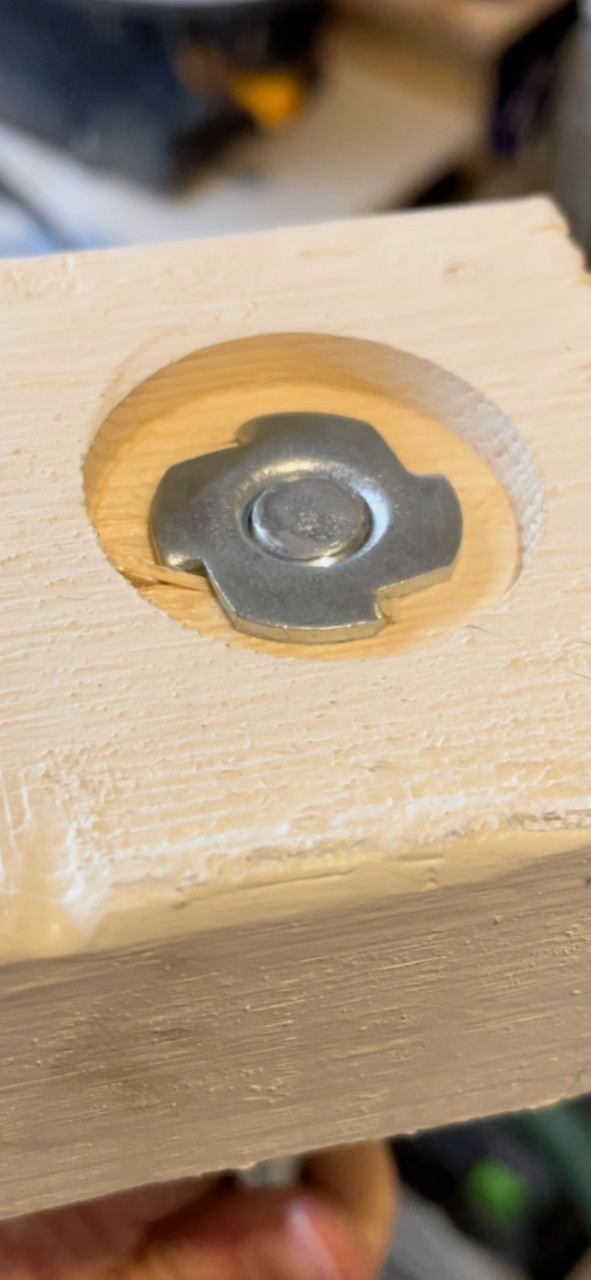
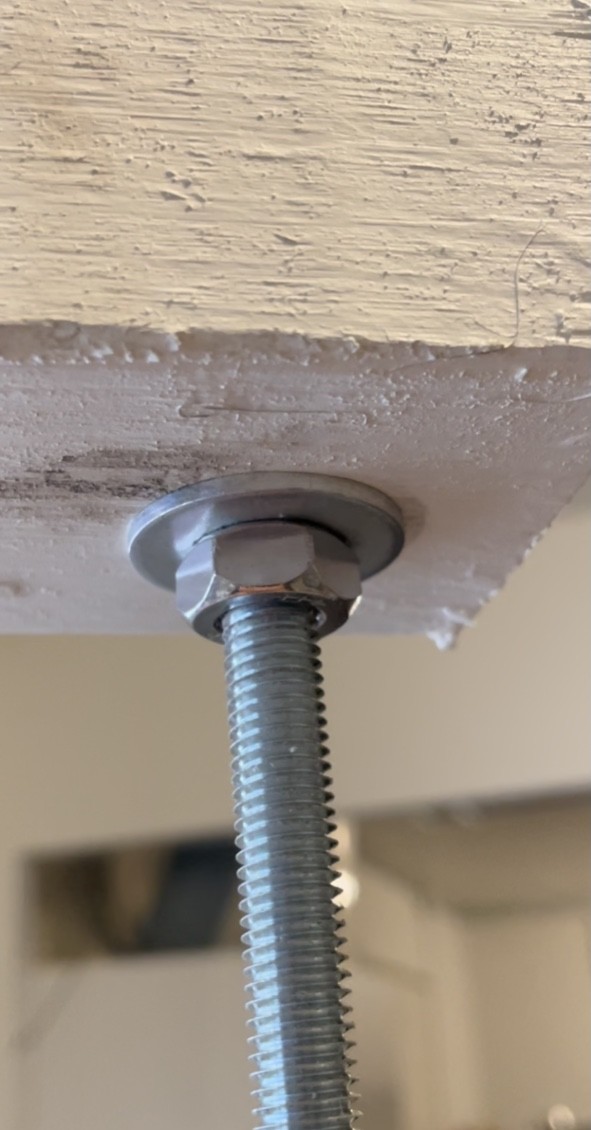

richardtenggren
Ingen-gör
· Norrlandet
· 6 615 posts
richardtenggren
Ingen-gör
- Norrlandet
- 6,615 posts

If you don't have loctite at home, you can measure where the nut ends on the threaded rod.
Where you want it to stop, you make 2-3 center punch marks. So if you want the rod to go in 10mm, make the center punch marks at 8mm so you can fit the punch marks into the nut.
Not completely foolproof but almost.
Where you want it to stop, you make 2-3 center punch marks. So if you want the rod to go in 10mm, make the center punch marks at 8mm so you can fit the punch marks into the nut.
Not completely foolproof but almost.
Violina said:
Thanks! Good solutions!L Lutte said:
richardtenggren
Ingen-gör
· Norrlandet
· 6 615 posts
richardtenggren
Ingen-gör
- Norrlandet
- 6,615 posts
Loctite is actually a company name, but it's understood to refer to their thread locking products, which come in various types. In your case, the main thing is to achieve higher friction than the hex nut on the side where you want to be able to adjust later. Thread locking is like a glue that activates upon tightening and thereby significantly increases friction.S SimonZ said:
Thread tape works well too.Loctite is actually a company name, but it implicitly refers to their thread locker, which comes in different variants, but in your case, the main thing is that you achieve higher friction than the hex nut on the side where you want to be able to adjust afterward.
Thread locking is like a glue that activates upon tightening and significantly increases friction.
richardtenggren
Ingen-gör
· Norrlandet
· 6 615 posts
richardtenggren
Ingen-gör
- Norrlandet
- 6,615 posts
Loctite is, as mentioned, a brand name. However, the product threadlocker is not really intended for these purposes, but works excellently. The compound tends to expand and, under certain conditions, become like glue. It is also moisture and rust resistant.
Thread tape is another option that you simply wrap around the threads, so the threads cut against each other, creating resistance or friction. With thread tape, you can more easily adapt to the purpose you are working on when it comes to carpentry work.
But as mentioned, both work excellently.
Thread tape is another option that you simply wrap around the threads, so the threads cut against each other, creating resistance or friction. With thread tape, you can more easily adapt to the purpose you are working on when it comes to carpentry work.
But as mentioned, both work excellently.