
586 views ·
4 replies
586 views
4 replies
How? - Renovate chimney with broken bricks
Good day!
It's soon time to renovate this chimney. As you can see, several bricks have cracked and it looks like the upper part has already been replaced at an earlier occasion.
My plan is to refurbish it as follows:
1. Prime with rödbruk
2. Mesh (metal or plastic mesh)
3. Refurbish so everything becomes top-nice!
What do you think, is this a solution for the next hundred years or is it something I'll need to redo in 5 years?
It's soon time to renovate this chimney. As you can see, several bricks have cracked and it looks like the upper part has already been replaced at an earlier occasion.
My plan is to refurbish it as follows:
1. Prime with rödbruk
2. Mesh (metal or plastic mesh)
3. Refurbish so everything becomes top-nice!
What do you think, is this a solution for the next hundred years or is it something I'll need to redo in 5 years?
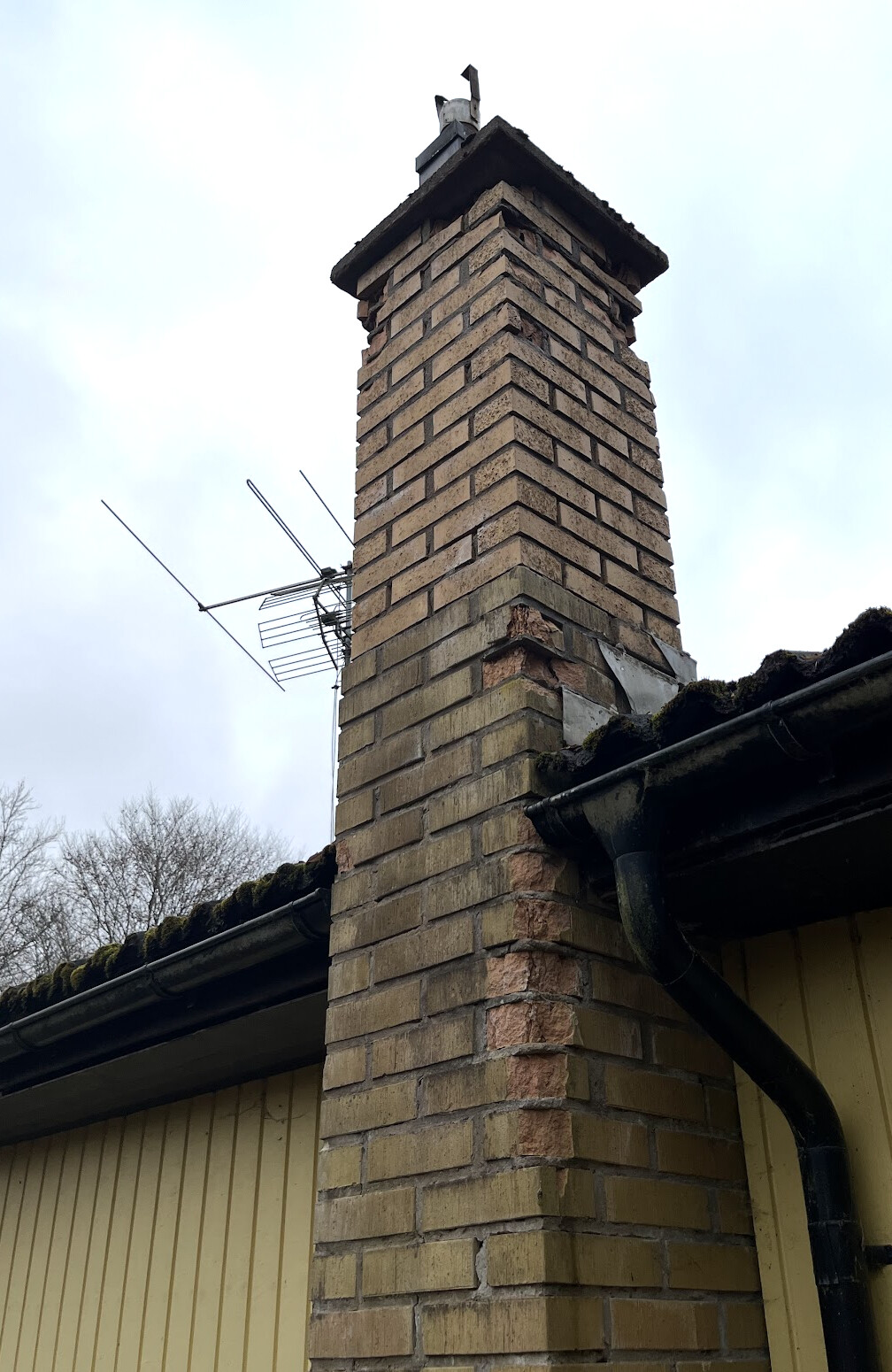
The chimney looks like the start of decay in an unused house that hasn't been heated for many years; in short, water has been absorbed into the stones, and the cold has then caused the bricks to crack due to frost damage, and this has happened many times.
It also seems that water from the gutter has splashed onto the stones, causing frost damage there.
The reason I mention this is that even if you re-plaster the chimney, you will soon get frost damage again unless you solve the underlying problem - that the chimney is not kept warm so that it dries out quickly again after rain, and also ensure that water from the gutters doesn't splash onto the chimney stack.
What does it look like inside? Does it have a liner from the stove/fireplace, which one would almost assume when seeing the top of the chimney, which in that case worsens the possibilities of keeping the chimney naturally heated with ventilation air from the house compared to it being a brick flue.
---
I also can't help but wonder what the thinking was when building a chimney stack essentially outside the house. There's a lot of stored heat in the base of the chimney stack from the combustion gases that is lost in this way, whereas a centrally placed chimney stack would have provided noticeable warmth from the stack for at least 8-12 hours after burning.
It also seems that water from the gutter has splashed onto the stones, causing frost damage there.
The reason I mention this is that even if you re-plaster the chimney, you will soon get frost damage again unless you solve the underlying problem - that the chimney is not kept warm so that it dries out quickly again after rain, and also ensure that water from the gutters doesn't splash onto the chimney stack.
What does it look like inside? Does it have a liner from the stove/fireplace, which one would almost assume when seeing the top of the chimney, which in that case worsens the possibilities of keeping the chimney naturally heated with ventilation air from the house compared to it being a brick flue.
---
I also can't help but wonder what the thinking was when building a chimney stack essentially outside the house. There's a lot of stored heat in the base of the chimney stack from the combustion gases that is lost in this way, whereas a centrally placed chimney stack would have provided noticeable warmth from the stack for at least 8-12 hours after burning.
Thank you for your response! That's exactly what happened. The house has been left unheated for a long time.X xxargs said:The chimney looks like the beginning of decay on a house left without heating for many years. In short, water has been absorbed into the stones, and the cold has then caused the bricks to crack with frost damage, and this has happened many times.
It also seems that water from the gutter has splashed onto the stones, causing frost damage there.
The reason I'm mentioning this is that even if you re-plaster the chimney, you'll soon have frost damage again unless you solve the basic problem - that the chimney is not kept warm so it dries quickly again after the rain and also to ensure that water from the gutters doesn't splash onto the chimney stack.
What does it look like inside—is there a liner from a stove/fireplace? This is almost assumed when looking at the top of the chimney, which, in this case, worsens the ability to keep the chimney naturally heated with ventilation air from the house compared to if it were a masonry flue channel.
---
Moreover, I can't help but wonder about the decision to build a chimney stack essentially outside the house, losing a lot of stored heat at the base of the chimney stack from the flue gases from burning. In contrast, a centrally located chimney stack would have provided noticeable heat from the stack for up to 8-12 hours after burning.
I also guess there's a pipe in the chimney just like you suspect, and it's certainly a strange choice to have only one side of the chimney stack indoors, as much heat is lost.
In any case, what do you think about my renovation plan? If I make sure to use it continuously so it stays warm, does it have a chance to last a long time, or is it a job that will need to be "redone" in a couple of years?
Interesting that you have two different types of bricks in your chimney - the lower part is yellow-green brushed, and the upper part looks like spun stone..B barkisar said:Good day!
Soon it's time to renovate this chimney. As you can see, several bricks have cracked and it looks like the upper part has already been replaced at a previous occasion.
My plan is to refurbish the whole thing as follows
1. Prime with rödbruk
2. Net (metal or plastic mesh)
3. Polish up so everything becomes top-nice!
What do you think, is this a solution for the next hundred years or is it something I'll need to redo in 5 years?
If you want to plaster the chimney, you'll still need to chisel out and replace the damaged bricks before plastering..
Thanks for the reply!J Jansson69 said:
Yes, it might be best to replace them, I was hoping to avoid that, but it might not last very long otherwise.
I suspect they have already had to replace the upper part of the chimney once, hence the different bricks.
/Barkisar
Click here to reply