
6,232 views ·
15 replies
6k views
15 replies
How much weight can an m24 (4.8) threaded rod support?
Hello!
How do I calculate how much weight an m24 4.8 graded threaded rod can withstand?
The rod is 1 meter long, and the weight will be approximately in the middle of the rod. The rod will act as a safety together with an identical threaded rod in a homemade barbell rack. The weight will be about 75-100 kg per threaded rod. Should they be able to handle this?
How do I calculate how much weight an m24 4.8 graded threaded rod can withstand?
The rod is 1 meter long, and the weight will be approximately in the middle of the rod. The rod will act as a safety together with an identical threaded rod in a homemade barbell rack. The weight will be about 75-100 kg per threaded rod. Should they be able to handle this?
Thanks for the reply!P pjkw said:
Yes, exactly, if some kind of accident occurs during a lift, I want the safety to withstand a drop from at least 0.5-1 meter height. Under normal use, significantly less/gentler stress.
By steel profile, do you mean something like a steel tube? The reason for the threaded rod is that it's convenient and cheap to just go to Biltema to buy one. Also, the diameter is quite small, which is good because it needs to be threaded through two holes in two horizontal 95x95 beams!
Thanks for the response! 15 tons sounds more than sufficient. What would you have chosen instead?S SSlangen said:
I was also considering buying 2 Galv threaded pipes DN25 (33.7x3.2mm). Should that work better?
Filletj said:
No, I don't intend to bend the bar, I preferably want something that doesn't bend at all under the load!B Bjober said:
G gbgustaf said:
Hope this is understandable! The frame is seen from the side and will consist of two identical ones as shown in the sketch. The load will, therefore, occur on 2 identical threaded rods if I need to release/drop the barbell during a lift!
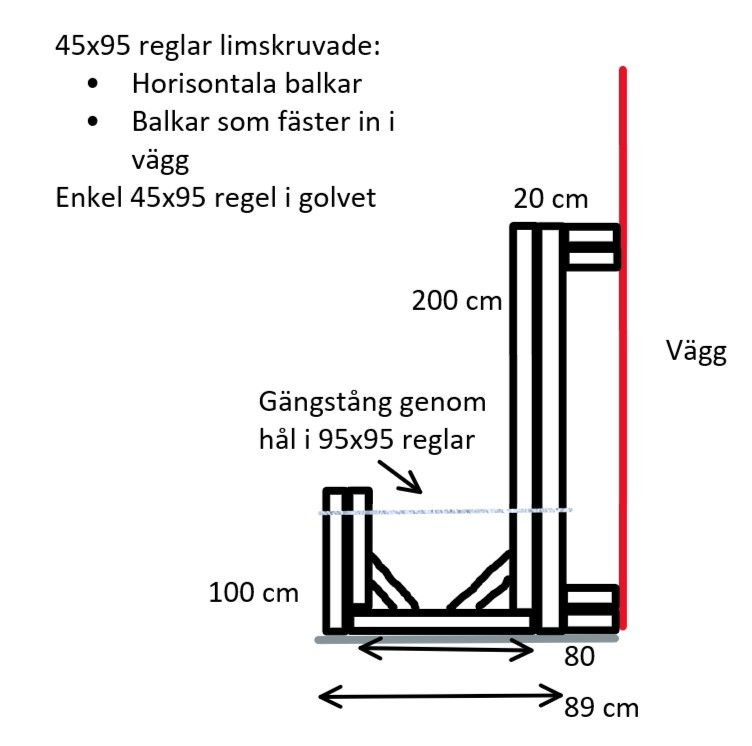
Yes, that's how I perceived it. You are going to subject the rod to a bending moment. Then it can't handle many kilos. Why not take a piece of wood that stands on edge if you are building everything else in wood anyway? Or are you going to have several holes so it becomes adjustable in height?
Yes, exactly, I plan to have multiple holes to make it adjustable!B Bjober said:
Okay, thanks for the important input. Maybe it's better to go for galvanized pipes instead?

In certain constructions, you want deformation of the safety bars to protect the rod and prevent bouncing. Then it also depends on the weights involved, if you routinely bend 250, it requires more than 150, etc.
With that out of the way, you can go for a substantial design, but it's possible to construct in other ways than a continuous steel rod.
With that out of the way, you can go for a substantial design, but it's possible to construct in other ways than a continuous steel rod.
Thanks for the response!Z z_bumbi said:In certain constructions, you want deformation of the safety bars to protect the rod and prevent bouncing. It also depends on the weights involved; if you routinely bend 250, it requires more than 150, etc.
With that out of the way, you can go big, but it is possible to construct in a different way than using a solid steel rod.
How would you have solved it instead of using a solid rod/pipe?

It's not possible to calculate. You can quite easily calculate the static load and what the bar can handle (depending on the bending you accept). But calculating dynamic loads like when weights are dropped is quite impossible because the input data is not known. For example, do both bars hit exactly at the same time? From what height? Angle?