
5,919 views ·
14 replies
6k views
14 replies
How is the strength affected when casting in an HEA beam?
Googled and asked as sub-questions in other threads but can't find an answer...
If I take an HEA 160 at 6m and cast it into a mold that is 20x20x6000, what would the properties be for this beam compared to if you don't cast it...?
Or is it simply so that it becomes rubbish, which is why I can't find anything...
If I take an HEA 160 at 6m and cast it into a mold that is 20x20x6000, what would the properties be for this beam compared to if you don't cast it...?
Or is it simply so that it becomes rubbish, which is why I can't find anything...

Self-builder
· Stockholm
· 8 642 posts
Hmm, can't see that an ingjutning would negatively affect the strength in any way!?
However, you do get other effects, such as increased self-weight (i.e., you must account for the weight from the casting in the strength) - and then cracking etc. can occur in the casting, if the beam were to expand, for example - depending on how you cast, of course
/K
However, you do get other effects, such as increased self-weight (i.e., you must account for the weight from the casting in the strength) - and then cracking etc. can occur in the casting, if the beam were to expand, for example - depending on how you cast, of course
/K
Member
· Östergötland
· 253 posts
It will probably be redundant if it is only the strength in the beam you are aiming for.
As for corrosion/fire protection, I have embedded beams just as you describe, but also with reinforcement cages and longitudinal bars according to a fairly detailed construction drawing.
As for corrosion/fire protection, I have embedded beams just as you describe, but also with reinforcement cages and longitudinal bars according to a fairly detailed construction drawing.
Okay, not entirely straightforward in other words... My idea is to place a 6m beam on two support walls with 1m resting on each side (4m span) and cast it all in concrete. This will be done under an existing concrete slab in an old barn that currently has a 7m span with a similar construction (but a rusty beam underneath, hence I want to reinforce it).
I primarily see the casting as corrosion protection but also to conceal the beam, and I imagine it would also become significantly stronger.
Cracking due to expansion feels tricky... it can be -20 and +30, so the beam is bound to move. If the concrete cracks and falls off after a year, it's a poor solution...
I primarily see the casting as corrosion protection but also to conceal the beam, and I imagine it would also become significantly stronger.
Cracking due to expansion feels tricky... it can be -20 and +30, so the beam is bound to move. If the concrete cracks and falls off after a year, it's a poor solution...
I seem to remember reading somewhere (here on byggahus?) that concrete and iron expand approximately the same with temperature differences.
Otherwise, most reinforced concrete structures would probably have problems?
Otherwise, most reinforced concrete structures would probably have problems?
Yeah, I also think it seems sketchy but I would really like someone to say that there are no issues with embedding a beam in this way...
Calculated (FEM) on an HEB 200 with a 4m span, fixed support on one end and loosely resting on the other end... 50 tons evenly distributed gave 13mm deflection which is 1/300th of the length so it should be sufficiently oversized
Calculated (FEM) on an HEB 200 with a 4m span, fixed support on one end and loosely resting on the other end... 50 tons evenly distributed gave 13mm deflection which is 1/300th of the length so it should be sufficiently oversized
Member
· Östergötland
· 253 posts
50 tons? What do you have on the second floor?
Self-builder
· Stockholm
· 8 642 posts
You might be right, but since it's not just reinforcing bars but a whole beam, even a difference that doesn't mean much in the case of reinforcement might actually matter...but I haven't calculated it or tried embedding such a large I-beam before, so I don't knowLostmoose said:
/K
Well, 50 tons is of course a lot... but I'd rather oversize considering I'm not a structural engineer If the beam costs a few extra thousand, I don't mind as long as I sleep better at night
What else could be done to conceal the beam? I don't need to cast it in, but I'd like to see a plastered surface outwardly...
I'll have to google further, and if I can't find anything, I guess that's "proof" that what I'm thinking isn't usually done...
If the beam costs a few extra thousand, I don't mind as long as I sleep better at night What else could be done to conceal the beam? I don't need to cast it in, but I'd like to see a plastered surface outwardly...
I'll have to google further, and if I can't find anything, I guess that's "proof" that what I'm thinking isn't usually done...
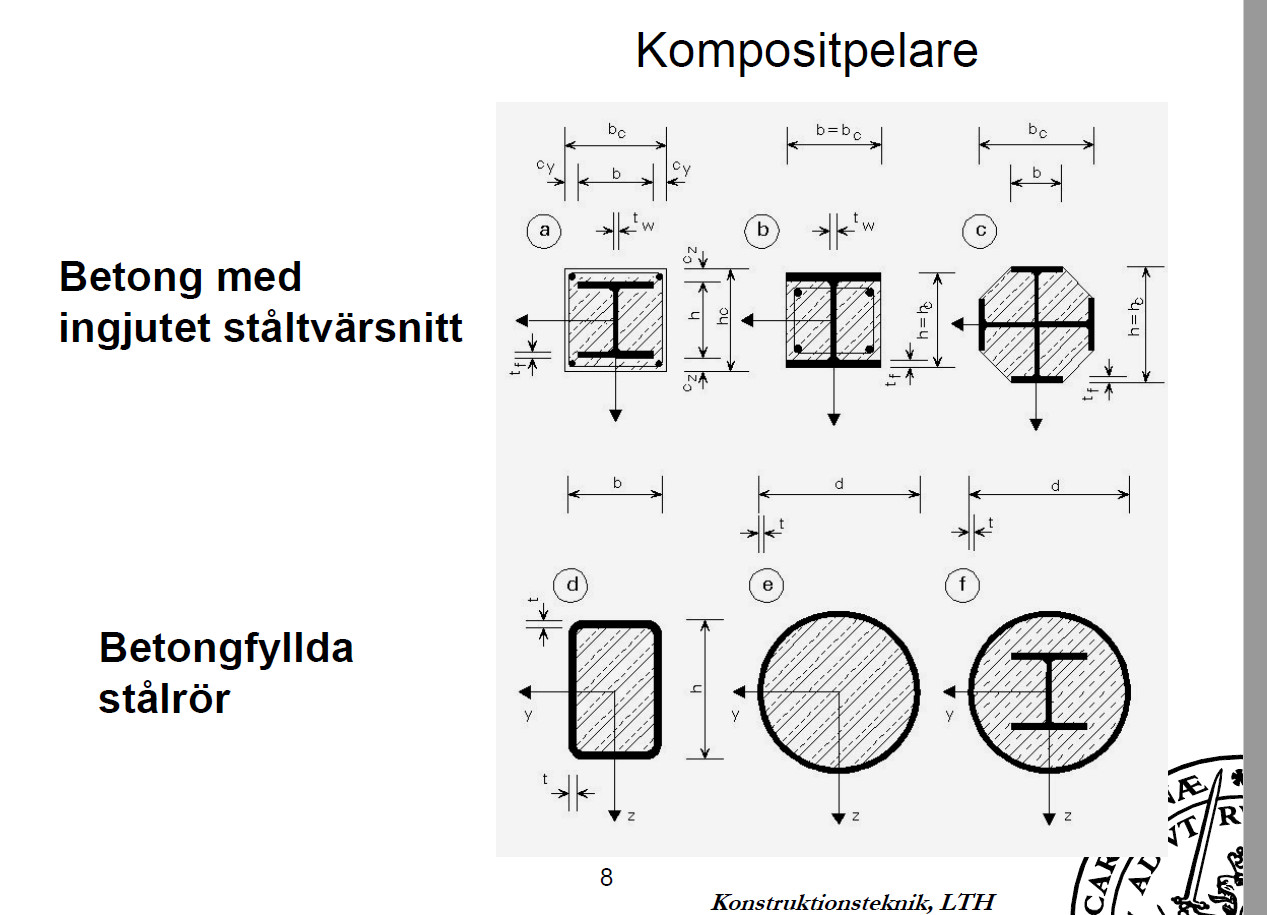
Asked around a bit and it's probably not that easy to get the concrete to adhere and not crack. Reinforced steel is "ribbed" for a reason... you could weld a lot of bös onto the beam but... the question is whether there will still be a lot of cracking...

I don't think simply embedding a beam directly will work.
I have seen truck transports with beams where there were loops of rebar welded on approximately every 20 cm. These were rectangular loops sticking out 20 - 30 cm from the beam.
I have seen truck transports with beams where there were loops of rebar welded on approximately every 20 cm. These were rectangular loops sticking out 20 - 30 cm from the beam.
I'm increasingly considering skipping the casting altogether and simply building a steel structure behind the wall for strength and building a lecamur in front solely for aesthetic reasons. Well-dimensioned and rust-protected steel should last a lifetime
I don't know how much difference it makes, but how much worse in terms of load capacity a beam/basket (iron + stirrups) with embedded rebar becomes?
You can hardly find anything on the big internet about how reinforcing concrete beams handle loads and even less comparisons between rebar like kamstål and I/H beams. I considered an I beam over openings in the façade but because I think the steel beam divides the concrete and risks cracks along the entire length, I chose kamstål instead, even though it feels like it can handle less load.
You can hardly find anything on the big internet about how reinforcing concrete beams handle loads and even less comparisons between rebar like kamstål and I/H beams. I considered an I beam over openings in the façade but because I think the steel beam divides the concrete and risks cracks along the entire length, I chose kamstål instead, even though it feels like it can handle less load.
Click here to reply