
3,217 views ·
18 replies
3k views
18 replies
How do I mount a narrow granite slab on top of a wall?
I have opened up a wall between the kitchen and living room and am now in the process of restoring the whole thing. Part of the opening is intended to consist of a low wall with a granite slab as a countertop surface on top. My question is how to secure this.
Attached is an image of how the wall looks today. When finished, it will consist of (from the living room's perspective) a 14mm veneered panel from IKEA (cover panel for the kitchen units), OSB, 70mm studs, 13mm gypsum. On the inside, there will be base cabinets with a granite slab on top and above this, tiling on the wall. All of this is under control. The problem is the slab intended to lie on top of the wall. It is a 40mm thick, 300mm wide, and 1200mm long granite slab. It will have an overhang of about 100mm on both sides of the wall. My concern is that if it's only glued, it might come loose if someone leans too much on it or something. I would prefer to avoid someone getting a granite slab on their toes from just over a meter height.
The gypsum on the inside is not in place yet, so if something needs to be done from the underside (considered drilling some holes in it and screwing through), it is possible. I am quite allergic to solutions like attaching some angle brackets on the underside and the like. So I would prefer to avoid that. If it can be seen from any angle that there's something not fitting in, I won't be able to stop being annoyed by it.
So what are your tips? Is it enough to glue it with PL400? How much point load can it take on the outer edge without the slab coming loose?
Attached is an image of how the wall looks today. When finished, it will consist of (from the living room's perspective) a 14mm veneered panel from IKEA (cover panel for the kitchen units), OSB, 70mm studs, 13mm gypsum. On the inside, there will be base cabinets with a granite slab on top and above this, tiling on the wall. All of this is under control. The problem is the slab intended to lie on top of the wall. It is a 40mm thick, 300mm wide, and 1200mm long granite slab. It will have an overhang of about 100mm on both sides of the wall. My concern is that if it's only glued, it might come loose if someone leans too much on it or something. I would prefer to avoid someone getting a granite slab on their toes from just over a meter height.
The gypsum on the inside is not in place yet, so if something needs to be done from the underside (considered drilling some holes in it and screwing through), it is possible. I am quite allergic to solutions like attaching some angle brackets on the underside and the like. So I would prefer to avoid that. If it can be seen from any angle that there's something not fitting in, I won't be able to stop being annoyed by it.
So what are your tips? Is it enough to glue it with PL400? How much point load can it take on the outer edge without the slab coming loose?
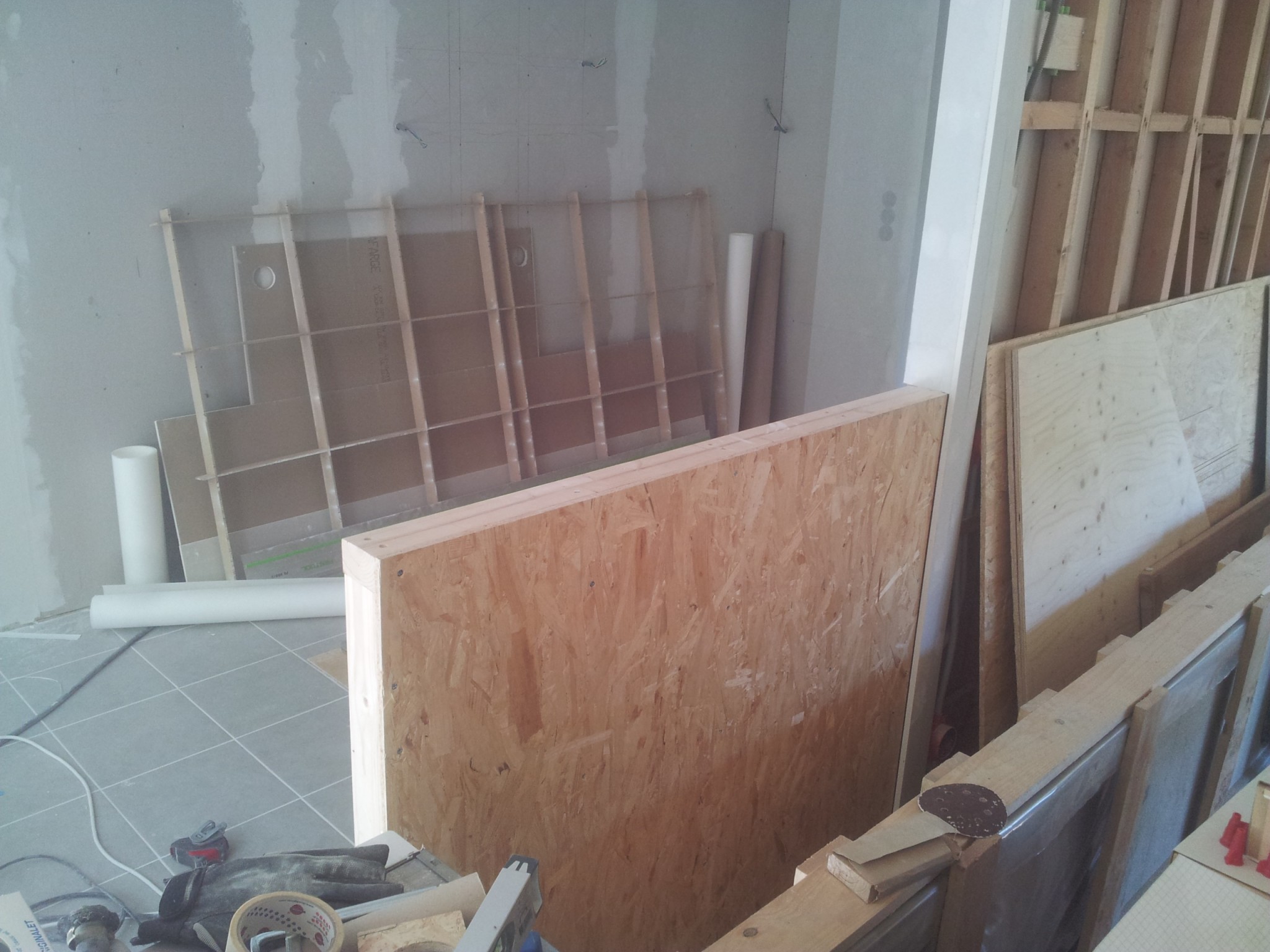

Hmm... I see an accident waiting to happen in this case. Could one consider attaching a slightly sturdier piece of trim (the same length as the width of the column) on top of the board against the column to secure it to some extent?
Yes, or even cutting out a piece from the column where the granite board can go in a couple of cm, that would prevent it from "tipping" if the glue were to come off unexpectedly.mlkjhr said:
Thinner works excellently, if you use a heat gun first, it softens it like chewing gum. I have removed items glued with PL400 without any problems, and then cleaned with thinner.snickarboden said:
Otherwise, I also believe in PL400. If I understand correctly, the adhesive surface is about 100mm wide, with 100mm extending on either side. So it's a substantial adhesive surface with relatively little overhang and also with a "counterweight" on the opposite side. I don't think there is anything to worry about when gluing the board.
If you still don't trust the glue, I think the best and most attractive solution is to place a molding under the granite slab in the corner between the granite slab and the wall, on each side, for example, a cove molding or another nicer one if you prefer, but still glue the slab.
There will be a tall cabinet in line with the pillar, which probably makes it very difficult to do in a nice way. But the suggestion with a list should definitely be evaluated. I had only thought about what could be done on the underside, so it was a completely new perspective for me. It was a good idea. I'm wondering if I can make it look satisfactory.b8q said:
This is something I've been considering as well. However, to be effective in increasing the glue surface, it's important that these moldings are also firmly attached, so that there is no movement in them. But that's probably easier to solve.thomasx said:
Maybe it will be a combination of several of the suggested options. I need to ponder this further for a while. (I have some other things to fix before I get to that.) I thank everyone for the good insights, and if anyone has more tips, I'm grateful. I'm also a bit curious if anyone has any figures on the strength of PL400? It would be interesting to get an idea of how much weight a glued-only slab can bear before it comes loose.
Yes, such a strip must be securely fastened to the wall. The board simply rests on it. You can screw it into the wall, so there should be no problems.pyro said:This is also something I've been thinking about. But for it to make any real difference in increasing the glue surface, it's important that these strips are also firmly attached, so there's no movement in them. But that is surely easier to solve.
Maybe it will be a combination of several proposals presented. I need to ponder this a bit more. (I have some other things to fix before I get to this.) I thank you for all the good points, and if anyone has more tips, I would be grateful. I'm also a bit curious if anyone has any figures on the strength of PL400? It would be interesting to get a picture of what load a purely glued board can withstand before it comes loose.
If I remember correctly, pl400 holds 30kg/cm2.
Yes, I remembered quite correctly

http://www.tremco-illbruck.se/celumdb/documents/PL400-TDS-SE_22208.pdf

Let's do some calculations:
Suppose three 100 kg guys jump up and sit on the edge.
The torsional moment would then be approximately 0.1 m (overhang) x 300 kg = 30 kgm.
Counteracting moment is 0.05 m (half the width of the wall) x 1.2 m (the length) x 300,000 kg/m2 (adhesive strength) = 18,000 kgm.
The safety margin is therefore 600 times.
Suppose three 100 kg guys jump up and sit on the edge.
The torsional moment would then be approximately 0.1 m (overhang) x 300 kg = 30 kgm.
Counteracting moment is 0.05 m (half the width of the wall) x 1.2 m (the length) x 300,000 kg/m2 (adhesive strength) = 18,000 kgm.
The safety margin is therefore 600 times.


Kan själv!
· Trelleborg
· 19 860 posts
However, the disc will tilt around one outer edge, and therefore you can count on the entire surface "holding against" it.