39,689 views ·
20 replies
40k views
20 replies
How do I cast the retaining wall in the best way?
Hello
I am planning to build a retaining wall, and after a lot of consideration back and forth, it will be made of so-called skalblock. It will be up to 1.9 m high, how is this best done with casting such a wall? Should it be cast in stages, or all at once? I would prefer to have hi
I am planning to build a retaining wall, and after a lot of consideration back and forth, it will be made of so-called skalblock. It will be up to 1.9 m high, how is this best done with casting such a wall? Should it be cast in stages, or all at once? I would prefer to have hi


Something went wrong.... I would prefer to have the concrete truck come here only once. From what I understand, it is risky to pour such high heights at once?
Feel free to share tips and ideas on how I should proceed to avoid mishaps......
Best regards
Feel free to share tips and ideas on how I should proceed to avoid mishaps......
Best regards
Here are some tips.
http://www.finja.se/App_Resource/Product/PDF/PB/21202050-1.pdf
As you can see, there are no construction examples for retaining walls, only free-standing walls. I believe Finja has good reasons for this. Neither leca nor skalblocks walls are suitable as retaining walls.
http://www.finja.se/App_Resource/Product/PDF/PB/21202050-1.pdf
As you can see, there are no construction examples for retaining walls, only free-standing walls. I believe Finja has good reasons for this. Neither leca nor skalblocks walls are suitable as retaining walls.
Certainly, but a search on Google tells me that it should work fine..... As I understand it, it's instead of a mold and with the right reinforcement, it should withstand the pressure.... Does anyone know for sure?
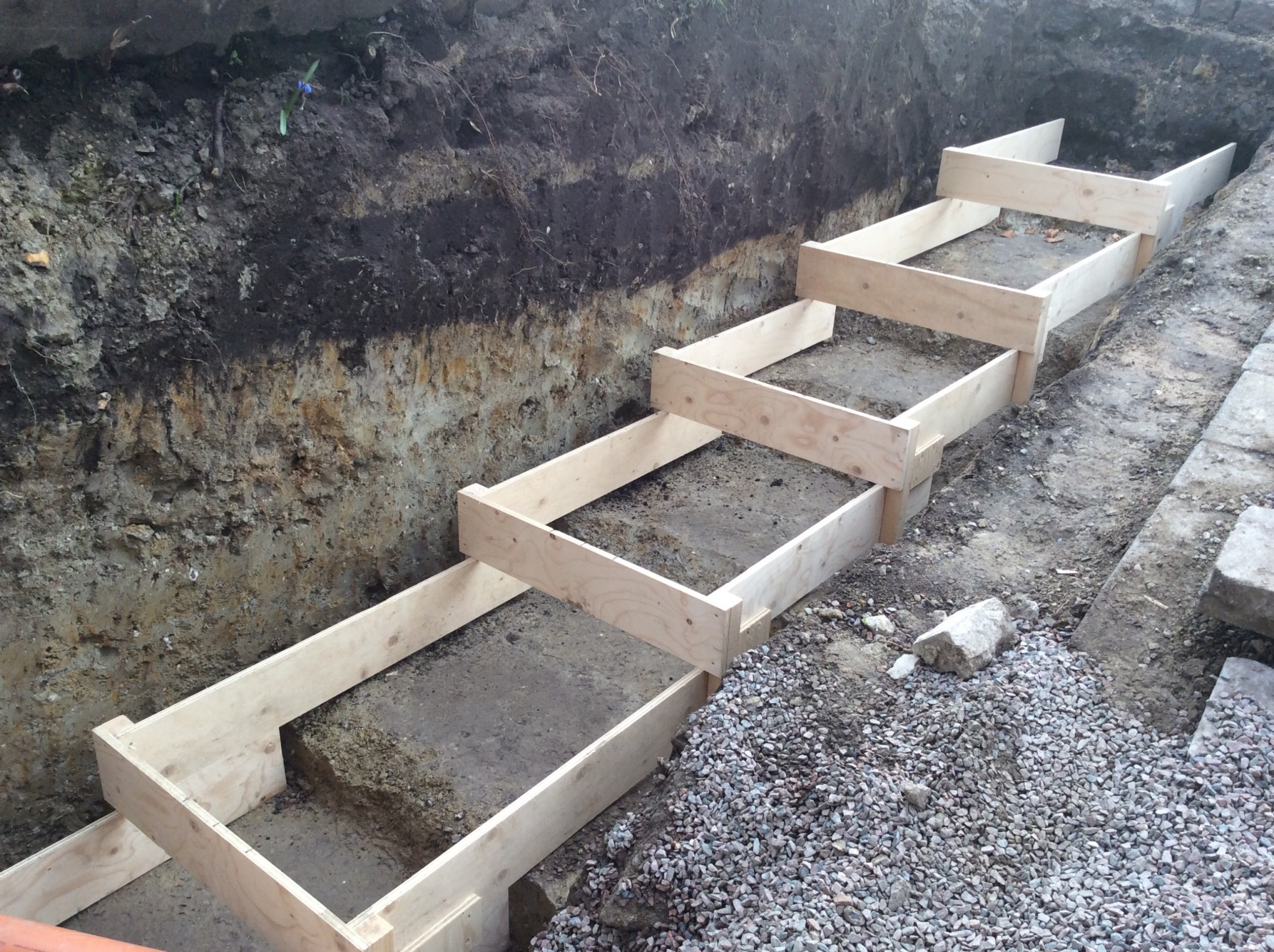
My current plan..... Pour a footing on macadam with protruding reinforcement, when it has set, start stacking blocks in two courses and pour up to halfway up the second block. Let it set....... Then stack up the blocks to full height and subsequently call the concrete truck and pour the rest......
Considerations: does it matter if I let the concrete set between pours?
When pouring at height, it apparently creates a hell of a pressure, what does this pressure want to achieve, does it want to lift the entire wall or tip it outward inward?
Does a cavity wall without mortar between the stones need sheets pressed against the blocks during the pouring?
Tips and ideas on this are gratefully received.......
Best regards
My current plan..... Pour a footing on macadam with protruding reinforcement, when it has set, start stacking blocks in two courses and pour up to halfway up the second block. Let it set....... Then stack up the blocks to full height and subsequently call the concrete truck and pour the rest......
Considerations: does it matter if I let the concrete set between pours?
When pouring at height, it apparently creates a hell of a pressure, what does this pressure want to achieve, does it want to lift the entire wall or tip it outward inward?
Does a cavity wall without mortar between the stones need sheets pressed against the blocks during the pouring?
Tips and ideas on this are gratefully received.......
Best regards
That's not entirely true. I agree that Leca blocks are not intended for walls that should withstand large stresses, but the hollow blocks from Finja or the alternative Fundablock are indeed intended for walls with high stresses.MathiasS said:
The examples of walls you refer to are precisely walls that are meant to withstand pressure from one side. The proposals are intended to be used as silos or manure pools, and these two applications likely result in just as much pressure as ground pressure would, depending of course on the soil type and how the land is used.
So I am convinced that it's possible to make retaining walls from hollow blocks, but the reinforcement and the anchoring of the footing are of great importance, as well as how the footing is designed.
Last edited:
Of course, it's possible to build retaining walls with form blocks. The question is how many counterforts are needed to prevent it from toppling. The walls in Finja's example have angles, which means that it's the interlocking of the walls that handles lateral pressure, not the anchoring in the ground. It's certainly not a design feature that makes the walls half as high at the open end of the waste box in Finja's document. The same applies if you're building a pool or similar construction, where the walls hold each other and the anchoring to the bottom becomes secondary.
If you build a long wall 2m high, the anchoring in the ground becomes absolutely crucial. The wall will of course hold, the question is how long it takes before it lies on the ground, whole and in one piece.
If you build a long wall 2m high, the anchoring in the ground becomes absolutely crucial. The wall will of course hold, the question is how long it takes before it lies on the ground, whole and in one piece.
Depending on how long the wall needs to be, you naturally have to manage the construction accordingly. But the principle is no more complicated than using L-supports. A wall reinforced and properly made of hollow block structures doesn't have to be much worse than a fully poured wall or a wall of L-supports. Look at Finja's constructions, they are of the L-support model with a substantial base plate to specifically prevent the wall from toppling.
If you have such loads that you think such a wall would topple, it is extremely simple to add tensile bands connected to the horizontal reinforcement between the courses, extending into the backfill and anchored there. Now, I don't think that is the big issue if we're talking about a regular home lot, but it is easy to add and avoids the hassle of building buttresses.
If you have such loads that you think such a wall would topple, it is extremely simple to add tensile bands connected to the horizontal reinforcement between the courses, extending into the backfill and anchored there. Now, I don't think that is the big issue if we're talking about a regular home lot, but it is easy to add and avoids the hassle of building buttresses.
Oceanis, I agree with you and don’t think I’ve said anything else (or yes, L-supports that are cast in one piece might hold a little better at the angle). In this case, the thread creator is thinking of a 2m high wall placed on a base, I assume that base is about half a meter wide => few similarities with an L-support.
Anchoring with some kind of anchor must also be possible as you say, with geogrid or with some other type of durable anchor.
However, it doesn't sound like TS has any thoughts on that, which is why I protest a little. I’ll close my mouth now.
Anchoring with some kind of anchor must also be possible as you say, with geogrid or with some other type of durable anchor.
However, it doesn't sound like TS has any thoughts on that, which is why I protest a little. I’ll close my mouth now.
It is exactly this type of discussion I am looking for, I lack the experience myself. To clarify, the wall is 1 meter at the lowest and 2 meters at the highest, of which 1.6 meters is above ground. A couple of corners and quite short stretches where it is at its highest (Max 2.5 meters).
However, I am still wondering if my approach in the post above has any big NO NOs!
However, I am still wondering if my approach in the post above has any big NO NOs!
MathiasS said:Oceanis, I agree with you and don't think I've said anything different (or yes, the L-supports that are cast in one piece are likely to hold a little better at the angle). In this case, the thread creator is considering a 2m high wall placed on a foundation, I assume that foundation is about half a meter wide => few similarities with an L-support.
Anchoring with some kind of anchor must also be possible as you say, with geogrid or some other kind of durable anchors.
However, it doesn't sound like TS has any thoughts on that and that's why I'm protesting a little. I'll shut my cakehole now.
We are philosophizing on a forum, so please continue to argue, it will surely give TS a lot of new things to think about

I have no intention of silencing you anyway....
Finja has a product called gränslös that I have used. http://www.finja.com/App_Resource/Page/file/betong/5063-1.pdf
I built a garage driveway with retaining walls that are about 1500 high at the highest point. I first poured a footing that should be 700 mm wide. A lot of concrete is needed for this, so I had the concrete truck come for it. Once it hardened, I built up the cavity wall and bonded it with setting adhesive. Then I poured in concrete that filled about one course. Once this hardened, it held the entire wall in place so it wouldn't shift when I filled the rest. Then the concrete truck came a second time. I cast the entire driveway and filled the wall all the way up at the same time. It takes about 80 l/sqm.
I built a garage driveway with retaining walls that are about 1500 high at the highest point. I first poured a footing that should be 700 mm wide. A lot of concrete is needed for this, so I had the concrete truck come for it. Once it hardened, I built up the cavity wall and bonded it with setting adhesive. Then I poured in concrete that filled about one course. Once this hardened, it held the entire wall in place so it wouldn't shift when I filled the rest. Then the concrete truck came a second time. I cast the entire driveway and filled the wall all the way up at the same time. It takes about 80 l/sqm.
Last edited:
fn76 said:Finja has a product called gränslös that I've used. [link]
I built a garage driveway with retaining walls that are about 1500 high at the highest point. I first cast a sole that should be 700 mm wide. It takes a lot of concrete for this, so I had a concrete truck come by for it. Once it hardened, I built up the facing wall and glued with mounting adhesive. Then I poured concrete that filled about one layer. When this hardened, it held the entire wall in place so it wouldn't shift when I filled the rest. Then the concrete truck came by a second time. I cast the entire driveway and simultaneously filled the wall all the way up. It takes about 80 l/sqm.
Interesting, do you have pictures?