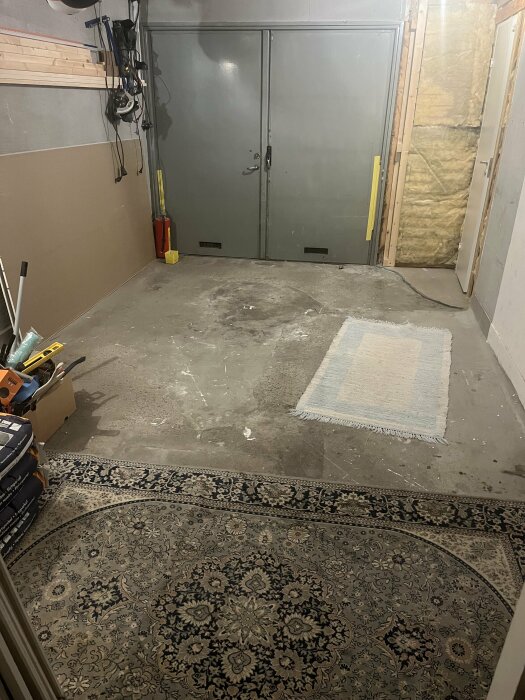
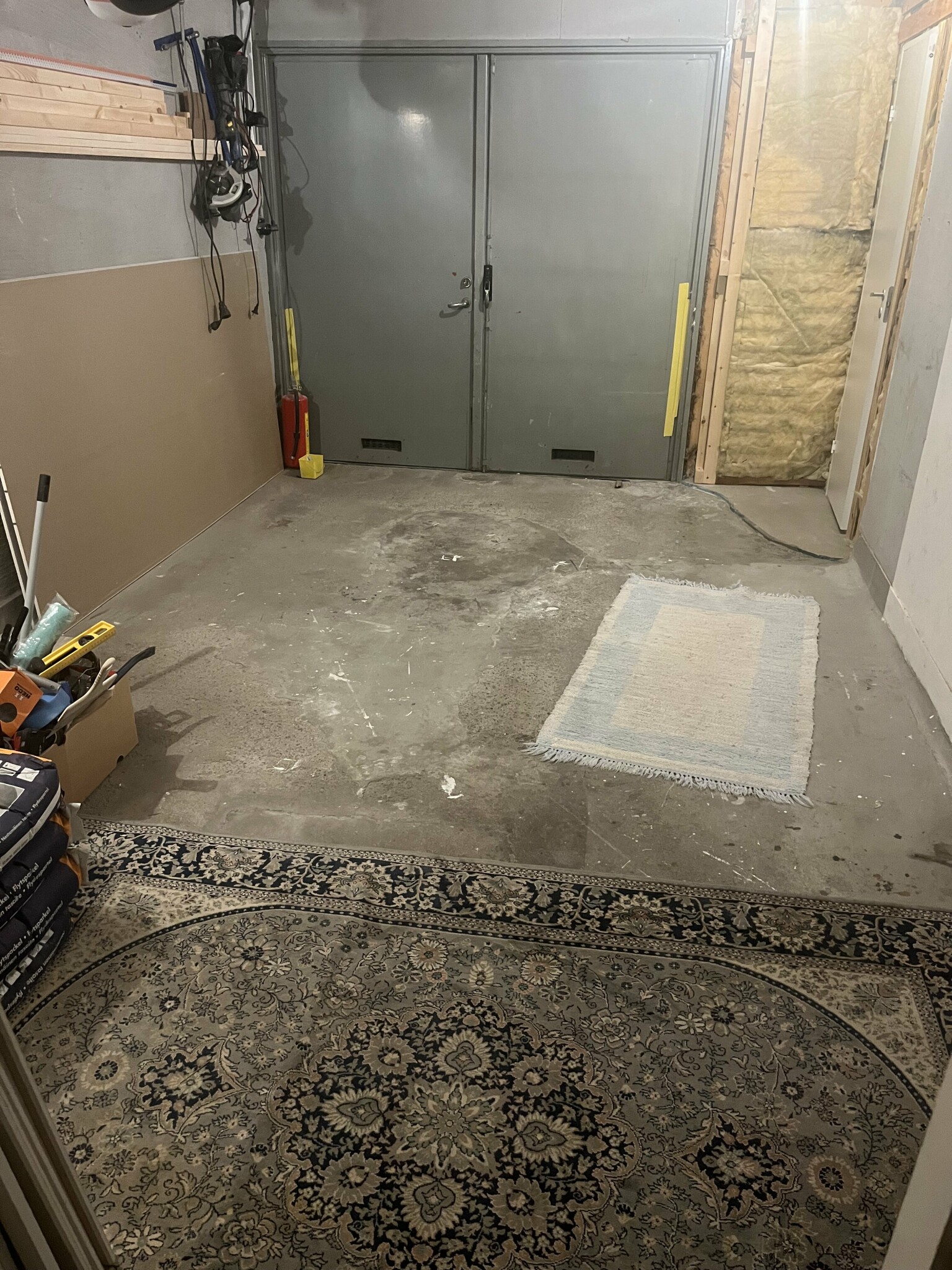
I have a garage where I'm going to apply self-leveling compound to the floor as it will be converted into a bedroom. But how on earth do I calculate the amount of self-leveling compound needed when the floor is sloped and a bit wavy in certain areas?
If I had used the cheap self-leveling compound from Byggmax, it wouldn't have been so critical. But now I'm planning to use Ardex K39 because it's so easy-flowing and has a long drying time, and it costs nearly 1000 SEK per bag and needs to be ordered, so I don't want to end up buying several bags too many.
How would you pros do it to calculate as accurately as possible since I want to use as little self-leveling compound as possible?
Measure the height you need for the spackle at as many points as you can with a laser. Then take the average of all the measurements = thickness of the spackle layer. Draw a grid pattern on the floor and measure at each intersection.
Measure the height you need for the putty at as many points as you can with a laser.
Then take the average of all measurements = thickness of the putty layer.
Draw a grid pattern on the floor and measure at each cross.
/Höghus
If you don't have a laser, is there any good way to solve it then? Otherwise, I'll have to go rent a laser, simply.
For a "real" builder, the material doesn't matter. He invoices it. Besides, it's his time that costs the most.
A real builder HAS a laser and sets level pins so they can achieve an even result.
Then they usually have a mixer with a pump in a van outside where the self-leveling compound is mixed, so it's easy to mix the amount needed.
But as an amateur, rent a laser and set level pins, so you can calculate the required volume.
Click here to reply
Vi vill skicka notiser för ämnen du bevakar och händelser som berör dig.


Höghus said: