The ceiling panels with a smooth surface look like typical plasterboard. They are also currently sold as ceiling plasterboard. These panels usually contain some fiberglass, so don't worry if you find fibrous material in them.
Thanks for all the great answers! So the only thing I can be pretty sure contains asbestos is the pipe insulation and the eternit in the boiler room. Then I chipped off some tiles in the bathroom. The tiles are on a wall covering made of yellow plastic sheets. The adhesive is quite light, but the dark grout looks like it contains small stone or glass fibers that glitter in the light. I'm planning to submit samples for analysis when I pass by the capital. It was much cheaper than Previa here in Lkpg. I assume the ceiling panels in the bedrooms are made of pure wood material. They feel very soft when you press in a screwdriver or something similar.
Regardless of the material, it is always advisable to wear a respirator during demolition work. There is always a lot of dust, and it's not healthy to breathe in even if it's not asbestos.
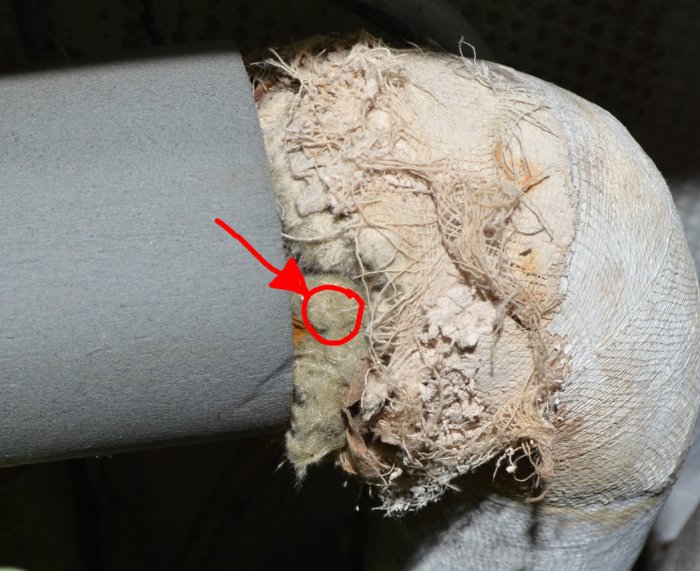
I have now received a response from A-analys and only (!) the asbestos cement boards in the boiler room contain asbestos. Thanks to all the help here on BH, I had already figured out that the thin boards in the rest of the basement are oil-hardened masonite and all the ceilings (probably) tretex. To my great surprise, the fiber insulation in the pipes wasn't asbestos either (see picture). I was almost completely sure about that. I didn't send in the insulation around the expansion tank in the attic because I found a logo that said "original rockwool." I can highly recommend A-analys where I got great free advice over the phone and a very quick response. Provided that the test results are indeed accurate
It's really strange that the pipe bend didn't contain asbestos. The circled part in the picture is obviously not asbestos, you wouldn't even need to test that. But to the right of your red circle, as an old asbestos remover, I would bet that it is gurmassa - which contains asbestos. But if the test says otherwise, I guess I'll have to back down.
I only sampled the circled area. I thought it was that fiber-like insulation that was asbestos. What do you mean by you to the right of the circled area? The white outermost part (I thought it was gypsum) or the gray in between? Could someone mark it on the picture? Thanks
So you mean the material that was used to apply the bandage?
I thought it was plaster on the outside (the snow-white) but maybe it's the same (asbestos) material all the way to the outside and just painted on?
In that case, it's on all the pipes, even on the straight sections
So you mean the mass that was used to apply on the bandage?
I thought it was plaster on the outside (the snow-white), but maybe it's the same (asbestos-) material all the way out and just painted on?
If that's the case, then it's on all the pipes even on the straight sections
The part that is under the gauze in the bend, which is slightly pink/skin-colored. It dusts like crazy and is only in the bend. If you don't want to remediate it, you can buy plaster bandage at the pharmacy and apply it, then paint with a fully covering paint afterward. Then it's bound and risk-free until the day someone starts cutting into the system.
(A "cake" encircled in blue.)
Great, thanks for the marking in the image
Then there's just one last question:
We have some straight pipes that have the same gipbinda on the outside. They look quite leveled out and as if it was done on site just like the bend.
Is there usually something else underneath there or is there a risk of asbestos there as well?
Vi vill skicka notiser för ämnen du bevakar och händelser som berör dig.