
7,013 views ·
15 replies
7k views
15 replies
Hole drilling in wooden joists
Hi,
I'm preparing to run radiator pipes on the upper floor. The pipes will come up roughly in the middle of the house. To reach both ends where the radiators will be placed, I'll need to pass through all the floor joists (10 rafters + 9 intermediate joists) which are spaced at 600 mm on center and measure 45x220 mm. I will need to drill 2 holes in each beam, about 25-30 mm each, to accommodate the two pipes needed for supply and return. Is there a risk that by doing this, I will weaken the structural integrity?
Where should I position the hole vertically, at the bottom, middle, or top?
Should I try to place the hole near the support or far from it?
Anything else I should consider?
I'm a bit hesitant about drilling holes in my new nice floor beams but I guess it's the only way to solve this? That's how it's typically done, I presume.
I'm preparing to run radiator pipes on the upper floor. The pipes will come up roughly in the middle of the house. To reach both ends where the radiators will be placed, I'll need to pass through all the floor joists (10 rafters + 9 intermediate joists) which are spaced at 600 mm on center and measure 45x220 mm. I will need to drill 2 holes in each beam, about 25-30 mm each, to accommodate the two pipes needed for supply and return. Is there a risk that by doing this, I will weaken the structural integrity?
Where should I position the hole vertically, at the bottom, middle, or top?
Should I try to place the hole near the support or far from it?
Anything else I should consider?
I'm a bit hesitant about drilling holes in my new nice floor beams
but I guess it's the only way to solve this? That's how it's typically done, I presume.Yes, you impair the load-bearing capacity of the construction. If it matters? Probably not.
Place the holes in the middle. Where you should place the holes in the field depends slightly on how far the beams span and whether they are continuous over supports or not. Generally, it's probably okay if you place them 15%-20% from the support.
I have no experience of how radiator pipes are usually routed, but do you really place them inside the floor structure? Thinking about the risk of leakage.
Place the holes in the middle. Where you should place the holes in the field depends slightly on how far the beams span and whether they are continuous over supports or not. Generally, it's probably okay if you place them 15%-20% from the support.
I have no experience of how radiator pipes are usually routed, but do you really place them inside the floor structure? Thinking about the risk of leakage.
Thank you for the quick response,
the beams are 8 meters long and have spans of 3 and 5 meters respectively, meaning the center support is 3 meters from one wall (and thus 5 meters from the other).
According to our HVAC guy, it is common to run radiator pipes in the floor structure, you can even place joints hidden in them as the heating system is a closed system.
the beams are 8 meters long and have spans of 3 and 5 meters respectively, meaning the center support is 3 meters from one wall (and thus 5 meters from the other).
According to our HVAC guy, it is common to run radiator pipes in the floor structure, you can even place joints hidden in them as the heating system is a closed system.
Okay, the optimal solution would then be to run the pipes in the 3-meter section, fairly close to the exterior wall. I don't think it makes a big difference, but at least stay a bit away from the center support and it should be fine.
I just talked to the plumber and he suggested that I leave a 50 mm gap between 2 floor particle boards and lay the pipes in that gap. If I do that, he thinks I might only need to carve out a notch about 10 mm deep and 50 mm wide at the top of the floor joists. Could that be a reasonable alternative? Or is it better to drill 2 30 mm holes next to each other in the middle of the floor joists?
I drilled all the floor joists for the radiator loop when I was building last year. Keep in mind that if you drill in the middle of the joist height and have c-c 60, it is very difficult to thread, for example, 22mm copper pipes; 15mm worked well since they are soft enough to bend slightly as you thread them in. The easiest would probably be PEX.
If I do it in the smaller section, I will end up under the bathroom floor, which doesn't seem ideal if one would need to access the pipes at some point. :Skalubah said:
If I am to carve out a 10 mm deep and 50 mm wide notch at the top of the beams in the larger section with a span of up to 5 meters, is it sufficient if I place the notch about 65-70 mm from the midpoint, or is it too close to the support? A notch at the top should ideally be placed as close to the middle of the span as possible, or am I thinking incorrectly? I assume there should be compression forces at the top in the middle of the span and tension forces at the top near the support, or am I wrong?
Do I need to contact an engineer to calculate this, or can I proceed without having to worry and listen for creaks from the upstairs in the evenings?
Gabbe1, at what height did you place the holes in the floor joists?Gabbe1 said:I drilled all the floor joists for the radiator loop when I built last year.
Keep in mind that if you drill in the middle of the joist height and have 60 cm centers, it is very difficult to insert something like 22mm copper pipes, 15mm went well because they are soft enough to bend a little as you thread them in.
The easiest would probably be PEX.
It is indeed as you describe the pressure and tensile forces. What happens when you carve out of the beam is that the beam's height, i.e., the lever arm, becomes smaller and the forces increase. It doesn't (in principle) matter if you do it at the bottom or top of the beam. However, if you make the hole in the middle, the lever arm is maintained.
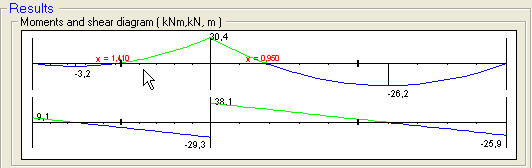
Attached is a moment and shear diagram (ignore the numerical values). The upper diagram shows the moment, which describes the pressure and tensile forces in the beam. Where it is green, there is tension at the top; where it is blue, there is pressure at the top. As can be seen, there is a point 0.95m in where you have neither pressure nor tension. A suitable place to carve! The location can change somewhat depending on the material and distribution of loads, but it is not so critical in your case.
You also need to check that there is no risk of shear failure at the point where you carve. You reduce the shear capacity to about 210/220 = 95%. Looking 0.95m into the shear diagram (lower), you can see that the shear force is perhaps 70% of the maximum = ok. In fact, you should also check the deflection, but I dare to promise that you will not notice any difference. In summary: Where you have high moments AND shear forces (= over the central bearing line), you should not reduce the height of the beam without doing a more detailed calculation. It also seems unnecessary to place the pipes in the middle of the span — admittedly, the shear force is low there, but the moment is high.
Attached is a moment and shear diagram (ignore the numerical values). The upper diagram shows the moment, which describes the pressure and tensile forces in the beam. Where it is green, there is tension at the top; where it is blue, there is pressure at the top. As can be seen, there is a point 0.95m in where you have neither pressure nor tension. A suitable place to carve! The location can change somewhat depending on the material and distribution of loads, but it is not so critical in your case.
You also need to check that there is no risk of shear failure at the point where you carve. You reduce the shear capacity to about 210/220 = 95%. Looking 0.95m into the shear diagram (lower), you can see that the shear force is perhaps 70% of the maximum = ok. In fact, you should also check the deflection, but I dare to promise that you will not notice any difference. In summary: Where you have high moments AND shear forces (= over the central bearing line), you should not reduce the height of the beam without doing a more detailed calculation. It also seems unnecessary to place the pipes in the middle of the span — admittedly, the shear force is low there, but the moment is high.
Thanks for the nice diagrams,
a question, you write:
"Where you have high moments AND shear forces (= above the mid-beam) you should not reduce the height of the beam without making a more detailed calculation."
How high is High? i.e. let's say I want to move the "notch" closer to the mid-beam, so it ends up about 65-70 cm from the mid-support. Will the shear forces be too high then? Or is it about staying under 95% (210/220) to be safe? I would then indeed get tensile forces at the top of the beam, but not so large...
Perhaps I should reinforce the floor beam with 50 cm long Laskar of 21x120 on both sides of the beam right at the point where I carve a notch? Should strengthen the construction, right?
a question, you write:
"Where you have high moments AND shear forces (= above the mid-beam) you should not reduce the height of the beam without making a more detailed calculation."
How high is High? i.e. let's say I want to move the "notch" closer to the mid-beam, so it ends up about 65-70 cm from the mid-support. Will the shear forces be too high then? Or is it about staying under 95% (210/220) to be safe? I would then indeed get tensile forces at the top of the beam, but not so large...
Perhaps I should reinforce the floor beam with 50 cm long Laskar of 21x120 on both sides of the beam right at the point where I carve a notch? Should strengthen the construction, right?
The shear forces increase slightly but probably won't be too high. However, you'll get both tension and compression on the top and bottom at the same time (see the moment diagram). These forces need to be considered simultaneously. If I were to guess, I think you can safely place the pipes 65-70mm from the support. You can probably place them directly above the support as well, considering the safety margins that exist + I find it hard to believe that the beams are currently designed to be utilized to 100%. If you're concerned, you can screw on a couple of laths. Place them at the bottom of the beam (so it looks like an upside-down T in section).
The further from the section's center of gravity you place the reinforcement, the more beneficial it is. That is why an I-beam looks the way it does. If it's difficult to access the underside, place them high just below the pipes. Avoid placing them in the middle.