
3,554 views ·
14 replies
4k views
14 replies
Help with roof trusses and tearing down a wall.
Electronics enthusiast
· hudiksvall
· 176 posts
We live in a single-story house with an angle from Hudikhus. I currently want to demolish a wall that sits in the middle of the house, but I would need some tips and advice from others. I'm a carpenter myself as well.
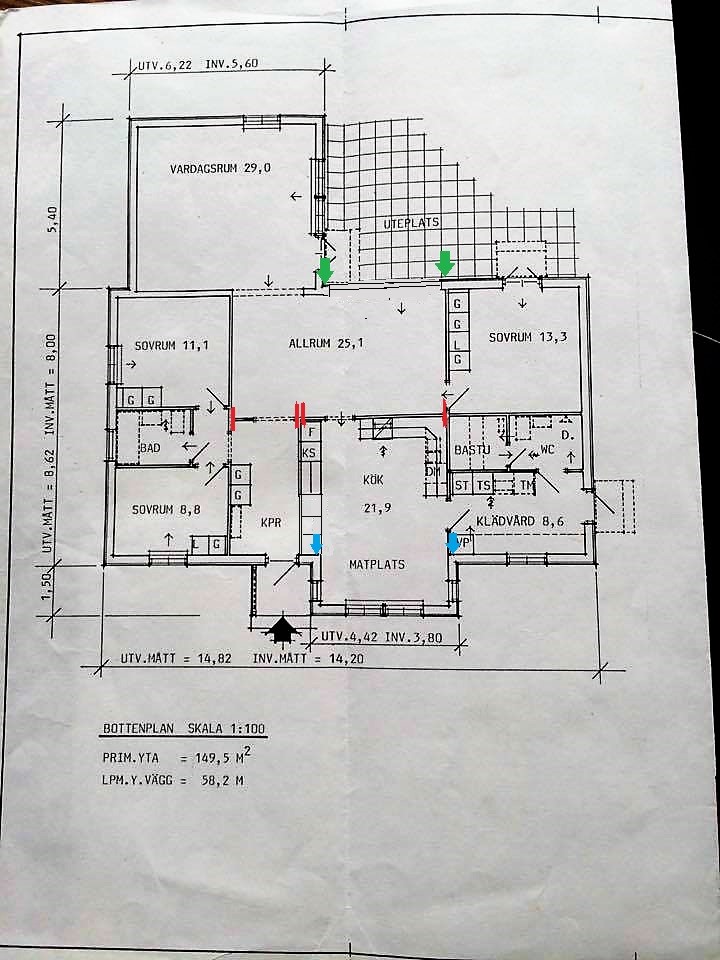
I have drawn on the picture I have inserted. It's the wall between the kitchen and the dining room, as well as kpr and the dining room that I want to remove. The red part that I have drawn needs to go.
On the bay window in the kitchen where I drew blue arrows, there is a C-beam that is 300x100 and with a thickness of 13 mm. Where I drew the green arrows, I have installed a glulam beam above a window section that is 315x140.
I have also inserted an image of what the rafters look like, and it does feel like these rafters are self-supporting, right? Because if the rafters are self-supporting, I don't think there will be any problem at all for the beams to support it.
Any tips and advice are appreciated!
I have drawn on the picture I have inserted. It's the wall between the kitchen and the dining room, as well as kpr and the dining room that I want to remove. The red part that I have drawn needs to go.
On the bay window in the kitchen where I drew blue arrows, there is a C-beam that is 300x100 and with a thickness of 13 mm. Where I drew the green arrows, I have installed a glulam beam above a window section that is 315x140.
I have also inserted an image of what the rafters look like, and it does feel like these rafters are self-supporting, right? Because if the rafters are self-supporting, I don't think there will be any problem at all for the beams to support it.
Any tips and advice are appreciated!
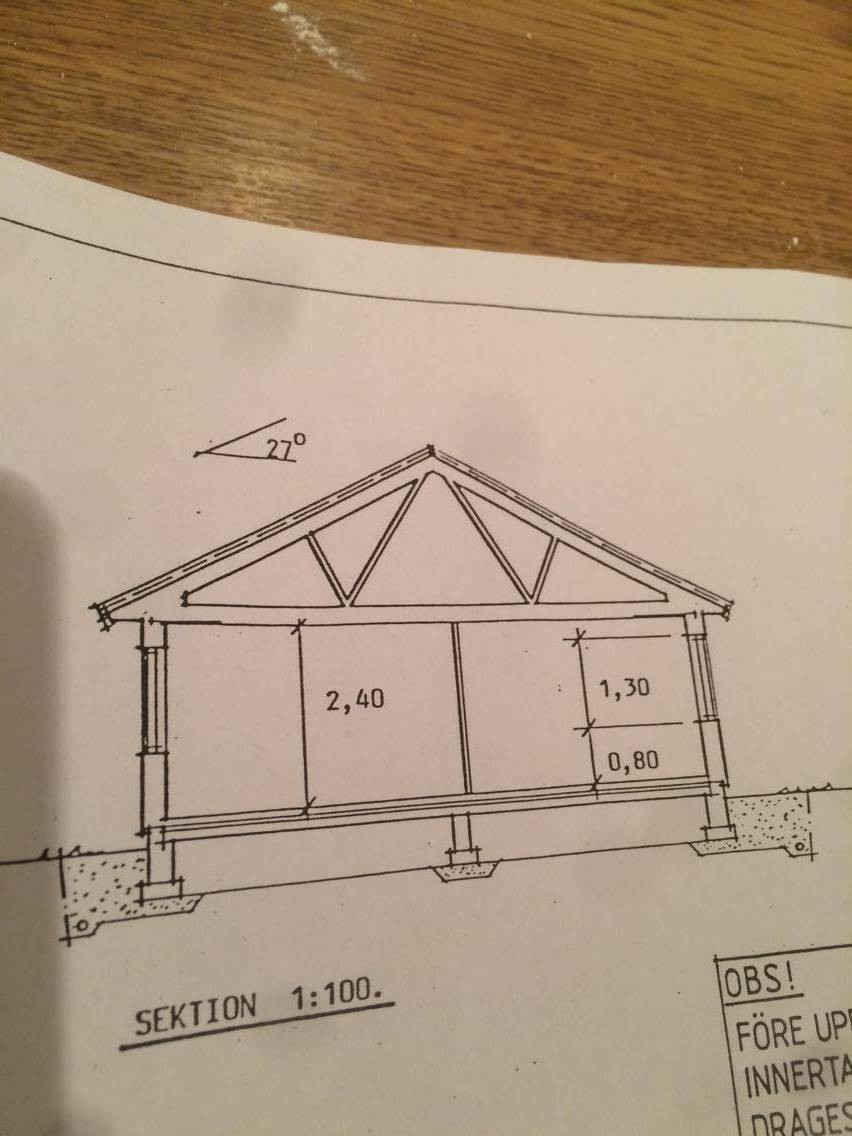

No, they should not be load-bearing. To be safe, you can check the dimensions of the truss's components. Theoretically, one could have chosen a truss designed for a lower snow load. In your case, in snow zone 3 and with an 8 m span, the top chord should be 45x195 and the bottom chord 45x170. Other supports should be 45x145. Timber class C 24. All according to Träguiden's table for W-truss 27 degrees.
Electronics enthusiast
· hudiksvall
· 176 posts
Okay, thanks for the answer! I'll check when I get home. But I remember that the bottom and top chords are larger in dimension anyway.J justusandersson said:No, they should not be load-bearing. To be sure, you can check the dimensions of the roof truss parts. In theory, it is possible to have chosen a roof truss intended for a lower snow load. In your case, in snow zone 3 with an 8 m span, the top chord should be 45x195 and the bottom chord 45x170. Other supports should be 45x145. Timber class C 24. All according to Träguiden's table for W-takstol 27 degrees.
Electronics enthusiast
· hudiksvall
· 176 posts
Hmm the top chord is 45x195 The bottom chord is 45x220 One of the supports furthest out towards the wall is 45x120 and the inner support is 45x70. What do you think about this?J justusandersson said:No, they shouldn't be load-bearing. To be sure, you can check the dimensions of the truss parts. Theoretically, one could have chosen a truss intended for a lower snow load. In your case, in snow zone 3 and with an 8 m span, the top chord should be 45x195 and the bottom chord 45x170. Other supports should be 45x145. Timber class C 24. All according to the Wood Guide's table for W-truss 27 degrees.
It is quite complicated to calculate on truss constructions. The struts are subjected to compression and tensile forces, so they don't need to be very strong. The difference between a meter-long 45x120 and a 45x145 subjected to compression is quite negligible. 45x70 is surprisingly weak in that situation, but it will certainly hold.
Electronics enthusiast
· hudiksvall
· 176 posts
Yeah, that's true, and I agree that 45x70 feels a bit weak. HmmJ justusandersson said:It's quite complicated to calculate on truss constructions. The supports are exposed to compressive and tensile forces so they don't need to be very strong. The difference between a meter-long 45x120 and a 45x145 exposed to pressure is quite negligible. 45x70 is surprisingly weak in that situation, but it surely holds.
Electronics enthusiast
· hudiksvall
· 176 posts
It should be possible to reinforce the studs with about 45x95 and nail plates, really?J justusandersson said:It is quite complicated to calculate on truss constructions. The support legs are subject to compressive and tensile forces, so they do not need to be very strong. The difference between a one-meter-long 45x120 and a 45x145 subjected to compression is quite negligible. 45x70 is surprisingly weak in that situation, but it will surely hold.
Absolutely.
Electronics enthusiast
· hudiksvall
· 176 posts
Anyone here who can calculate roof trusses? Or is there some program for it? It must be quite simple as long as you have the formula.

The braces, which were 45x70, are primarily subjected to tensile forces, and in such cases, the cross-sectional area is significant. If you screw two 23x95 boards on either side of the existing brace, as well as to the upper and lower frames, the result will be even better than a 45x145. Use wood quality C 24. You do not need to calculate the other parts.
Electronics enthusiast
· hudiksvall
· 176 posts
Okay. That sounds much simpler than sawing in 45x95 and a lot of nail plates! Okay, so you also think I should screw it to the top and bottom rails, then? On the bottom rails, I'll have to splice it similarly to the top. Where should I splice, then? I could also glue as well; that should reinforce it a lot!J justusandersson said:The brace that was 45x70 is primarily exposed to tensile forces, and it is the cross-sectional area that matters. If you screw two 23x95 boards on either side of the existing brace, as well as on the upper and lower frames, the result will be even better than a 45x145. Use wood quality C 24. You don't need to calculate the other parts.
I don't know exactly how it looks on your roof trusses. But the new boards should be a bit longer than the existing braces, so you can screw into both the upper and lower frames. Since the load is tensile force, you don't need to glue. This is important in the case of compression and bending.
Electronics enthusiast
· hudiksvall
· 176 posts
Oh, so you mean just the ones I screw into the diagonal braces should be longer so I can screw them into the upper and lower beams?J justusandersson said:
Yes, and in the existing stage.
Click here to reply