
Hello!
I live in a detached house built in 1939 and I plan to remove a wall that separates the kitchen from the living room. On the blueprint, the wall is "dashed" (perhaps it was optional during the construction of the house?) and there is a wall that separates the kitchen from the dining nook. That wall has been removed several years ago and the kitchen has been extended into the dining nook.
My question is how should I interpret the blueprint? I do not perceive the wall between the kitchen and the living room as load-bearing, so can I remove the wall without support?
I live in a detached house built in 1939 and I plan to remove a wall that separates the kitchen from the living room. On the blueprint, the wall is "dashed" (perhaps it was optional during the construction of the house?) and there is a wall that separates the kitchen from the dining nook. That wall has been removed several years ago and the kitchen has been extended into the dining nook.
My question is how should I interpret the blueprint? I do not perceive the wall between the kitchen and the living room as load-bearing, so can I remove the wall without support?
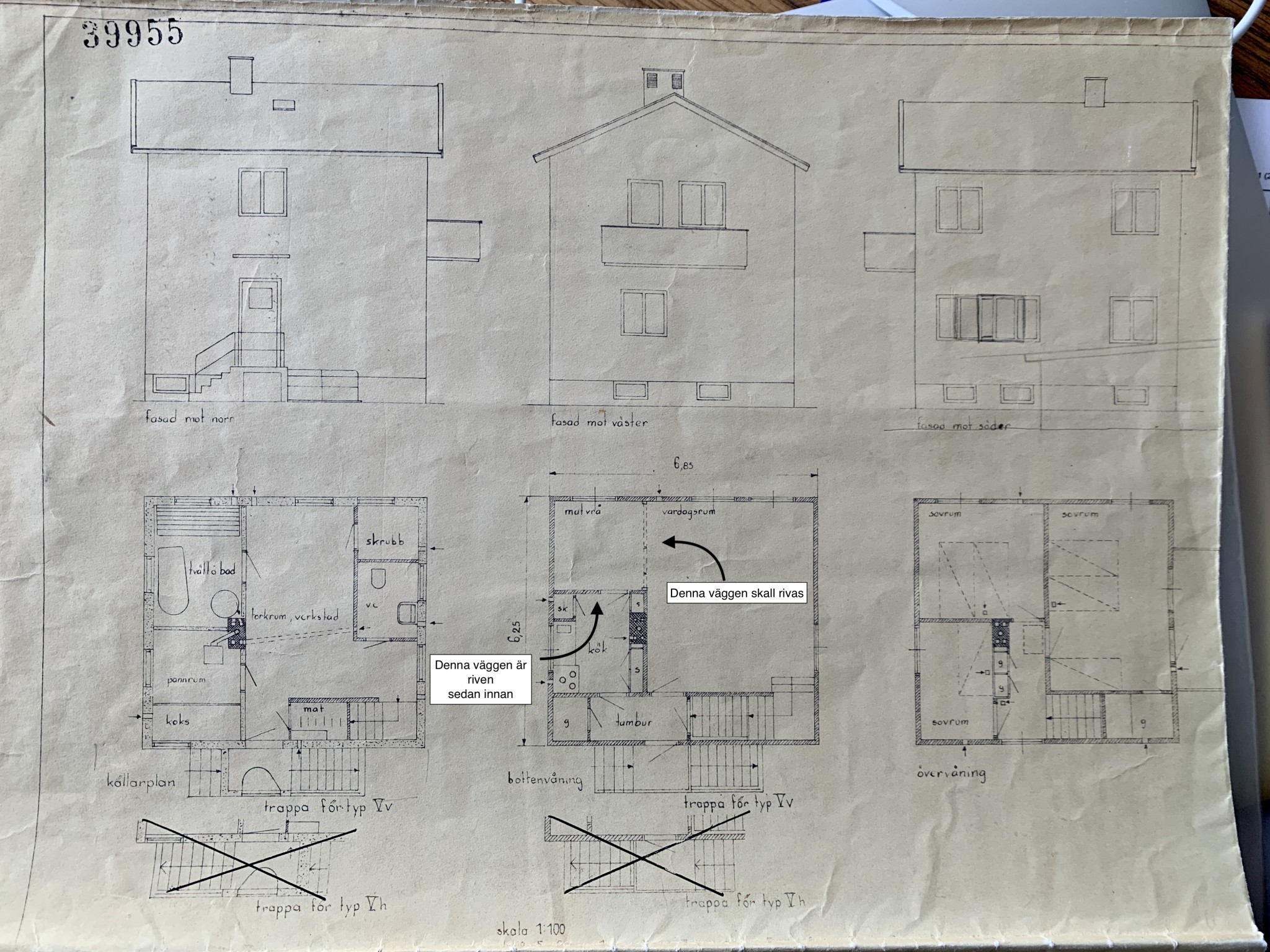

Hi, my guess is that the wall you want to tear down might be load-bearing. Alternatively, there might be a beam embedded in the wall. I think that depending on the direction of the floor joists, the span would be too long if there is nothing load-bearing there.
If I looked at the drawing without any comment from you, I would interpret it as if there's a beam there.
If I looked at the drawing without any comment from you, I would interpret it as if there's a beam there.

I don't think the wall you want to demolish is load-bearing. The only load-bearing interior walls are probably the walls that border the stairwells. This was possible because the house is quite narrow, and they accepted much more flexibility back when the house was built. The fact that the wall is dashed suggests it might be an early catalog house, for example, from Svenska Trähus in Tranås. I say think because you can never know for sure with houses from that time. A good idea is to do as @Takstolsnissen suggests and check the direction of the floor joists. The house has a plank frame.
Thank you for the answers!
On the upper floor, the floorboards have their short ends positioned in the direction along the kitchen (on the drawing, from the dining nook towards the kitchen). This might not necessarily mean that the floor joists run across and go in the direction of the dining nook-living room, but I guess the probability is quite high that they do. Or?
I also took a closer look at the drawing, and it actually looks like there are two drawn-in... well, pillars/supports or something like that at either end of the wall I was planning to demolish. Maybe there's a beam in the wall that's supported by these, which in turn supports cross-running floor joists? I'll have to open it up and check!
On the upper floor, the floorboards have their short ends positioned in the direction along the kitchen (on the drawing, from the dining nook towards the kitchen). This might not necessarily mean that the floor joists run across and go in the direction of the dining nook-living room, but I guess the probability is quite high that they do. Or?
I also took a closer look at the drawing, and it actually looks like there are two drawn-in... well, pillars/supports or something like that at either end of the wall I was planning to demolish. Maybe there's a beam in the wall that's supported by these, which in turn supports cross-running floor joists? I'll have to open it up and check!
The troublesome thing with this type of house is that the floor joists can have different directions on the same floor! With the information you have gathered, everything indicates that the wall is load-bearing. The hatching on the drawing could mean that there is a beam there.
Click here to reply