
Hello,
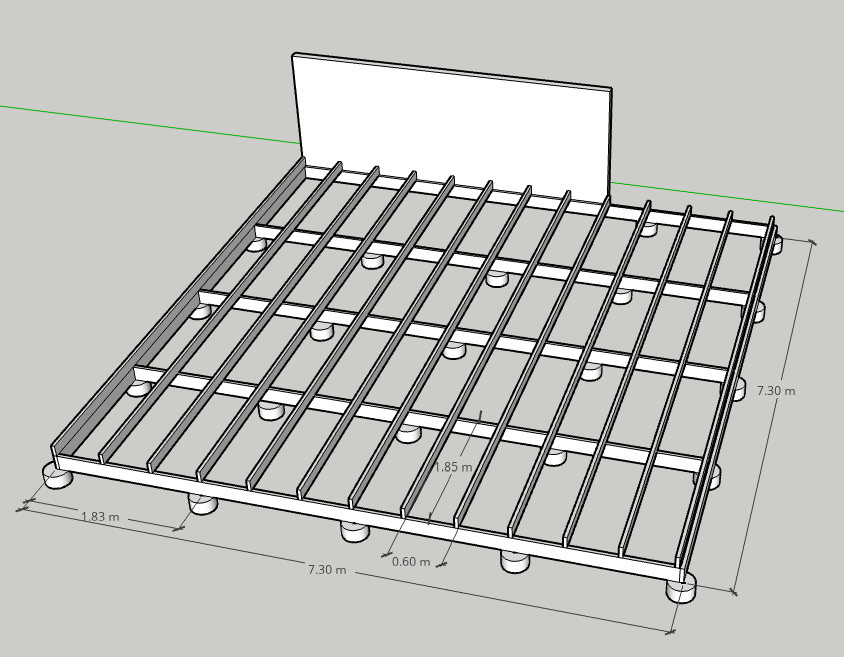
We are in the process of planning this summer's deck construction and are currently sketching the structural drawing. We are also wavering between building 7300 x 7300 mm or 11300 x 7300 mm, but regardless of the final size, it seems that the design principle will be relatively similar, so we have only sketched the 7.3 x 7.3 m version.
Proposed materials and dimensions for the timber are as follows:
Concrete piers with adjustable post shoes
Beams - 45 x 195 mm C24
Joists - 45 x 145 mm C24
Decking, edge boards, and trim - 34 x 145 mm
The ground where we intend to place the deck is also somewhat sloped, so we may need to use 95 x 95 posts in some of the piers at the far end to raise the beams and level the deck. Could this have any noticeable/negative impact on load-bearing capacity? Additionally, the deck will be built at an angle to the house where we have the opportunity to attach one of the beams directly to the facade, hence no piers under that section of the beam.
So to the big question:
What do you think about the construction in the picture with the wood dimensions specified above? For example, are the distances between the piers sufficient given these dimensions? If we were to choose the slightly longer option, the plan is just to add more rows of piers and beams with similar distances. And do you think using posts to raise parts of the deck might negatively affect load-bearing capacity in any way?
I am incredibly thankful for any thoughts/input regarding the construction in the picture, as well as any help with calculations, etc.
We are in the process of planning this summer's deck construction and are currently sketching the structural drawing. We are also wavering between building 7300 x 7300 mm or 11300 x 7300 mm, but regardless of the final size, it seems that the design principle will be relatively similar, so we have only sketched the 7.3 x 7.3 m version.
Proposed materials and dimensions for the timber are as follows:
Concrete piers with adjustable post shoes
Beams - 45 x 195 mm C24
Joists - 45 x 145 mm C24
Decking, edge boards, and trim - 34 x 145 mm
The ground where we intend to place the deck is also somewhat sloped, so we may need to use 95 x 95 posts in some of the piers at the far end to raise the beams and level the deck. Could this have any noticeable/negative impact on load-bearing capacity? Additionally, the deck will be built at an angle to the house where we have the opportunity to attach one of the beams directly to the facade, hence no piers under that section of the beam.
So to the big question:
What do you think about the construction in the picture with the wood dimensions specified above? For example, are the distances between the piers sufficient given these dimensions? If we were to choose the slightly longer option, the plan is just to add more rows of piers and beams with similar distances. And do you think using posts to raise parts of the deck might negatively affect load-bearing capacity in any way?
I am incredibly thankful for any thoughts/input regarding the construction in the picture, as well as any help with calculations, etc.
It looks good. The posts should not affect the load-bearing capacity if done correctly. I would have chosen to make the posts out of double 4x95 instead because I think it is. Don't forget to draw in double joists for the fris if you're going to have it.
Nice! One tip is to move the outermost rows of plintar in a bit so the placement isn't as precise. And the plintar won't be visible from the outside either.
With those plinth distances, you can have floor joists at 45x120 and support beams at 45x145 if you want to save money and reduce construction height.davidzet said:
Hello,
We are in the process of planning this summer's deck construction and are currently sketching the construction drawings. We are also wavering between building 7300 x 7300 mm or 11300 x 7300 mm, but regardless of the final size, it feels like the design principles will be relatively similar, so we have only sketched the 7.3 x 7.3 m variant.
Planned materials and dimensions of the timber are:
Concrete plinths with adjustable post bases
Support beams - 45 x 195 mm C24
Screw joists - 45 x 145 mm C24
Decking, fascia, and skirting - 34 x 145 mm
The ground where we plan to place the deck also slopes a bit, so we may need to use 95 x 95 posts in some of the plinths on the far end to raise the support beams and level the deck. Could this have any noticeable/negative impact on the load-bearing capacity? Furthermore, the deck is being built at an angle against the house where we have the option to attach one of the support beams directly to the facade, hence no plinths under that part of the beam.
So to the big question:
What do you think about the construction in the image with the aforementioned timber dimensions? Are the distances between the plinths sufficient given the dimensions? If we choose the slightly longer option, the plan is just to add more rows of plinths and support beams at similar distances. And do you think the use of posts to raise parts of the deck in any way negatively affects the load-bearing capacity?
I am incredibly grateful for any thoughts/input on the construction in the image as well as any help with calculations, etc.
Thanks a lot for the response, it's great to hear that it doesn't affect the load-bearing capacity. What do you mean by posts with double 45x95? Would you screw them together into posts before installation?maah said:
That's a very good tip! I hadn't thought of that at all. There is really no reason to place them at the very edge. Thank you so much!Aron Roger said:
Is there any risk of it flexing then? We have tried to account for materials properly to ensure it feels robust. The plan is also to dig out closer to the house where the ground is higher, so we won't need to elevate it as much at the end where the ground is lower. Saving building height would therefore be nice to avoid quite as much digging work.K Kane said:
Those dimensions are based on a snow load of 250 kg/m2.There is no risk of it sagging then? We've tried to choose the materials properly to ensure it feels robust. The idea is also to dig out next to the house where the ground is a bit higher, so we avoid raising it too much on the end where the ground is a bit lower. Saving building height would be nice to avoid quite as much excavation work.
Click here to reply