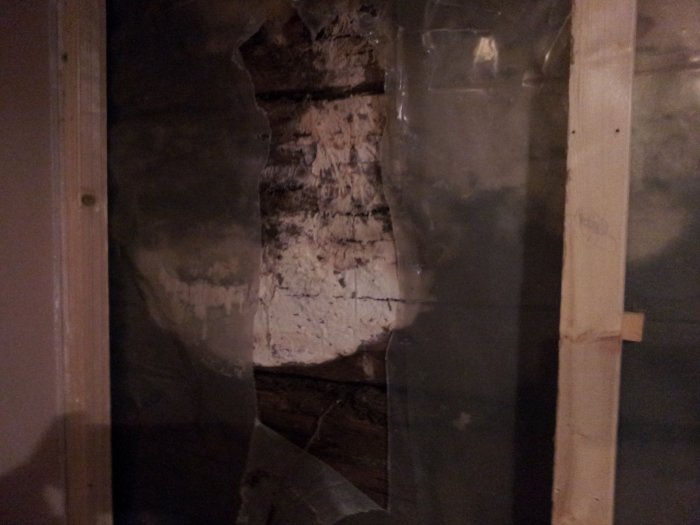
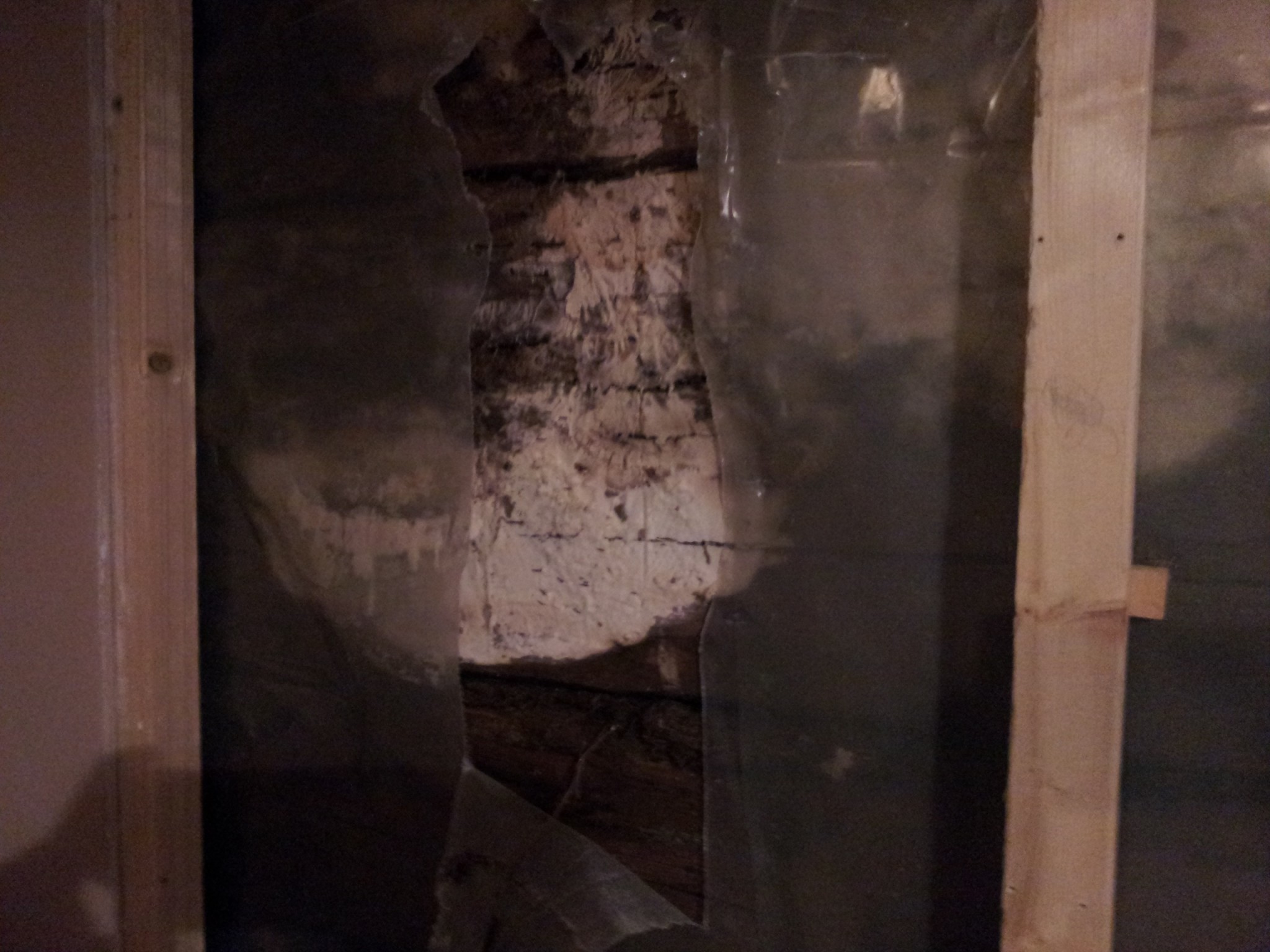
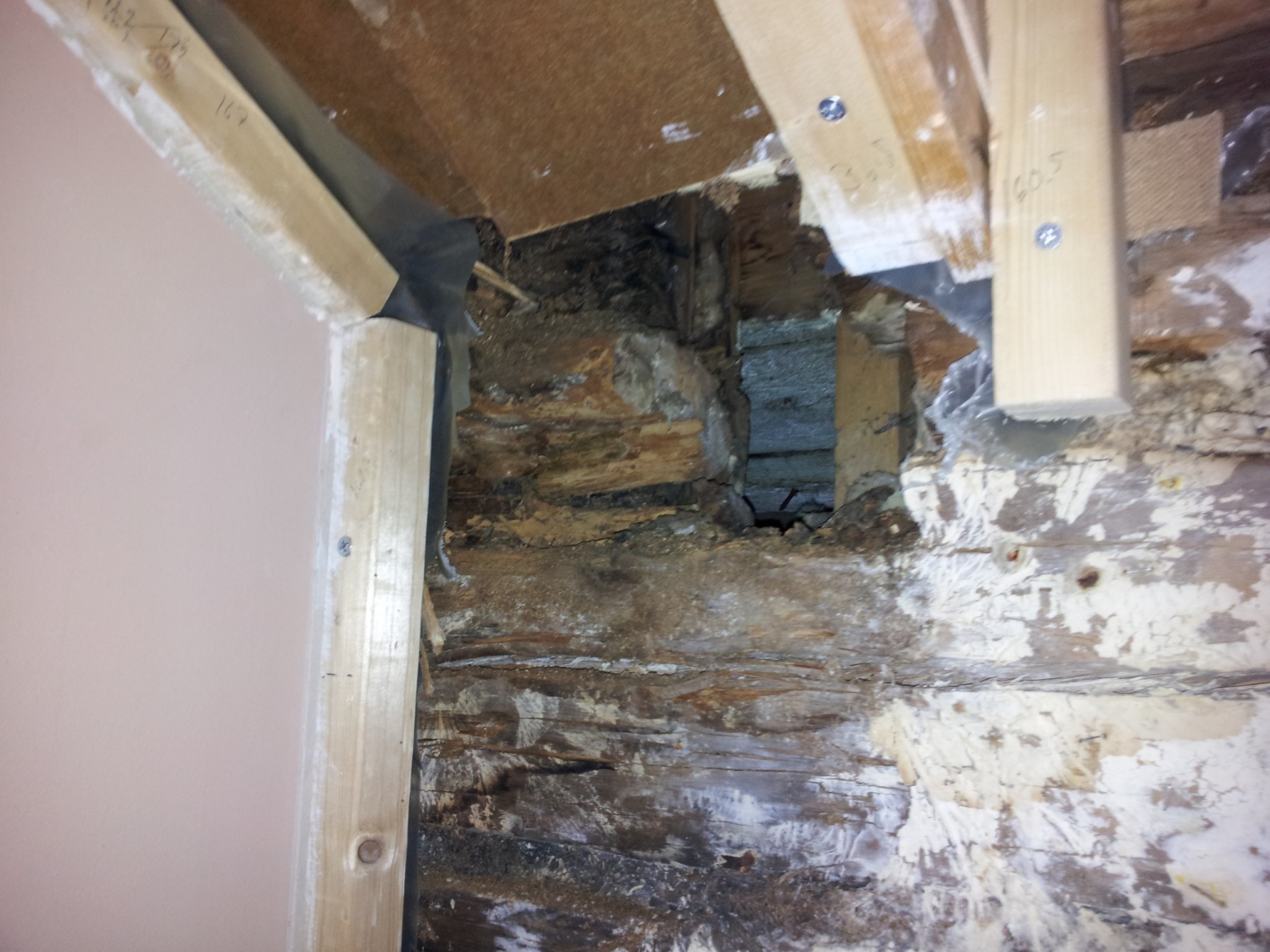
We are a family with marginal finances due to sick leave, and today when I was fixing and putting new inner covering on a wall upstairs, I exposed the logs in the wall. These were water-damaged and very porous and must be replaced somehow. We know where the moisture comes from, and this will be addressed, but what do we do about the bad logs?
Can we just cut away the damaged ones and put new ones there?
How do I ensure the stability so that the roof doesn’t sag during the work?
And how do I attach the new logs to each other and to the "old" wall to make it durable?
Found pressure-treated logs that seem to be OK from a company, but I want more technical advice on how to best install the new ones.
A little hard to see in the pictures, but is it horizontal planks?
You don't need to replace it with exactly how it looks now if you're not into historic building preservation.
I would frame it with vertical studs and cut away the damaged wood.
Tip 1: Skip the plastic in old houses, use wind barrier film instead.
Saw a program with "arga snickaren" where a house with rotten logs near the roof was replaced. So replacing logs shouldn't be a problem, just make sure to support upwards when a wall is torn down.
If only the outside is rotten, you can replace parts of the log, using a chainsaw, axe, chisel, and splice in a new piece.
Exactly how are existing logs and new pieces joined together?
Real timber (150 and 200 mm wide) can be found at some building merchants. Woody had it in this area. I recall it costing around 100 SEK per meter. You can cut off the rotten logs and insert new ones by nailing them in place. I find it a bit tricky to replace timber if you're not familiar with it, but the carpenter did it exceptionally fast. (A building conservator wouldn't likely approve of using nails instead of dowels, but that's another story)
The "syll" is, by the way, the beam at the very bottom of the house. The only difference from the other beams is that the syll always rots, while the others only rot occasionally.
As a consolation, I don't believe there is any reason to panic. There are plenty of houses with a few rotten logs that are perfectly livable.
I removed what was bad and built up with new where needed. In another place where the log was rotten all the way through, I removed the bad part and filled up with 2x4".
In a house with horizontal logs, the load is distributed over relatively large areas, so I don't think it matters if a part doesn't have full bearing capacity.
As for tools, the reciprocating saw was very helpful.
Hello!
Sorry to hear you've had problems like this. As far as I can see from the pictures (and that's a factor of uncertainty), it looks like dry rot. This means you should probably start by calling your insurance company and ask them to take a look at it. A leak that causes water to run between a plastic and a timber wall (or another wooden wall) provides a very good breeding ground for dry rot, mold, and other unpleasant things you don't want.
What needs to be done is to roughly strip the timber wall and see how extensive the damage is. It could be anything from what you see now and just a little more to as much as can be imagined. There's hardly any middle ground either where you do a little and hope it will work, it needs to be addressed directly. An indication of how big the problem could be is if you know how long the leak and the plastic have been there. The smell should also reveal what's going on. Active dry rot smells like fungus.
If it's the case that quite a lot needs to be replaced, there's also the option of replacing the timber with studs if there aren't the means to replace it with logs. It's a sad alternative, but better than, for example, removing too little in the hope of doing it cheaper.
As others have written - Do not use pressure-treated wood indoors, it will start to smell.
Then it looks like you have white mold where it's damp, which can be mitigated with good ventilation.
But if you suspect mold, check your home insurance and then call Anticimex..
But check your insurance!!!
Hello everyone.
Thank you for your responses. It feels really good that you want to give me/us tips on how we can proceed.
Leaning towards removing the damaged part of the timber wall, (bring out the chainsaw and buzz) then setting up studs.
It doesn't seem to be more damaged than an area of about 3 meters affected, so away with it.
The previous owner had placed plastic directly against the logs, and that has resulted in the current situation, unfortunately.
I will definitely use weather-resistant foil instead, and absolutely not pressure-treated wood, I PROMISE
What I’m thinking
1: remove all the damaged timber
2: install new studs as replacements. Question here? Should I place weather-resistant foil outward, meaning as far out towards the exterior wall as I can, insulate between the studs, place new weather-resistant foil then gypsum? Or what do you recommend as a moisture barrier between the inner wall and insulation so that indoor moisture doesn't migrate out? Or as it seems, could good diffusion be positive as it allows the house to "breathe"?
Oh, how grateful I am that you are getting involved, you are all so sweet.
Take care for now, the thread will probably continue for a little while longer.
Thankful hugs to you all.
Jennie
When we build timber frame houses today, we construct in the following order, from the inside to the outside.
Plasterboard-rough sheathing-45*45(extra insulation)45*195(frame)-exterior plasterboard(instead of wind paper)-nailing battens-panel.
On the latest house, we added another 45*45(insulation) between the frame and the exterior plasterboard.
At another customer's request, we used both wind paper and exterior plasterboard as the customer wanted both belt and braces..