Planning to remove a load-bearing wall of 6m in a one and a half story house...
I have measurements for a glulam beam 115x630 that could work, but it's not an option since the ceiling height is 240, and I would bump my head every time I pass.
Now for the problem, according to the guy who designed the house, the steel beam should handle at least 8kn/m to be on the safe side, suggesting calculating for 10kn/m. The local steel supplier calculated this with some information about the house and came up with an HEA beam of 400mm!!! Necessary? It's gigantic and weighs 750kg. There are "rule of thumb tables" online, and according to them, a 115x630 glulam corresponds to an HEA 240, not a 400...
Correct me if I'm wrong, but it sounds like a lot? If there was a structural engineer up here in the forest, I would hire one, but there isn't...
So if anyone experienced can do a bit of calculating or suggest a structural engineer via phone, it would be great.
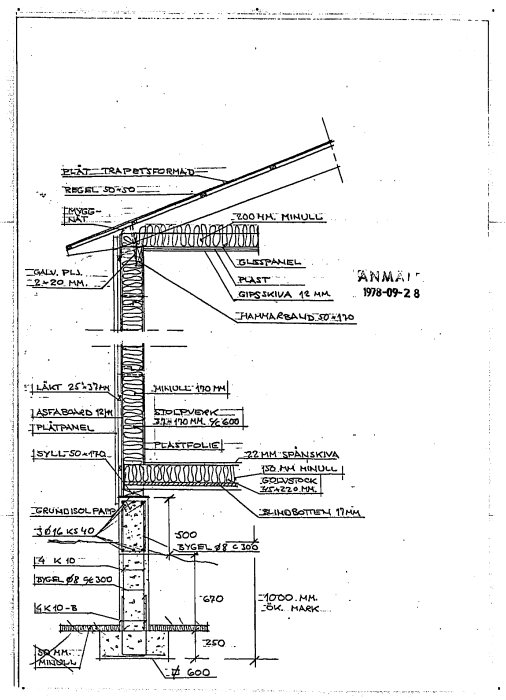
House width: 9200mm
Roof pitch: 38 degrees
Load-bearing wall: 6m
Distance between rafters: 1200
Living in Arvidsjaur, so there's about a meter of snow on the roof in winter.
Assuming that "the guy who designed the house" knew what he was doing and you therefore have about 6 tons of distributed load (10kn/m), an HEA220 will suffice.
I have then dimensioned against deflection, which I set to a maximum of 15mm (span/400), meaning the beam can handle significantly more load before plasticizing.
However, note that this calculation is entirely based on the figure of 10kn/m; if that is not correct, then neither is my conclusion.
The measurement sounds completely unreasonable. However, I am not a designer.
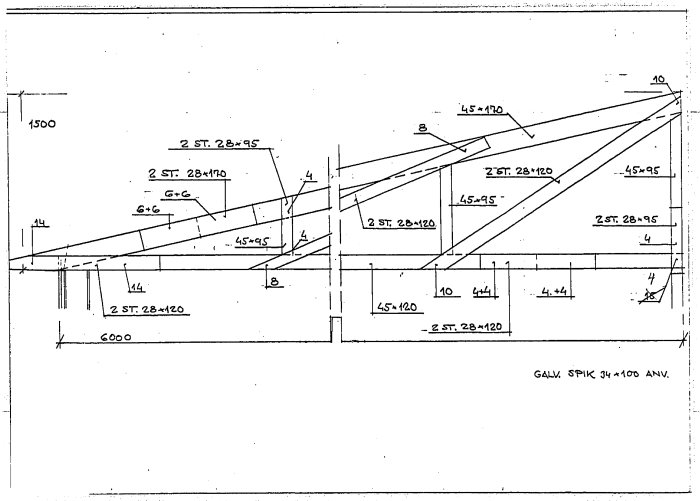
But what does it look like? You're writing about snow loads, etc. But usually, that is transferred down to the outer walls via the roof trusses. Is your construction such that the beam really has to take some of the snow load as well?
We have a steel beam in the intermediate floor (2-story house), in an extended part that is about 5 x 8m. The beam has a span of about 5m and supports a load from 4m of floor each way.
In our case, it's an HEA 180 beam.
Now, we actually have two beams that are spaced about 2m apart. But that's due to a staircase that comes up just where the beam would have gone. Originally, there was a beam drawn in. It was changed to one on each side of the staircase, but the dimension wasn't changed.
You, on the other hand, have a slightly longer span and a greater width which gives more load on the beam. So you might need a little more than an HEA180. And IF the load from the outer roof actually comes down on this beam, then you might need considerably more. But in that case, even the heavy glue-laminated beam is probably too weak.
We have a glue-laminated beam in the ridge of the expansion in question. If I remember correctly, it is 470mm high (5m long). But as I said, this is in Stockholm, less snow load. And slightly less span than in your case.
Thanks for the quick response! Yes, I trust the pensioner. Absolute minimum 8kn/m but it feels safer to over-dimension a notch since we are building to withstand all our snow... Let's say I go for a 220/240, is it possible to set wood at each end or is steel required down to the concrete? I've been in contact with different people and everyone says differently...
I also found it so unreasonable, which is why I had to research it further. If I'm going to install a 400, I'll have to find other solutions instead.
As you say, of course, the outer walls take up the weight from the snow; the beam (the wall) doesn't take it all by itself.
Thanks for the quick response! Yes, I trust the pensioner. Absolute minimum 8kn/m but it feels safer to oversize a notch since we are building to withstand all our snow.. Let's say I go with a 220/240, is it possible to put wood on each end or does it have to be steel down to the concrete? I've been in contact with different people and everyone says something different..
I would install steel pillars (but then again, I am a mechanical engineer) but it works with wood too, as long as it's properly sized. But keep in mind that the concrete foundation should be able to handle up to 3 tons of load at each pillar as well.
I have a 5400 mm long HEA 200 beam that replaces the load-bearing wall over my living room/dining room, which runs across the entire house. The beam is located within the attic floor, and therefore is not visible.
The attic is mostly used for storage with bookshelves and other "junk," and is simply furnished. However, it all feels very stable.
The trusses have a span of 8400 mm to the outer edge of the exterior walls.
Regarding the concrete slab, the information from the 80s was uncertain if they were 6-7cm or 10cm thick. In any case, I was planning to place a proper steel plate underneath to minimize the point pressure that will occur.
I actually didn't think much more about it, but what can a concrete slab withstand?
6 meters span and 10 kN/m in line load gives you a HEA220, which results in a 15 mm deflection.
If you can accept a 22 mm deflection, a HEA200 will suffice.
Hello
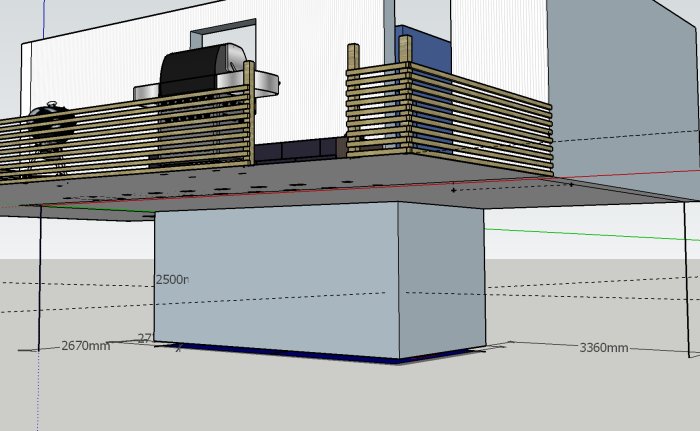
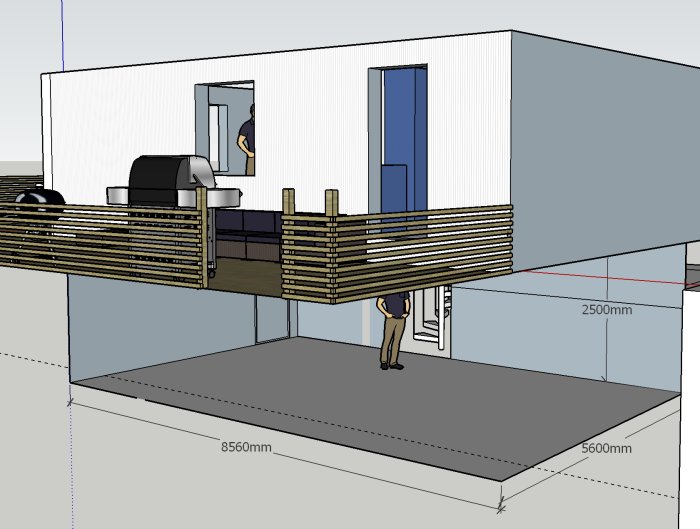
I am sitting and trying to figure out which beam I need in my basement that is going to be excavated.
There are many things to keep track of after reading here and in other threads.
Anyone with experience who can help me in the right direction?
The beam will be almost 9 meters long.
The beam will sit where the partition wall (the long side to be removed) is currently supporting the upper floor:
Before:
In order to answer this, you will need some drawings of the house and information on where in the country the house is located to calculate the loads affecting the beam. Generally, 9m is very long for a simply supported beam, which will result in it being very tall. You should consider placing some pillar under the beam.
Yes, it will be a long beam. 9 meters is a long span.
It would be a shame if a pillar had to be placed in the middle, part of the hope was to be able to play ping pong in the basement.
The house is located in Stockholm.
In the room above the basement, there is a kitchen and a sofa group.
No load-bearing walls.