
11,212 views ·
28 replies
11k views
28 replies
Help; reinforce stud or use steel beam?
Hello, I'm thinking about building my own rolling pool cover (outdoors). I'll have load-bearing beams over the pool with decking on top. I want the cover to be as low as possible, but the load-bearing beams need to span about 310cm. I see that 195mm timber beams span exactly 310cm in a span table for decking, but the construction height then becomes too high (195mm beams + 28mm decking + 20mm space under the beams to be able to roll away the cover = 243mm), as I need it to be under 200mm, but preferably as low as possible.
I see two possibilities: (1) use a galvanized steel beam instead of a timber beam, or (2) use a slimmer beam like 145mm and reinforce it with something like a metal plate. The questions to this forum would be: (1) what format and dimension of steel beam would correspond to a 195x45 timber beam? And (2) how do I reinforce a 145x45 beam so that the deflection matches a 195x45? There is also question (3): does anyone have any other good suggestions?
I see two possibilities: (1) use a galvanized steel beam instead of a timber beam, or (2) use a slimmer beam like 145mm and reinforce it with something like a metal plate. The questions to this forum would be: (1) what format and dimension of steel beam would correspond to a 195x45 timber beam? And (2) how do I reinforce a 145x45 beam so that the deflection matches a 195x45? There is also question (3): does anyone have any other good suggestions?


Difficult to have any opinions without knowing more about the conditions. What does it look like around?
I find it hard to see how you could avoid using steel beams. You might also consider the height. If there are conditions to build a little higher, it doesn’t have to be bad because you can insulate more under the deck and reduce the pool's operating costs.
Regarding the span table, you must remember that your load-bearing beams also need support, so you probably need to go up even more in dimension on the wooden beams (or were you already accounting for that?). You also need to consider how you will stabilize the wooden deck while it moves. Which direction is the pool 310 cm in? How is it supposed to work?
I find it hard to see how you could avoid using steel beams. You might also consider the height. If there are conditions to build a little higher, it doesn’t have to be bad because you can insulate more under the deck and reduce the pool's operating costs.
Regarding the span table, you must remember that your load-bearing beams also need support, so you probably need to go up even more in dimension on the wooden beams (or were you already accounting for that?). You also need to consider how you will stabilize the wooden deck while it moves. Which direction is the pool 310 cm in? How is it supposed to work?
Okay, a bit more detail: The pool has internal dimensions of 300x600cm. The pool cover is intended to roll on aluminum tracks (u-profile 40x25mm) that rest along the pool on a concrete beam in the pool construction and outside the pool on wooden beams running under the track. Unfortunately, I need to keep the construction height under 20cm as the cover needs to roll under another decking segment and I have a 20cm height difference between different segments. Everything is under construction, so there is some flexibility, but I have an existing deck 60cm above the pool and therefore plan the step/height between segments to be 20cm. Insulation with 10cm of cellplast should be sufficient, I think, but I will naturally fill in as much as possible. I don't know what a "support" is, but I had planned for the beams to be attached to a frame of the same dimension to form a frame on which I will then place decking.
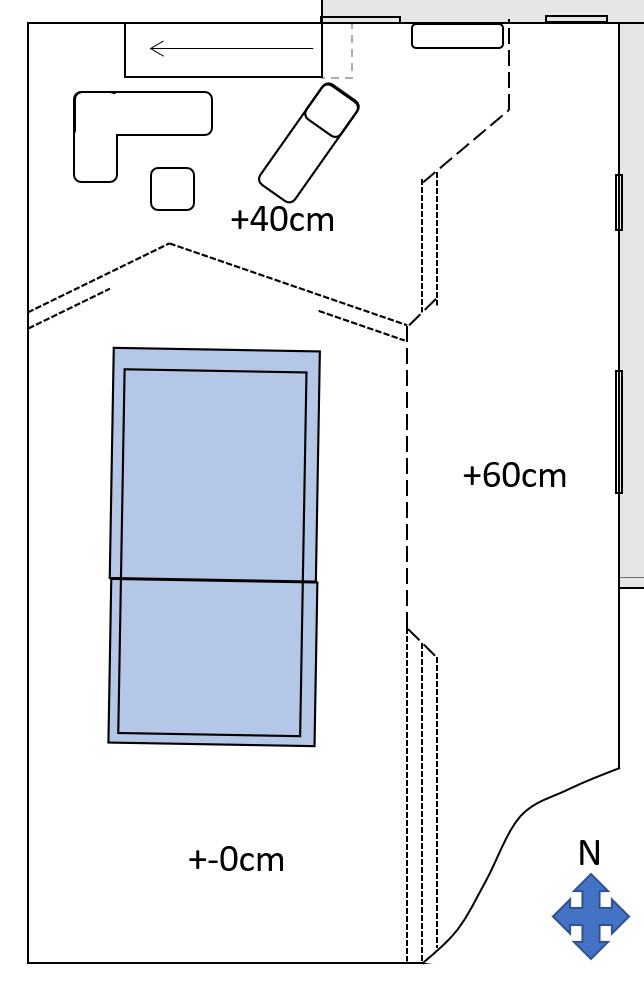
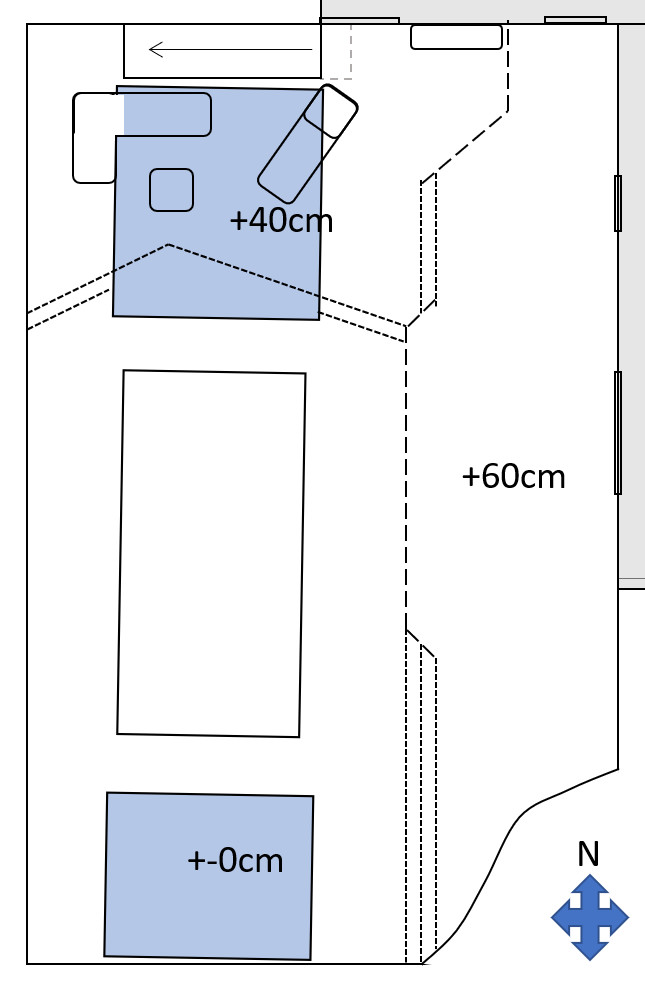
Attached are 2 images of how the entire area with decking and the pool is intended to look. In one image, the blue pool cover is over the pool and in the other, it is rolled away with half the cover going each way. The part that rolls north is rolled in under another decking segment. The height of each of the three segments is specified from the segment that is the lowest (around the pool).
Attached are 2 images of how the entire area with decking and the pool is intended to look. In one image, the blue pool cover is over the pool and in the other, it is rolled away with half the cover going each way. The part that rolls north is rolled in under another decking segment. The height of each of the three segments is specified from the segment that is the lowest (around the pool).
Fun question! The simplest way to compare beams of different materials is to look at the product of the moment of inertia and the modulus of elasticity. If you want to use steel instead of 45x195, you can either take an IPE 100 or a VKR 100x50x5. A 45x195 weighs about 13.6 kg, an IPE 100 about 25.1 kg, and a VKR 100x50x5 33.5 kg. An alternative solution is to make an I-beam out of wood by screwing and gluing two "flanges" of 22x120 timber onto a 45x120 stud. You can also make a box beam out of k-plywood, but in that case, you gain nothing in height. You can also take a laminated beam 115x315 of the homogeneous kind and split it in half.
Thanks for some concrete options. I'll check them out and do some calculations on them.J justusandersson said:Fun question! The simplest way to compare beams of different materials is to look at the product of the moment of inertia and the modulus of elasticity. If you want to use steel instead of 45x195, you can either choose an IPE 100 or a VKR 100x50x5. A 45x195 weighs approximately 13.6 kg, an IPE 100 about 25.1 kg, and a VKR 100x50x5 33.5 kg. An alternative solution is to make an I-beam of wood by screwing and gluing two "flanges" of 22x120 timber onto a 45x120 joist. You can also make a box beam of k-plywood, but in that case, you gain nothing in height. You can also take a 115x315 glulam beam of the homogeneous type and split it in half.
Another variant: Glue (polyurethane glue) and screw together 3 pieces of 22x170 boards of good quality. Although I don't have verified data on the modulus of elasticity for this, I know it becomes stiffer than regular glulam. It's difficult to manage that span with 145 mm height other than in steel.
Thanks for the numbers! Good to have for comparison. The weight of the roof shouldn't be too high, so staying at cc600 is beneficial. Is there any way to reinforce a 45x145 so that it corresponds to a 195x45? (for example, by gluing a plate on the side or using steel strapping on the underside)I icho said:
It is possible to reinforce a 45x145 with steel. If you glue screws a flat steel 140x6 mm on the side of such a beam, the result will be more bending stiff than a 45x195 beam. Of course, the load affects the deflection. I assume that TS has verified that 45x195 c/c 600 is sufficient for the purpose. The deflections calculated by icho assume fairly large loads.
I have obtained data from the span table that has circulated here. It can be found for example at https://www.scribd.com/doc/8497711/Spannviddstabell According to the table, 195x45 K18 spans 3.1m when used as a floor joist at cc600 and a snow load of 250kg/m2. I plan to use c24 and live in Uppsala with a snow load zone of 200kg/m2.J justusandersson said:
The task of 45x195 in that table seems completely correct. With your conditions, you have better margins.
Yes, I also think there are margins. But I don't have enough experience to assess how much. But the idea of 145x45 + a sheet sounds attractive. Could it work with 120x45 + sheet?J justusandersson said:
if you want to increase the stiffness with sheet metal, you should place the sheet metal on the top and bottom of the beam.
placing it on the side of the beam naturally helps as well but "less".
Top/bottom is where the greatest tension/compression occurs and where the steel is most effective.
How to calculate such a sandwich is beyond my ability.
placing it on the side of the beam naturally helps as well but "less".
Top/bottom is where the greatest tension/compression occurs and where the steel is most effective.
How to calculate such a sandwich is beyond my ability.
I don't quite agree with hyggabus. You utilize the steel's stiffness better by placing it on edge.
If you put a 120x6 flat steel on each side of a 45x120 beam, it should work. However, I suspect that any variant involving steel will be quite expensive (and heavy).
If you put a 120x6 flat steel on each side of a 45x120 beam, it should work. However, I suspect that any variant involving steel will be quite expensive (and heavy).