I hope this is the right forum category, the moderator may feel free to move it if desired.
My garage is small. It is sized for 60/70s cars, so driving in my V70 -02 works...but it's very cramped. Therefore, the garage is never used to store any car, but it is my workshop. Since there is so little space, I have to make use of the walls. The garage is part of the basement and of its four walls, two are logically facing inwards to the house and two outwards, where one has the garage door and the fourth is below ground.
It is the latter that I would like to utilize better, and therefore need some tips and advice. I have screwed up two "carrying lines" of 45x70 studs on this wall to be able to attach various things, which has worked reasonably well. However, it is quite limiting since it is only two horizontal lines with 70 mm width that can be screwed into. I would therefore like to put up boards to have more freedom to hang things. The boards also need to be sturdy enough to hang some slightly heavier items with regular screws.
The first thing I'm considering is what material to use. I want it to be somewhat nice-looking, so I'm not too keen on OSB boards. Is plywood the only option left then?
The second is penetrating moisture. I don't want moisture to accumulate between the boards and the wall, so some kind of ventilation is required. If the "carrying lines" were vertical, I wouldn't be as worried since I know hot air rises, but now the carrying lines are horizontal, and then the airflow isn't as good. How much flow is needed for the circulation to be sufficient? Is it enough if I saw off the studs a little here and there, creating a few centimeters of spacing? I don't have problems with damp walls in the basement, so the old drainage from the mid-80s apparently still works reasonably well.
The wall itself is plastered concrete hollow block.
Ps I would have liked to take some pictures and upload them...but there's so much stuff in the garage right now that the wall is barely visible... Ds
12 mm K-plywood is probably the natural choice. Pine plywood is much nicer but quite a bit more expensive. A few gaps in the "bärlinorna" are enough for you to get sufficient ventilation.
You might think that birch plywood is nicer...because K-plywood is pine, right? Unfortunately, the K-plywood I've seen is really ugly, with a very rough surface and knot holes. But I guess it depends on how much you are willing to spend.
Nice that I can reuse the support beams. I might also add some vertical studs between them to further reinforce.
K-plywood is probably spruce, I think. Not the most beautiful in the world unless you paint it. Usually has a better and a worse side. If you only need a few sheets, you can usually pick out nice ones. Pure pine plywood is probably 4 times as expensive. Birch, I believe, is even more expensive. You can get very far with 12 mm unless you want to mount extremely heavy things.
Spruce it might be...painting is something I will definitely do. In the garage, it has to be white to make it as bright as possible. I'll do some measurements to see how much I need...might have to clean out a bit so I can get a better overview of what possibilities I have. I'll take some pictures when it's done and upload them so you can see how it looks.
There aren't any extremely heavy things, and if there will be any, I'll go through the plywood and plug into the wall.
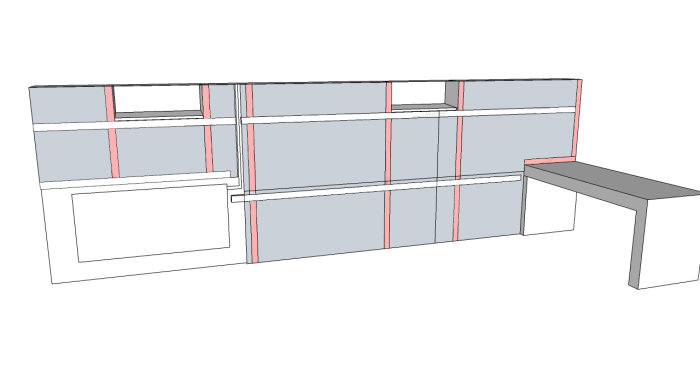
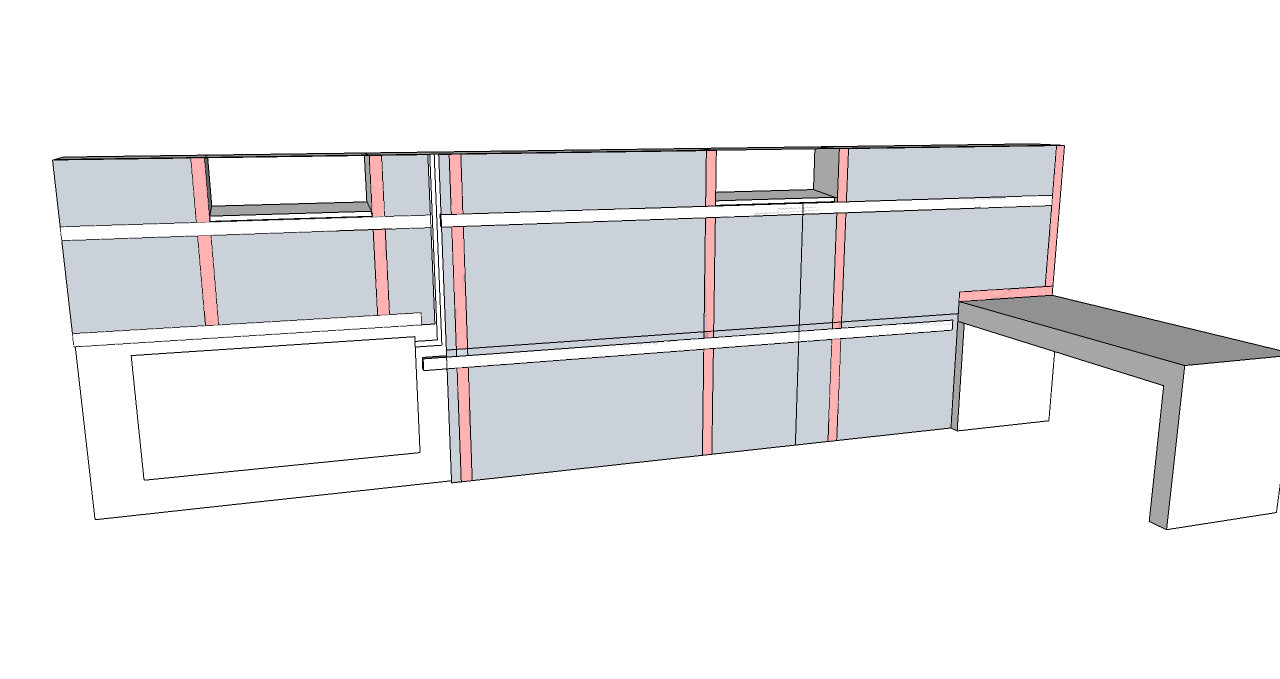
No pictures yet, but I have made a drawing of how I plan to do this.
The horizontal studs are the ones already on the wall. The red-marked ones are the ones I am thinking of adding to improve stability. The gray-marked are the five plywood boards I plan to screw on. One joint ends up a bit awkward, under the right window, but I don't think it will cause any problems. I might add an extra vertical stud there if I feel it's needed. I will also need to move up the lower stud about 8 cm to cover the joint between the upper and lower boards.
I'm unsure if I need/should install horizontal studs at the ceiling and floor as well. The advantage is obviously strength and stability, but the downside is that I'm enclosing more air. As I've drawn it now, there are three fields that are "boxed in" where no air circulation will occur, the two beneath the windows and the large one between them. If I choose to add horizontal studs at the top and bottom as well, it becomes five more.
Click here to reply
Vi vill skicka notiser för ämnen du bevakar och händelser som berör dig.

 Ds
Ds