Looking for some interpretation help related to drawings of a 1950s house. As you can gather from the question, I'm not entirely versed. Yellow brick facade built in wood.
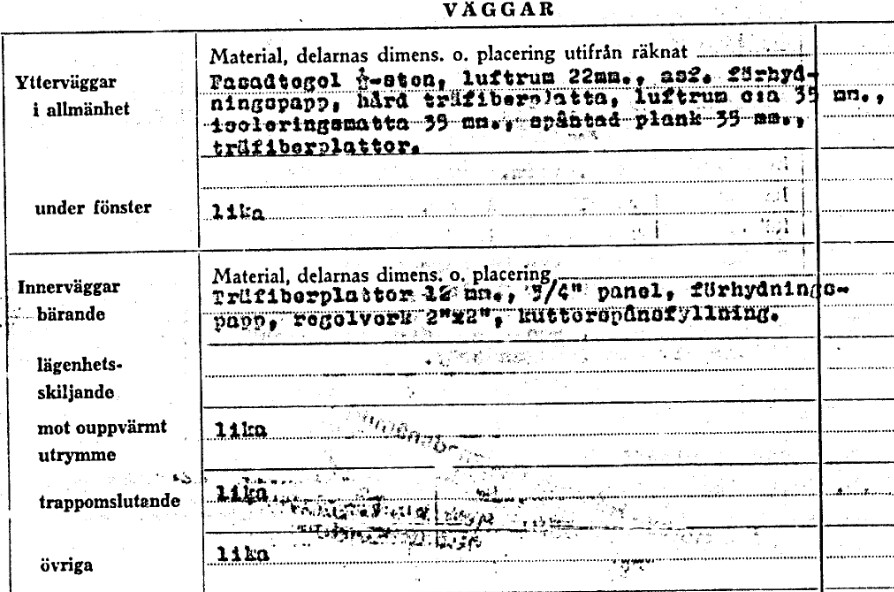
The walls are described as follows.
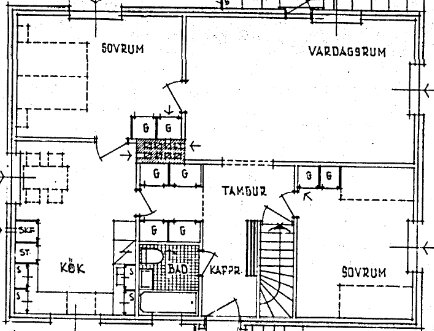
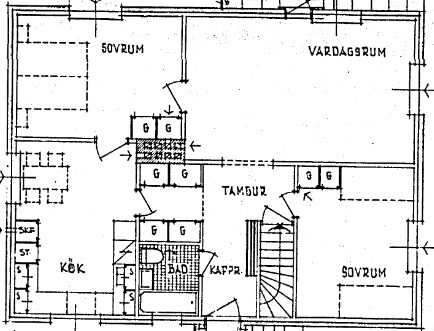
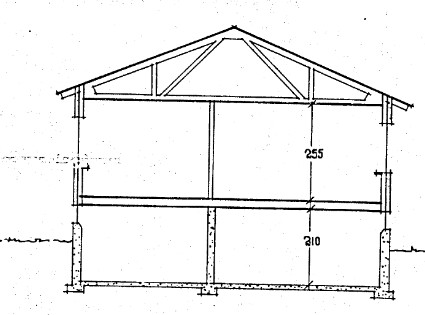
In the drawings, it looks like there is an interior wall adjacent to the exterior wall. Am I making a correct interpretation? That is, that the interior wall is load-bearing but not the exterior wall (envelope).
I can add that I'm trying to figure out if the facing brick is load-bearing or not. I understand that facing brick 1/2-stone is generally not load-bearing, but at the same time, the other material in the exterior wall feels a bit "weak" if this is the case here. If a load-bearing interior wall is directly adjacent, that's a different matter.
Shouldn't it be built with 70 studs? (equivalent to 35 insulation + 35 air) It's not that uncommon for the time. And surely the tongue-and-groove wood adds something too.
Doesn't that form have a box with "frame" or similar where it states the dimensions of the studs?
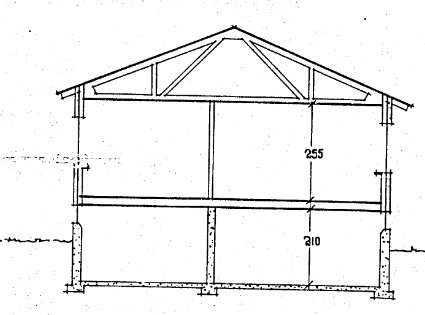
It states that the outer wall is 35 mm grooved plank, so it should be the load-bearing walls. Facade bricks usually do not have a load-bearing function. Interior walls 2x2" are quite thin to be load-bearing. The drawing also shows a free-spanning truss. Check that reality matches the description before doing anything.
Should be built with 70 studs? (equivalent to 35 insulation + 35 air) That's not so unusual for the time. And the tongue and groove wood probably adds something as well.
Doesn't that form have a box with "frame" or similar where it states the dimensions of the studs?
That sounds reasonable. Unfortunately, I can't find anything like that. I'm scratching my head a bit that the framework is mentioned in the interior walls but not the exterior ones. I'll probably need to check this on site. (Currently in the investigation phase of a property we're considering buying.)
It states that the exterior wall is 35 mm tongue and groove plank, so it should be the load-bearing walls. Facade bricks usually do not have a load-bearing function. Interior walls 2x2" are on the smaller side to be load-bearing. The drawing also shows a self-supporting truss. Check that reality matches the description before you do anything.
35 mm feels a bit under-dimensioned. As you write, it's probably an on-site inspection that applies in this case. Hard to get a grasp of the construction from the drawings/descriptions I have.
I read it as (likely) 2x3" studs filled with half insulation, half air. On the inside, rough wood paneling and something akin to tretex. On the outside, masonite(-ish) and roofing felt. Outside of that, air gap and brick facade.
Isn't that a pretty ordinary wooden house with a brick facade from the time when fuel for the heating system was considered a limited expense?
Where do you get the 2"x3" studs from? It's clearly stated that the outer wall is made of 35 mm tongue-and-groove plank, a common dimension from the time when walls were still built with vertical planks.
Maybe you don't know what a plank wall is?
Where are you getting the 2"x3" studs from? It clearly states that the exterior wall is made of 35 mm tongue-and-groove plank, a common dimension from the time when walls were still built with standing planks.
Maybe you don't know what a plank wall is?
The question I'm asking myself is whether it's reasonable for just 3.5 cm thick wood to be the only load-bearing structure in the exterior wall. That is, clearly thinner than the interior walls. 50s catalog house.
In any case, this will be checked on-site.
Thanks!
Click here to reply
Vi vill skicka notiser för ämnen du bevakar och händelser som berör dig.

 Yellow brick facade built in wood.
fahlis said:
It states that the exterior wall is 35 mm tongue and groove plank, so it should be the load-bearing walls. Facade bricks usually do not have a load-bearing function. Interior walls 2x2" are on the smaller side to be load-bearing. The drawing also shows a self-supporting truss. Check that reality matches the description before you do anything.