
1,288 views ·
13 replies
1k views
13 replies
Height difference chimney/wall during tiling
Hi! I’m planning to tile one of the walls in my 1930s kitchen completely. One corner is concrete due to the chimney stack, and the rest is made of solid wooden planks (I’ve already removed all the masonite). There's a level difference between the wooden wall and the chimney stack. The size of the level difference will be 3-5 mm once the plasterboard is applied to the wooden wall. So, the plasterboard sticks out that much. This means that I need to apply something on the chimney stack to compensate for this, right? Can I glue a board to it? Or do I need to add some kind of layer of something? I want to do this properly but need to know how. I have no experience with this but want to do it myself.
Post a picture. A picture says more than... 😁M Mgns L said:Hello! I am planning to tile one of the walls in my 1930s kitchen. In one corner, there is concrete due to the chimney, and the rest is solid wood planks (I've already removed all the masonite). There is a difference in level between the wood wall and the chimney. The size of the difference will be 3-5 mm once the plasterboard is applied to the wood wall. The plasterboard sticks out that much. Does this mean I need to apply something on the chimney to compensate for this? Can I glue a board on? Or do I have to build up a layer of something? I want to do this properly but need to know how. I have no experience with similar work but want to do it myself.
Here is the image. I am talking about the vertical level difference. Not the horizontal (even deeper) level difference visible in the image. The vertical one is, without having removed the masonite here, about 3-4 mm. If I remove the masonite (5-6mm), the plasterboard that is 13 mm will stick up by a millimeter or so.
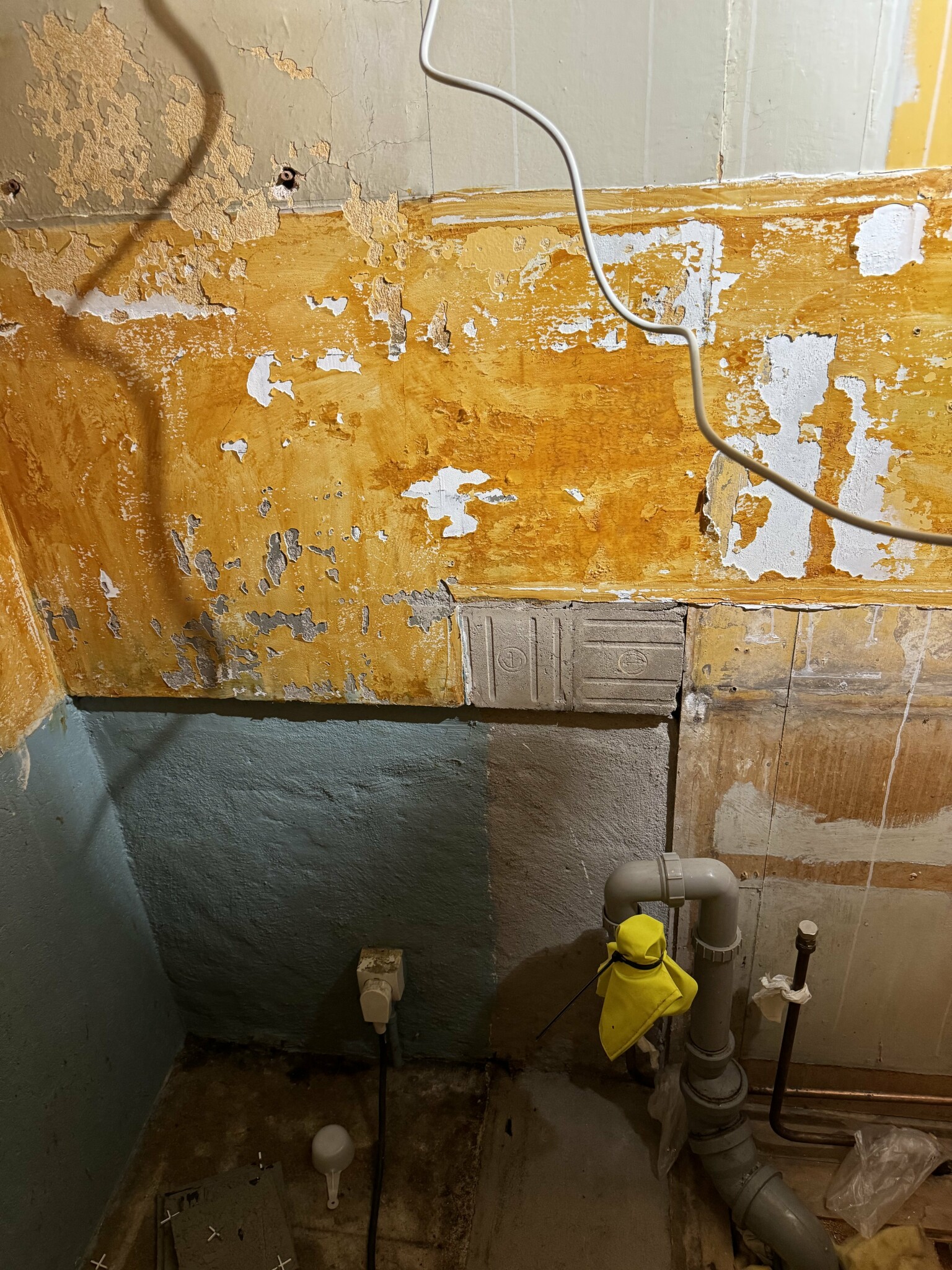
M Mgns L said:Here is the picture. I'm talking about the vertical level difference. Not the horizontal (even deeper) level difference shown in the picture. The vertical is approximately 3-4 mm without having removed the masonite here. If I remove the masonite (5-6mm), the plasterboard, which is 13 mm, will protrude a few mm.
On the yellow area, if I understood correctlyRejäl said:
If there is plaster behind, you can level it with gypsum mortar.M Mgns L said:Here is the picture. I'm talking about the vertical level difference. Not the horizontal (even deeper) level difference visible in the picture. The vertical one, without having removed the masonite here yet, is about 3-4 mm. If I remove the masonite (5-6mm), the plaster, which is 13 mm, will stick up by a few mm.

Yes, that might be the solution. I guess I’ll have to venture into yet another unknown world – casting gypsum... How do you make it as smooth as the rest? A giant putty knife? Is it difficult?Luddis_1 said:
Best answer
You don't cast plaster; it comes in powder form that you mix with water and then apply it like putty and align it with a straightedge or a straight board to achieve a flat surface on the wall...M Mgns L said:
So a mortar tub, a trowel, and putty knives of about 15cm and 25cm are what I usually use…
Thanks!Rejäl said:You don't cast plaster mortar, it's in powder form that you mix with water, then you apply it like putty and align it with a straightedge or a straight board so that you achieve a flatness on the wall...
So a masonry bucket, a trowel, and a putty knife of about 15cm and 25cm are what I usually use...
If you apply plaster over the entire wall, you can dab some plaster mortar on the chimney breast to act as glue for the plasterboard on the chimney breast. The rest of the plasterboard you screw in. That way, you don't have to try to get it level with the rest.
Click here to reply
Similar threads
-
Build a brick wall against chimney stack
Building Materials and Construction Technology -
How to transition a wall to a chimney breast?
Building Physics -
Hur högt upp på väggen bör vedkaminens rökrör gå in i murstocken?
Ved, Pellets, Flis -
Duschvägg mot murstock.
Badrum -
How to fix level difference at new and old wall / door?
Building Materials and Construction Technology