
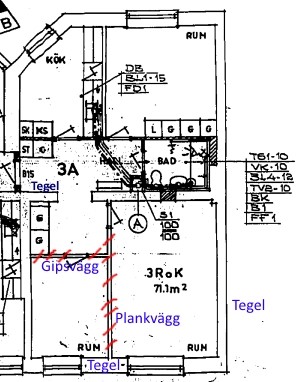
Hello, I have a question about the load-bearing capacity of beams of different dimensions. We are planning to demolish a wall in a turn-of-the-century apartment. The wall (plank wall) is not originally load-bearing, but "may have developed a load-bearing function" over time because it has been there for a long time. See the attached drawing.
Our neighbor created an opening in a similar wall and received a recommendation from an engineer to install a "glulam beam L90x225 or alternatively a steel beam HEA 120. Beam supports at least 95x95 posts...".
Our neighbor opened up about 2.6 m in the wall, but we want to remove the ENTIRE wall (about 5.32 m) and are now wondering about the dimensions of the beam. We have been considering either glulam 140x360 or 90x405 (or equivalent) or a steel beam HEA 160 so that the beam doesn't drop too much from the ceiling.
What I wonder about is what you think is a suitable thickness for the beam. The other question is whether we can place a steel beam on two glulam posts, or do we need to have the pillars in steel as well? If so, what type?
Grateful for any input!
Our neighbor created an opening in a similar wall and received a recommendation from an engineer to install a "glulam beam L90x225 or alternatively a steel beam HEA 120. Beam supports at least 95x95 posts...".
Our neighbor opened up about 2.6 m in the wall, but we want to remove the ENTIRE wall (about 5.32 m) and are now wondering about the dimensions of the beam. We have been considering either glulam 140x360 or 90x405 (or equivalent) or a steel beam HEA 160 so that the beam doesn't drop too much from the ceiling.
What I wonder about is what you think is a suitable thickness for the beam. The other question is whether we can place a steel beam on two glulam posts, or do we need to have the pillars in steel as well? If so, what type?
Grateful for any input!
Welcome to the forum,
In order to even be able to comment on this, it's necessary to determine how much load might be expected to bear on the beam. What is above your apartment?
A HEA120 doesn't handle a very large amount over a 2.6m span, so I assume the neighbor's constructor didn't account for any major loads.
In order to even be able to comment on this, it's necessary to determine how much load might be expected to bear on the beam. What is above your apartment?
A HEA120 doesn't handle a very large amount over a 2.6m span, so I assume the neighbor's constructor didn't account for any major loads.

Hello and thanks for the quick responses!
Above the apartment, there is an identical apartment (with a similar plank wall - just a slightly expanded doorway), our apartment is on the 1st floor of 3 (+ attic) in the building.
Under our wall, there is a beam running lengthwise in the floor (the wall stands directly on the beam). We suspect that there is a similar one in the ceiling but haven't checked it yet - we will probably look into that tonight.
Since this is not a load-bearing wall, there should ideally be no load at all (I guess?), but we want to set up something to be on the safe side and avoid any possible settling.
Here is also a quote from the neighbor's opinion: "The wall does not primarily have a load-bearing or stabilizing function for the overlying floor or vertically bearing elements. The existing floors span between the core wall and the outer wall.
Even though the wall does not primarily have a load-bearing function, there is a risk that the wall has attracted load from the nearest floor surface. Therefore, it is appropriate to insert a beam over the opening to maintain stiffness so that the overlying floors do not sag next to the wall."
I understand that it might not be possible to use his opinion directly (his apartment is on the 2nd floor), but since the wall is of the same type, it should be able to provide some information.
Above the apartment, there is an identical apartment (with a similar plank wall - just a slightly expanded doorway), our apartment is on the 1st floor of 3 (+ attic) in the building.
Under our wall, there is a beam running lengthwise in the floor (the wall stands directly on the beam). We suspect that there is a similar one in the ceiling but haven't checked it yet - we will probably look into that tonight.
Since this is not a load-bearing wall, there should ideally be no load at all (I guess?), but we want to set up something to be on the safe side and avoid any possible settling.
Here is also a quote from the neighbor's opinion: "The wall does not primarily have a load-bearing or stabilizing function for the overlying floor or vertically bearing elements. The existing floors span between the core wall and the outer wall.
Even though the wall does not primarily have a load-bearing function, there is a risk that the wall has attracted load from the nearest floor surface. Therefore, it is appropriate to insert a beam over the opening to maintain stiffness so that the overlying floors do not sag next to the wall."
I understand that it might not be possible to use his opinion directly (his apartment is on the 2nd floor), but since the wall is of the same type, it should be able to provide some information.
I understand, that's a shame..
And what do you think about the reasoning to "scale up" from the neighbor's solution? Assuming everything else is equal. (To determine a value, we used an online dimensioning tool for roof beams, then input the length 2.6 m and parameters that gave the result 90x225. Then we kept the other parameters but increased the length to 5.32 m. That's when we got 140x360).
And regarding the second question, does it work well to have a steel beam (e.g., HEA 160) resting on two glulam columns?
And what do you think about the reasoning to "scale up" from the neighbor's solution? Assuming everything else is equal. (To determine a value, we used an online dimensioning tool for roof beams, then input the length 2.6 m and parameters that gave the result 90x225. Then we kept the other parameters but increased the length to 5.32 m. That's when we got 140x360).
And regarding the second question, does it work well to have a steel beam (e.g., HEA 160) resting on two glulam columns?
The reasoning is not necessarily incorrect, but it does not necessarily hold true. The neighbor lives, as I understand it, higher up and if there are loads in the wall, it is likely higher the lower you go in the house.
You can certainly use glulam columns together with a steel beam, just keep in mind that the foundation for the columns must be designed to handle these point loads.
You can certainly use glulam columns together with a steel beam, just keep in mind that the foundation for the columns must be designed to handle these point loads.
Click here to reply