
6,451 views ·
44 replies
6k views
44 replies
Hardness plywood vs pine

Admittedly, my ballistic knowledge dates back a few decades, but I wonder if you haven't made it unnecessarily difficult for yourself by involving a layered material like plywood?

Renovator
· Stockholm
· 21 112 posts
Any old pine tree is penetrable by a crappy bullet. It's about the amount of gunpowder, the type of bullet, and the weight of the bullet used. Even among full metal jacket stories (which have lead in the middle), there are round nose and pointed nose. Then you have full metal jacket solid bullets, copper bullets, etc., all with different properties.
But in general, a 6mm rifle cartridge, like .243, goes through a wall or a solid pine with ease. The bullet and the load can be more important than the caliber.
But it's fun that you can no longer hide behind a drywall!

richardtenggren
Ingen-gör
· Norrlandet
· 6 615 posts
richardtenggren
Ingen-gör
- Norrlandet
- 6,615 posts
Did my thesis for SSAB where I spent a large portion on ballistic testing. It was conducted at Åkers Krutbruk where they have a test bunker specifically for ballistic testing, so reach out to them and you can get real results 
I don't know if my thesis will be of any help since it also deals with steel and bending, but above all, the English is so-so...
However, there are probably good references to interesting literature.
I don't know if my thesis will be of any help since it also deals with steel and bending, but above all, the English is so-so...
However, there are probably good references to interesting literature.
Renovator
· Stockholm
· 21 112 posts
Pine tree, you mean a living pine? The fact is that living trees are very resistant, a fairly narrow tree can withstand even 7.62x51. Pine timber, on the other hand, is dried and very soft, even .22 lr penetrates quite deeply. But of course, we must modulate this correctly since pine studs are a common component in interior walls. We will also modulate drywall correctly so it will be interesting at indoor rangesG guggen said:Any lousy bullet can go through an older pine tree. It depends of course on the amount of powder, which bullet, and the weight of the bullet used. Even among full metal jacket stories (which have lead in the middle) there are round nose and pointed nose. Then you have full metal jacket solid bullets, copper bullets, etc., all with different properties. But generally, a 6mm rifle cartridge, like .243, goes through a wall or a solid pine tree easily. The bullet and load can be of greater importance than the caliber. But it's fun that you can’t hide behind a drywall anymore!
Edit: our game is military, so it’s just FMJ like M855A1 which is the new NATO 5.56x45 cartridge
richardtenggren
Ingen-gör
· Norrlandet
· 6 615 posts
richardtenggren
Ingen-gör
- Norrlandet
- 6,615 posts
What I noticed during the ballistic testing was that the variation in bullet velocity is extremely large for standard military ammunition, the Russian 7.62x39 had the widest spread.
To achieve approved test series (V50 test according to NATO standard), we had to load ourselves and weigh the powder to achieve consistent speeds.
(The V50 test aims to find the breakpoint where the bullet penetrates the sample, six bullets are to be fired, of which three should go through and three should be stopped, the speed range should be a maximum of 50 m/s if I remember correctly.)
So to get more realism, you can include a certain range in bullet velocity
To achieve approved test series (V50 test according to NATO standard), we had to load ourselves and weigh the powder to achieve consistent speeds.
(The V50 test aims to find the breakpoint where the bullet penetrates the sample, six bullets are to be fired, of which three should go through and three should be stopped, the speed range should be a maximum of 50 m/s if I remember correctly.)
So to get more realism, you can include a certain range in bullet velocity

And the penetration is likely to vary with the square of the velocity (i.e., proportional to the kinetic energy).
Renovator
· Stockholm
· 21 112 posts
We will use V50 data but unfortunately there is only data for AR500 steel. Most steels used as protection on the map are mild steel, which is much less resistant.What I noted during the ballistic testing was that the variation in bullet velocity is extremely large with standard military ammunition, the Russian 7.62x39 had the largest spread.
To achieve approved test series (V50 test according to NATO standard) we had to load ourselves and weigh the gunpowder to get even speeds.
(The V50 test is about finding the breakpoint where the bullet penetrates the test, you must fire 6 bullets, of which three must penetrate and 3 are stopped, the speed range should be a maximum of 50 m/s if I remember correctly.)
So to add more realism you can introduce a certain range in bullet velocity
Edit: M855A1 and M80A1, which we used as a reference for 5.56x45 and 7.62x51, seem to have quite low spread actually. But we will randomize muzzle velocity a bit. We will randomize some deviation corresponding to the real-world deviation as all weapons have some deviation. However, for example, the L96 (sniper rifle 90) will have extremely little.
Edit: we will also module Kevlar correctly, this is not completely correctly configured but still kinda cool
Last edited:
richardtenggren
Ingen-gör
· Norrlandet
· 6 615 posts
richardtenggren
Ingen-gör
- Norrlandet
- 6,615 posts
Okay, but consider that these are for testing the material, so often the factory load is topped up to get a complete series, which obviously depends on the type of steel, thickness, and ammunition.
So the bullet velocities may not be representative of reality.
Renovator
· Stockholm
· 21 112 posts
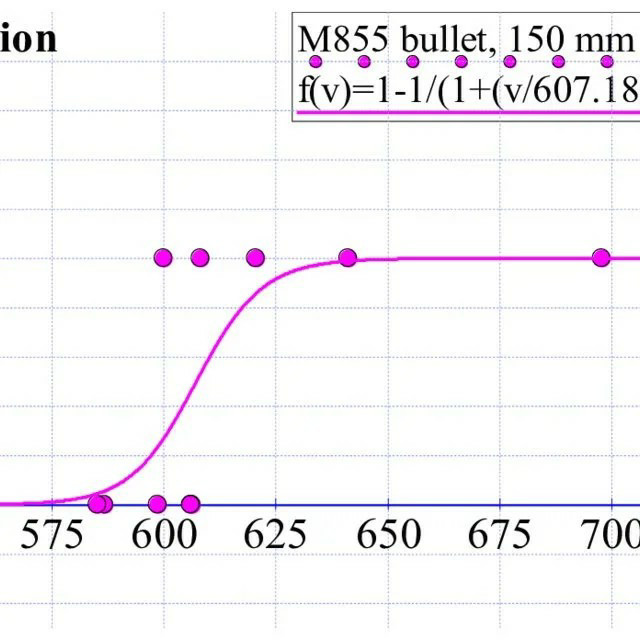
I have found the v50 for exactly these two cartridges, M855A1 has its v50 at approximately 600 m/s (against AR500)
Edit: but AR500 is quite an uninteresting material except for modeling the soldier's plates in the vest. Concrete, wood, and gypsum walls as well as thinner steel are more common
richardtenggren
Ingen-gör
· Norrlandet
· 6 615 posts
richardtenggren
Ingen-gör
- Norrlandet
- 6,615 posts
I remember no data, and it was withheld in my report, but the approach was roughly as follows.
Fire some standard cartridges with known powder weight, measure speed, and based on the results, increase or decrease the powder weight on the upcoming cartridges.
So if penetration occurs with a standard cartridge, you decrease the powder amount until there is no penetration, and so forth.
Then you need to achieve three of each within the given speed range to calculate the average speed of these, which becomes the V50 for the given caliber/bullet type and material quality/thickness.
So what I'm trying to say is that the V50 speed can be irrelevant if the test is conducted on thicker/thinner plate. Since the bullet speed is higher/lower than normal.
Tests are conducted according to different threat classes within various standards, more info can be found here;
https://www.ssab.se/-/media/Files/E...n-you-and-the-riskV12020.pdf?m=20201029100438
Fire some standard cartridges with known powder weight, measure speed, and based on the results, increase or decrease the powder weight on the upcoming cartridges.
So if penetration occurs with a standard cartridge, you decrease the powder amount until there is no penetration, and so forth.
Then you need to achieve three of each within the given speed range to calculate the average speed of these, which becomes the V50 for the given caliber/bullet type and material quality/thickness.
So what I'm trying to say is that the V50 speed can be irrelevant if the test is conducted on thicker/thinner plate. Since the bullet speed is higher/lower than normal.
Tests are conducted according to different threat classes within various standards, more info can be found here;
https://www.ssab.se/-/media/Files/E...n-you-and-the-riskV12020.pdf?m=20201029100438
Renovator
· Stockholm
· 21 112 posts
Not completely irrelevant as it gives us a good picture of the minimum speed to penetrate hard steelI don't remember any data, and it was covered up in my report, but the approach was something like the following.
Shoot some standard cartridges with known powder weight, measure speed and based on the result increase or decrease powder weight on upcoming cartridges.
So if you get penetration on a standard cartridge, you decrease powder amount until you don't have penetration, and so on.
Then you need to get three of each within the given speed range, to then calculate the average speed of these, which becomes V50 for a given caliber/bullet type and material quality/thickness.
So what I'm trying to say is that the V50 speed may be irrelevant if the test is conducted on a thicker/thinner plate, as bullet speed is higher/lower than normal.
The tests are conducted according to different threat levels within various standards, there's some info here;
[link]
The data I had was indeed for the predecessor M855. The newer M855A1 is a revision that provides even better AP attributes.
richardtenggren
Ingen-gör
· Norrlandet
· 6 615 posts
richardtenggren
Ingen-gör
- Norrlandet
- 6,615 posts
Understand that such things are more interesting to you, but unfortunately, I can't contribute anything regarding these.
That's why I mentioned it might be irrelevant, if you check s11 on my link, you have speeds there and what thickness a certain protection class requires.
Another interesting thing is the dispersion is greater than one might think. My tests were conducted with a lab weapon mounted on a coordinate table, yet we still got a certain dispersion in the hit pattern. Now, military ammunition is probably made to kill and not for target precision (except for sniper ammunition). I assume it was mostly due to the bullet's balance and shape.
That's why I mentioned it might be irrelevant, if you check s11 on my link, you have speeds there and what thickness a certain protection class requires.
Another interesting thing is the dispersion is greater than one might think. My tests were conducted with a lab weapon mounted on a coordinate table, yet we still got a certain dispersion in the hit pattern. Now, military ammunition is probably made to kill and not for target precision (except for sniper ammunition). I assume it was mostly due to the bullet's balance and shape.
Renovator
· Stockholm
· 21 112 posts
Yep for example we randomize 0 to 0.5 MOA to simulate thisI understand that such things are more interesting for you, but unfortunately, I can't contribute anything regarding these.
That's why I wrote that it might be irrelevant. If you check s11 on my link, you'll find speeds there and what thickness a certain protection class requires.
Another interesting thing is the dispersion is greater than one might think. My tests were conducted with a lab weapon mounted on a coordinate table, yet we still got some dispersion in the shot pattern. Now, military ammunition is made to kill and not target shoot (except for sniper ammunition, of course). I assume it was mostly due to the bullet's balance and shape.
Renovator
· Stockholm
· 21 112 posts
We also simulate the speed of soundUnderstand that such is more interesting for you, but unfortunately I can't contribute anything regarding these.
That's why I wrote that it might be irrelevant, if you check s11 on my link you have speeds there and what thickness a certain protection class requires.
Another interesting thing is the spread is greater than you think. My tests were done with a lab weapon that was set on a coordinate table, but still, we got a certain spread in the hit pattern. Now military ammunition is probably made to kill and not target shooting (except for sniper ammunition then). I guess it was mostly due to the bullet's balance and shape.
that the shot reaches before the sound