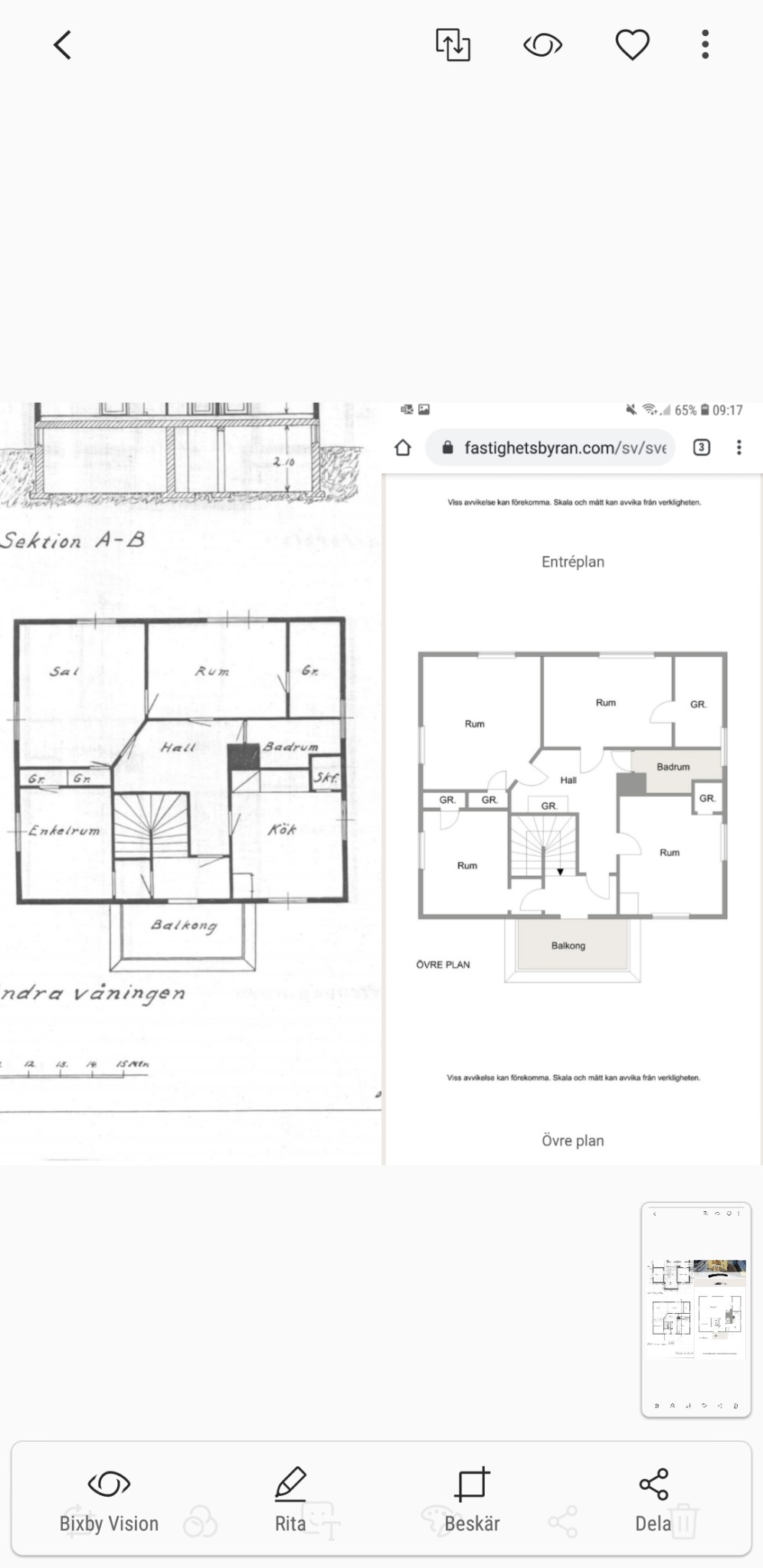
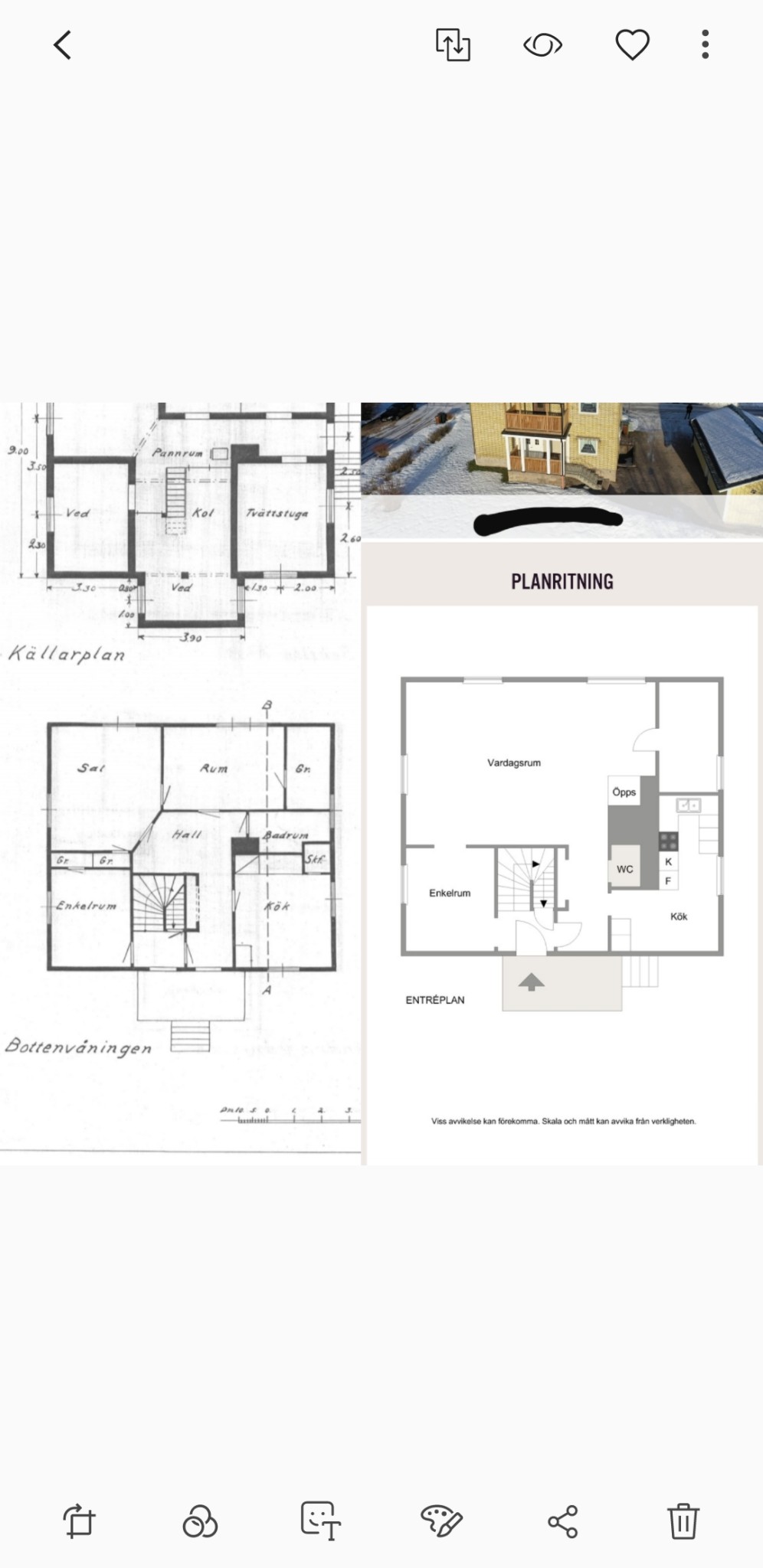
When we moved into our house this summer, I immediately felt that the upstairs is very "wobbly." I understand that's how it is with older houses. Ours is from 1930. But it is mostly in two rooms upstairs. I've got hold of the original drawings, and you can see that most walls on the ground floor have been removed. However, this was done sometime during the 50s, so a long time ago. I don't see any signs that it should be dangerous, and as I said, it was a long time ago. But I still can't stop thinking about it.
Is there any way to guess if any of those walls were load-bearing?
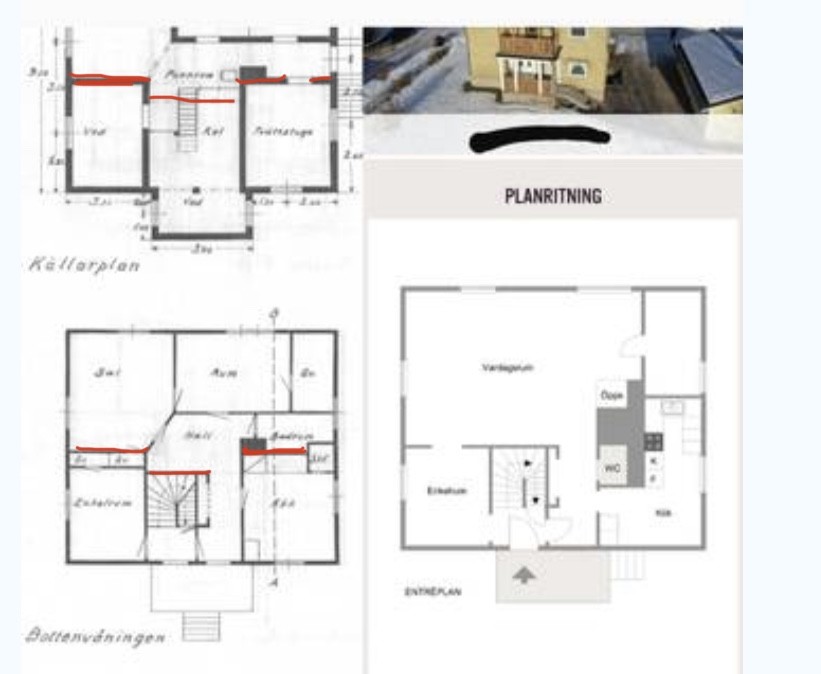
Adding two pictures, original drawing versus today's floor plan. Upper floor and ground floor.
There are no drawings after the walls were removed except for these newest ones I have. Nor is there any information about changes in the floor plan at the municipal archive.
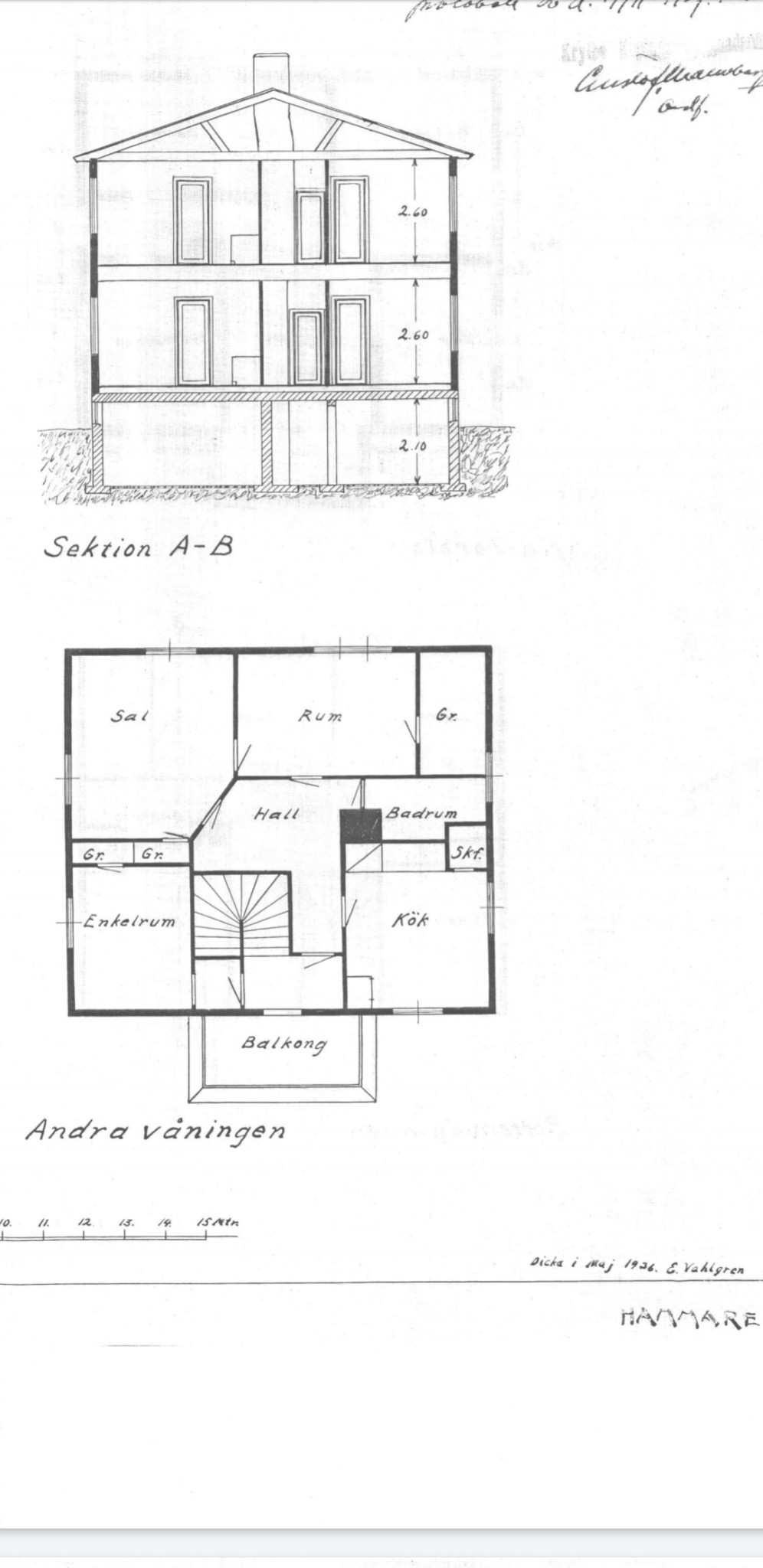
Unfortunately, I can't answer your question, but those who know a lot about house construction usually want to see the sectional drawing, the one you can see a bit of above the original floor plan of the Second floor. If you have information on how walls and joists are built, it is usually helpful as well.
Attaching image of the sectional drawing. Additional information I will have to get back with.
Hi,
I am quite used to guessing structural systems with lacking documentation. It seems that the floor slab over the basement is a heavy one, probably concrete? Is that correct?
Most of the walls underneath it are probably also heavy walls and are load-bearing. (Which doesn't necessarily mean they have to bear it). In the old layout, they have then followed with all the walls upwards with roughly the same layout. Practical to transfer loads from the interior walls straight down without any complications even if the loads would only come from the wall's own weight.
Now, let's look at what's a bit more important. You should have a load-bearing line roughly across the whole house somewhere around the middle. From gable to gable, that is. These walls transfer loads from all the floors. On the upper floor, it appears to be as it was when built.
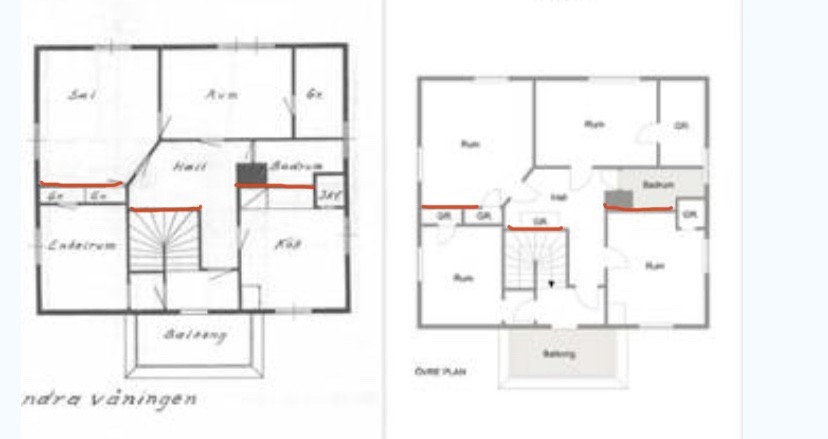
Now looking at the ground floor. I have marked with red lines where I think the most important walls are. Compare reality with these. There should be a wall or beam remaining there. Is there a beam in the basement where I drew the red line? (Which should have been there since it was built).
Now everyone should be aware that those layouts drawn by a poor realtor are about as accurate as if Sture, 95 years old, drew them. For example, it looks like the fireplace and wall from it are gone but it has been moved further up in the picture. Probably a drawing error. If the wall on the far left has been moved (new load-bearing wall built slightly below it, it should also be on the upper floor.
It doesn't matter if the bearing no longer lands directly above it in the basement if it's a concrete floor slab and it still is quite close to the basement wall.
Amanda's husband here, part of this "load-bearing wall problem."
I thought I'd add some details about the situation in the house in case it helps clarify our issue.
Firstly, the floor plan isn't quite accurate.
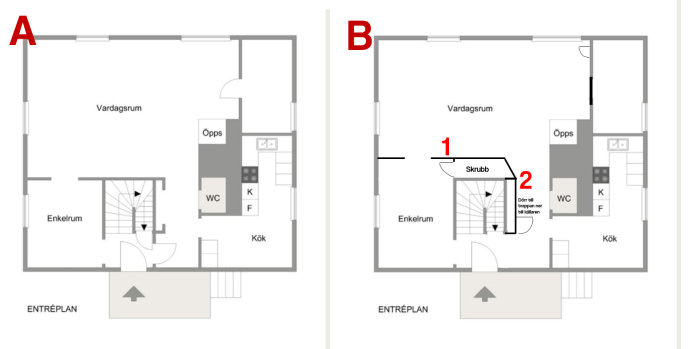
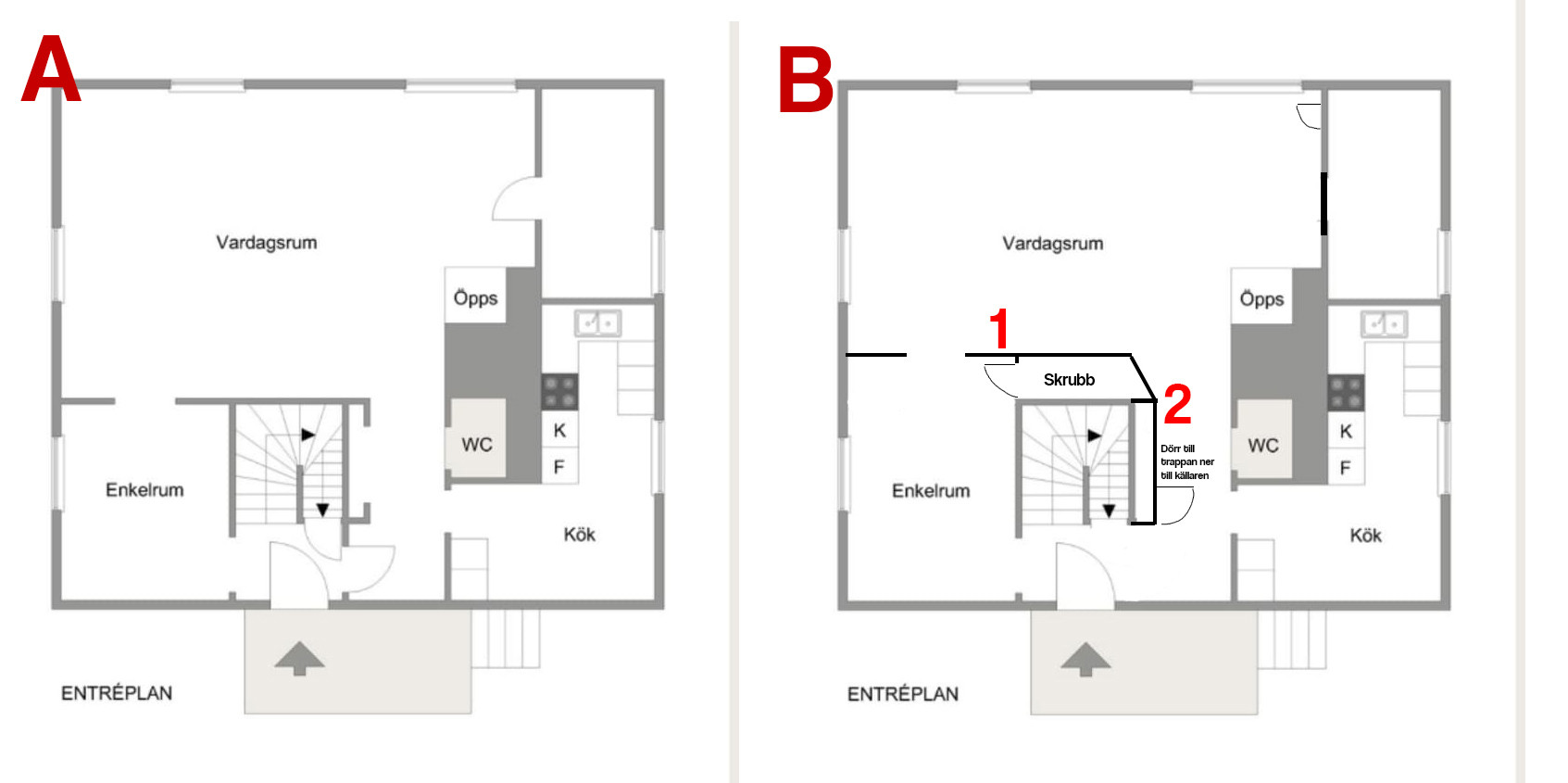
It looked like this in A, but in reality, it's like B with a closet behind the stairs and the door to the basement on the side of the stairs. The wall right behind the stairs isn't exactly where it is in image A. So image B is correct.
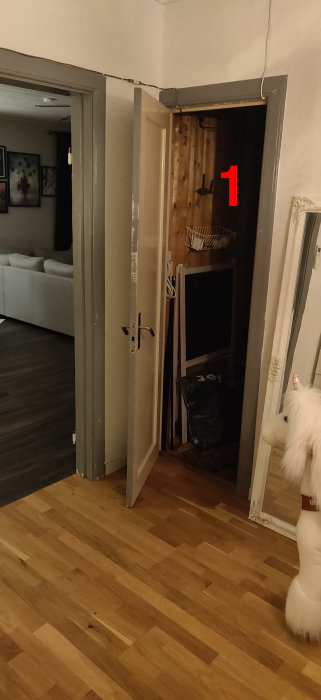
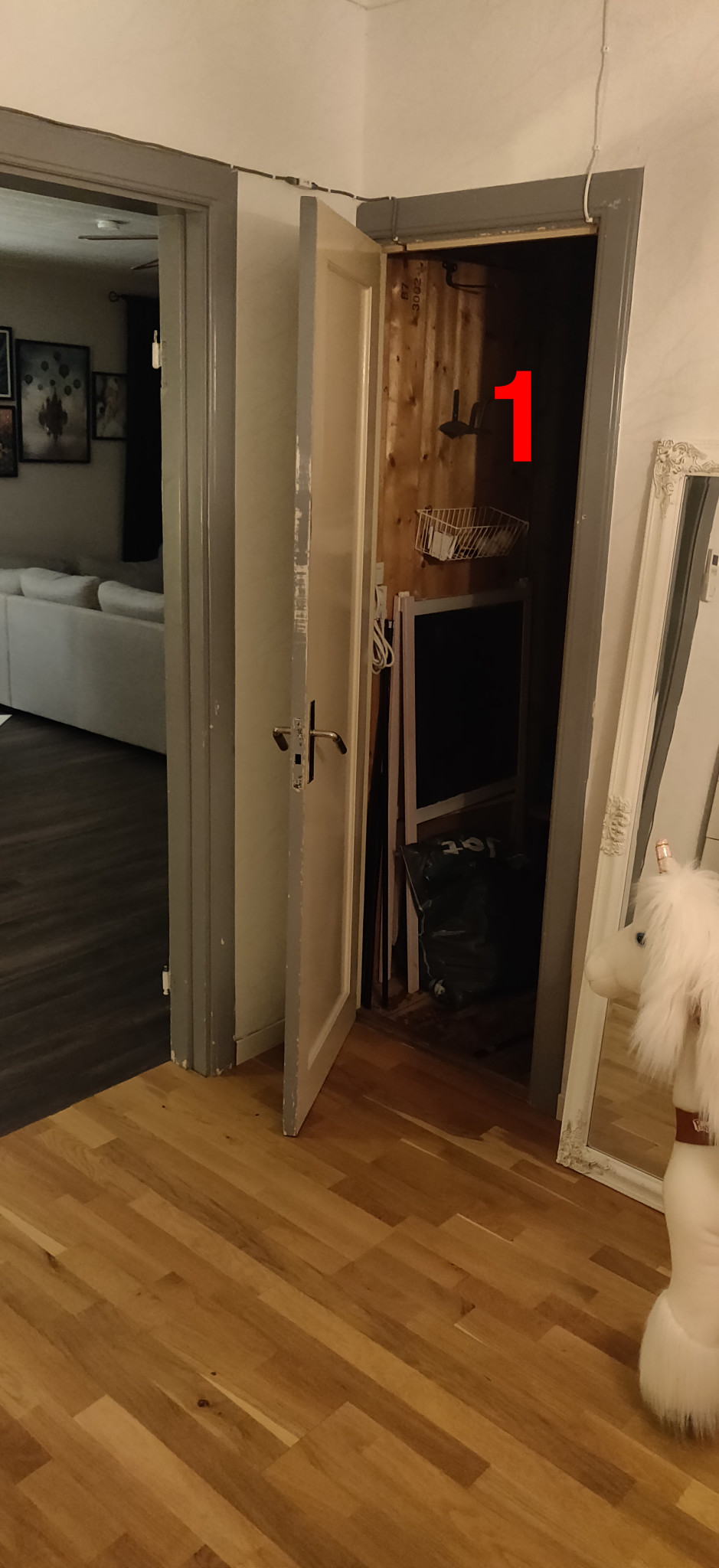
You can see in these other images the closet and the slanted wall right next to the "2" in the image above.
Then there's the thing with the joists, which I don't know much about.
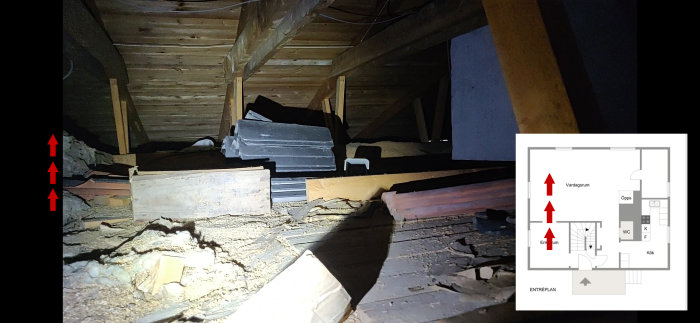
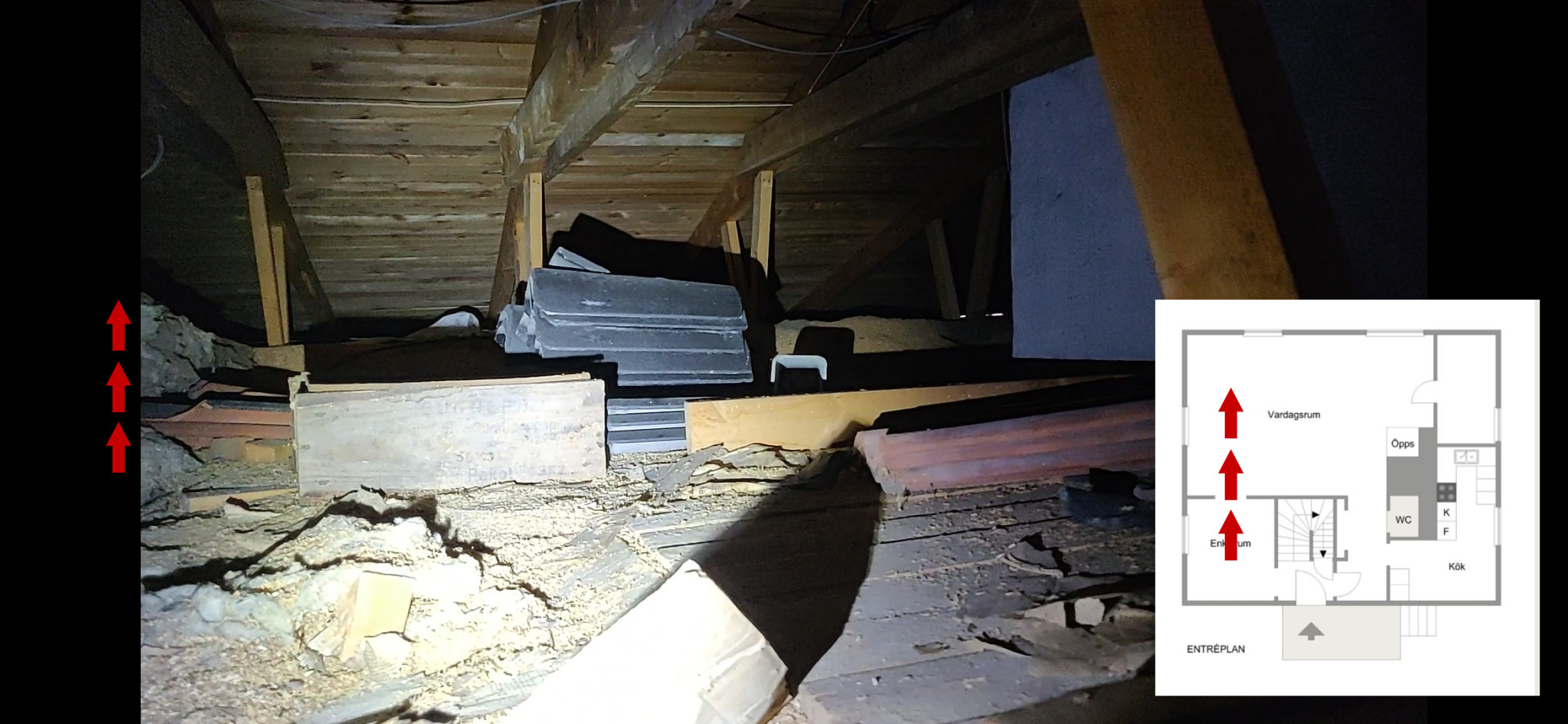
I went up to the attic and looked at how it looks.
There are beams running along the direction of the arrows, but also crossing over as you can see a bit in the image. The photo is taken from me standing on the ladder, and I have beams on either side of me going forward. But they don't go very far, maybe about a meter, then they end, and a new beam overlaps a bit and extends a couple of meters forward.
I don't know how this helps determine if the removed walls on the ground floor were load-bearing or not.
The idea is to know how much we can load the upper floor and/or if we need to put up a beam in the living room downstairs to secure it.
Although multi-story buildings from the 1930s are generally much more wobbly than what we are used to today, the removal of walls on the ground floor of your house is far too extensive. If the walls have been replaced with a beam, it must have substantial dimensions. Somewhere, I don’t think the beam exists. I guess the existing floor joists have been spliced together, which is not a satisfactory solution, even though it has obviously lasted quite a while. Using a laser measurer, it is possible to measure the deflection that occurs with different loads and thus get a good picture of the condition. I believe a glulam beam is required in the ceiling of the ground floor. It might need to rest on three pillars, but that depends, among other things, on the ceiling height.
Edit: Picture B does show a better situation than picture A, but I see no reason to change my post. The problems are on the ground floor.
Then reality matches my assumption better and how I drew the load-bearing walls. So, no displaced wall.
By the way, you can see in the attic that the roof trusses have been reinforced at the ends. There could be many reasons for this. Perhaps some water got in, and they started to deteriorate at the ends, so they were reinforced a bit to prevent them from giving way outward. The beam lying crosswise seems to be located exactly where there is no transverse wall by the stairs. I base this on seeing the chimney protrude in the picture. It is obviously also new. Perhaps it was on the underside before, and they wanted to move it to have clear height to the underside of the roof? Or perhaps they just felt they wanted to support it if it never had support in the middle there.
I absolutely don't think you need to worry about anything. Then again, if it's springy, that's another matter. That is also the case with many new houses that are incorrectly built. It simply means spans that are too long or beams that are too low or spaced too far apart to provide the necessary stiffness against sagging and bounce. If you see it as a problem, you'll need to make some larger interventions, but probably nothing you want to do if it's just a bit of bounce. Now, of course, I don't know how much it bounces, but yeah. If you want more help than that, you should bring in a real construction engineer who can look at it on-site. It's a bit difficult for me to say more without seeing it.
The house has a plank frame. It was common for all plank walls parallel to the ridge to be load-bearing for the floor joists. @Ludvigjohnssons interpretation of the support is not correct. The floor joists were often 3x7 inches, strong but wobbly at larger spans. There were often quite long splice lengths. However, all plank walls had a load-bearing function, even those parallel to the rafters, which could, for example, replace a floor joist.
But what conclusion can be drawn then? Are the walls that are gone downstairs so bad that the ceiling might collapse if loaded with bookshelves, beds, and other things in the rooms above? I mean, it doesn't even seem like there's any tendency to lean or give way. I think that if they were really load-bearing walls that were removed a long, long time ago, there should have been consequences. Whether the floor upstairs sways is different. I don't think it's really noticeable, but my wife thinks it feels a lot. But you still want to know for sure if the missing walls downstairs were crucial.
But the thing is, there's also a new ceiling in the living room. It's been lowered quite a bit compared to the rest of the house. Could be hiding some sort of beam in there? And that's why you can't see if it sags or anything.
Regardless, it sounds like there are differing opinions about these load-bearing walls. We'll simply have to bring someone here who can take a look.
judtusanderson is very competent in this area and he is absolutely right, such plank walls that this house had often have a load-bearing function. But since there is a new lowered ceiling, we do not know if reinforcements have been added. Open up the ceiling where there should be a beam and check, preferably just as you have concluded with the help of someone who can calculate it.
Unfortunately, I can't contribute any expertise on load-bearing and construction, but if in the end, it turns out that you would like to install some form of beam, you can consider whether you want a glulam beam or an iron beam. A wooden beam feels more in style with the house, but an iron beam takes up less height, especially with larger spans.
Thank you for all your answers, and for taking the time to help us.
I really hope there is some kind of beam hidden under the ceiling here in the living room that is lowered.
If not, does anyone have any idea how much it costs to hire someone to fix a beam?
Unfortunately hard to answer. How long is a piece of string? To begin with, it will cost you the ceiling. Take it down and check how it looks in the beam structure and under where it is lowered. Then, if there is no existing support structure, you'll need to bring in a structural engineer, which is at least one workday for a couple of thousand per hour. The beam itself is usually not that expensive, a couple of thousand. Then some competent ladies or gentlemen need to install the beam and restore the ceiling, which I would estimate takes about a workweek for two people at around 500-800 SEK/hour. Then add material costs for a new ceiling depending on what you want. If you don't choose the cheapest option, it's between 60,000 and 90,000 after ROT I would guess. But that’s really a guess, possibly less, expect a bit more, surprises can appear.
Last edited:
Vi vill skicka notiser för ämnen du bevakar och händelser som berör dig.