I have never done any casting. I have been looking for several days for a very basic guide on how to cast a basement floor with concrete/EPS-concrete. Finja's guide was pretty good, but I have some questions.
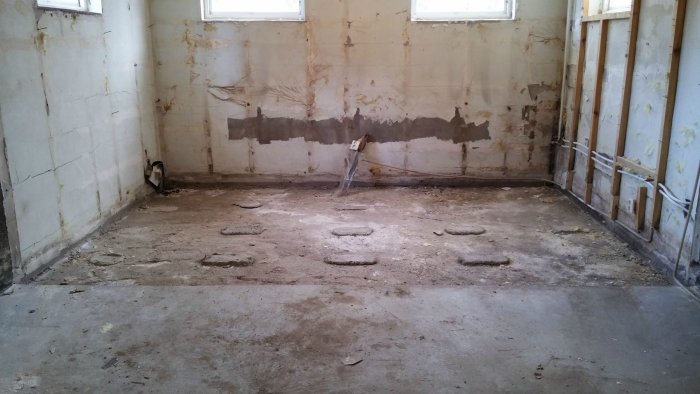
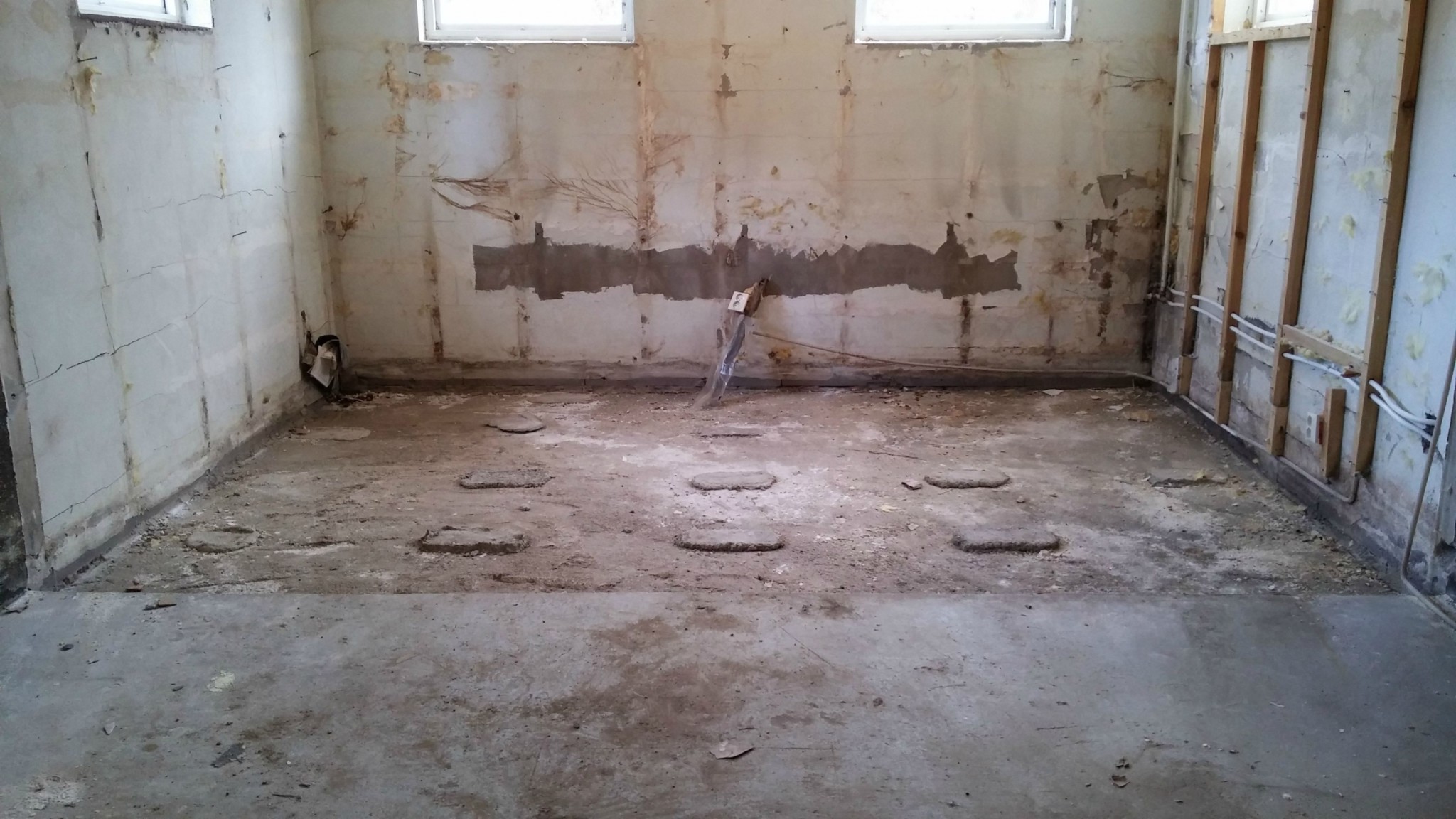
The basement space with a concrete floor on an uninsulated slab is 40 sqm, of which about 10 sqm is approximately 80 mm lower than the rest. I plan to cast the lower floor to level it with the rest. I intend to use EPS-concrete to provide some insulation plus it implies significantly fewer bags.
As I understand, you do the following:
1. Prime the floor, the existing concrete substrate, i.e. the slab in this case
2. Fix screed guides at the desired height in some EPS-concrete
3. Mix and pour the concrete
4. Level the concrete with a straight edge against the screed guides
5. When the correct level is reached, remove the screed guides and fill in the channels with EPS-concrete
6. Let it dry
7. After a day, apply leveling compound/self-leveling screed at least 20 mm above the EPS-concrete with reinforcement
My questions:
Is the above absolutely easiest?
Should the screed guides be made of wood, does it matter?
When do I remove the screed guides?
What should be the distance between the screed guides - the area is about 2.8 m x 4 m?
How to handle the EPS-concrete against the walls, fill the concrete all the way to the wall?
Anything I should consider?
Tools I need? I was thinking of using a mixer in a bucket
Very grateful for the help! I want to try to do this anyway (sometime has to be the first! ), if it goes to hell I'll hire a pro.
Just take two or three studs depending on how wide it is. When you need to put them up, you'll have to dig a little at one end and then pull up the stud.
It depends on what you have to pull with. If you have a stud that's as wide as the room, two paths are enough.
If it's a concrete/masonry wall, yes, if it's organic, lay a paper in between.
Borrow a mixer. Saves you a lot of time. A trowel can be good too.
Came up with an important question: Since the processing time is 15-60 minutes, how should I proceed? I'll probably skip the cement mixer, thinking about buying a sturdy hammer drill/drill instead or a mortar mixer. Should I mix one bag and pour it out, then mix a new one and pour it out afterward? Is there a risk that the screed tracks will get stuck if I'm too slow?
the risk of having too few tracks is that you can easily weigh down between the tracks and then get a track-shaped floor
How big is the room? it mixes quite smoothly in a trash bag too, do not use a tombola
No, there's no risk, you can easily lift them up the next day.
I did it at one place by simply laying out 45*45 beams nailed together with 2 28*70 on top of the beams, cast between the beams, and just pulled everything back and continued casting
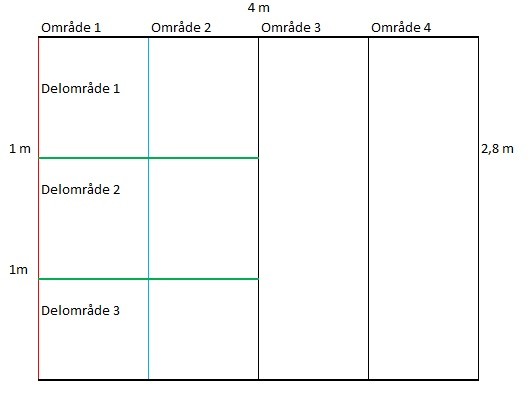
This is quite a small space. How about having 4 areas and filling one (1) at a time? The space is 2.8 meters deep, based on the image above, and 4 meters wide. Five joists at 2.8 m = 4 areas. Each area then needs about 150 liters of mixed EPS concrete, which is about 4 bags. According to Finja, 24 50-liter bags are needed for 10 sqm and 10 cm layer thickness, I'm going to make 11 sqm and about 6 cm thick = about 18 bags. Is that too many, too few areas? Will I have time to mix before it sets? I was thinking of filling one area at a time.
I was thinking of mixing in a water barrel from Jula of about 200 l, I assume you can mix around 2 bags at a time? How long does it take with a drill and mixing paddle?
Then do I remove the guide rails a few hours after, alternatively the next day? And then fill the grooves with some newly mixed EPS concrete?
I have never mixed more than one bag at a time, I think I counted on about 10 minutes per bag for mixing and spreading. Make shorter rules, fill the first compartment, start with the second, and when you've gone about a meter or so, move the rule back and fill the hole, fill another meter and move and fill, then you'll be done immediately.
Keep in mind that it creates dust, and you'll get foam balls everywhere
You don't need to make the surface 100% perfect, the filler will fix that.
It's best to open a bag and roll up the opening, turn it upside down in the barrel, open the bottom with, say, a knife and pour the water into the bag, lift the bag out, and then mix, this way it creates the least dust.
If it is the room in the picture, make sure to remove the wooden studs attached to the wall as well before you start building the new floor. Organic material in basements can cause problems in the future and absolutely do not cast any stud in, so take at least enough of them so they are above the new floor level.
When it comes to casting and screed rails I will pass, as there are others with practical experience in that area who can help.
I've never mixed more than one bag at a time, I think I counted about 10min / bag for mixing and laying out. Make shorter battens, fill the first compartment, start with the second and when you've done about 1m or so, move the batten back and fill the hole, fill another meter and move and fill, then you'll be done right away.
Keep in mind that it creates dust and you'll get foam beads everywhere
You don't need to get the surface 100% because the leveling compound will fix that.
The best way is to open a bag and roll up the opening, turn it upside down in the barrel, open the bottom with, for example, a knife and pour the water into the bag, lift out the bag and then into the mixer, that way it creates the least dust
Thanks!
Each Subsection below is about 1 square meter, approximately 2 bags.
Should I do it like this then? See picture too..
1. Set up the surface with five battens of 2.8 m running the entire depth of the area, as I wrote above.
2. Place a cross batten (the green one) in Area 1 to form Subsection 1
3. Mix two bags
4. Pour the bags into the area
5. Let it set
6. Remove the cross batten and move it 1m to form Subsection 2
7. Do the same to form Subsection 3
8. When the entire Area 1 is filled, the red batten against the wall can be removed.
9. Similarly, Area 2 is filled and when the entire Area 2 is filled, the blue batten is removed
10. Continue like this until everything is filled
Sorry, I'm completely lost on this, hopefully, this thread will help others in the future.
I had made it easy for myself, place a cross laser on the floor so you get a reference point. Pour freehand, it's not a large area, and since eps requires leveling compound, I would have let that handle the fine details.
No, if you do it like that, you'll have to keep at it for several days, casting, moving, casting, moving, and soon you'll be done. I find it difficult with lasers myself, but I know many people do it that way.
No, if you do it that way, you'll have to keep going for several days, pour move pour move and you'll soon be done
I personally find it difficult with a laser but know that many do it that way
Would you have done as I described above with my "nice" drawing?
Had always balanced off fine deduction tracks and then deducted against these. You earn on this because of less need for self-leveling compound than using a laser if you are not very experienced with casting.
However, I think the crossbars are completely unnecessary. Even if you mix continuously, you will always lay EPS "wet on wet" so you don't need to separate with these. Longitudinal ones that you balance against work just fine.
I would definitely have considered fine level guide boards and then leveled against these. You save on this due to the reduced need for floor leveling compound compared to using a laser unless you are very experienced with casting.
However, I think the cross braces are completely unnecessary. Even if you mix continuously, you will always lay EPS "wet on wet" so you don't need to divide off with these. Lengthwise guides that you level against work just fine.
Don't forget your boots...
myrstack, so you believe that it works like my drawing (sorry for the explicitness but I need to be sure since I am such a beginner at this) even without the cross braces, meaning just lay area 1, then area 2, then area 3, then area 4 and remove the 2.8-meter guides at the far end as it starts to set a little?
Vi vill skicka notiser för ämnen du bevakar och händelser som berör dig.

 ), if it goes to hell I'll hire a pro.