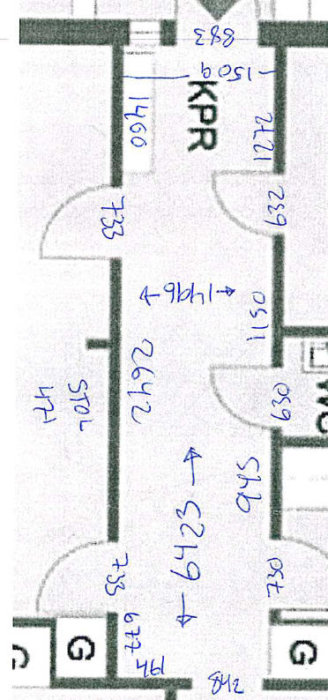
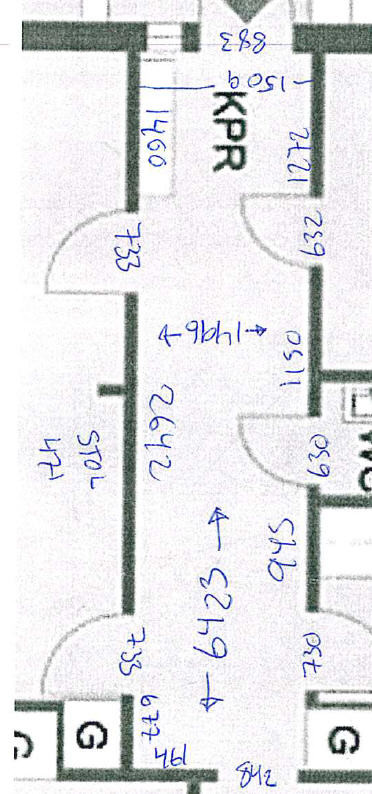
Hello, I'm wondering if anyone has a good way to measure and calculate what I need to cut from the floor when laying it.
I am going to lay flooring in an elongated hallway where I have a "waist" in the middle of the floor. How can I create a "straight" line in this hallway to adhere to? Does anyone have a good trick?
I'm considering laying a piece of flooring along the "straightest" wall, then measuring from that to determine the size of the waist to figure out how much needs to be cut, and using a laser to see if the line I've marked out allows me to adhere to that wall, or if it too "bulges."
Or does anyone have any good tips?
The floor has a tile-like appearance, so there will be "edges" similar to grout lines that will be visible, hence I want it to align with the hallway to trick the eye into thinking it's straighter than it is.
It looks like this. Disregard the measurements as they are just approximate.
I have placed a floor row on the wall that doesn't have the WC and drawn on it, and it seems (without starting the laser yet) to be fairly straight, so the waist is quite close to the WC. I will measure later what different dimensions I have to the wall from the "line" so I know how large the waist is.
You are on the right track.
Of course, it somewhat depends on how the floor looks, but the most important thing is usually not to have a too narrow piece anywhere. If your measurements are somewhat correct, there is about a 13 mm difference in different parts. If you have a "plank" that is 120 mm on one side and 107 at the waist, it won't be noticeably visible. However, if the plank is 30 on one side and 17 on the other, then it looks odd. So you have to balance that with how much you cut off on the first side.
There wasn't much of a waist.
If the left wall is straight, lay the first row along it. Possibly with length-sawn boards depending on how their width fits with the room's width in terms of division.
You are on the right track.
It of course depends a bit on how the floor looks, but the most important thing is usually that you don't end up with too narrow a piece somewhere. If your measurements are somewhat correct, it varies about 13 mm in different parts. If you get a "plank" that is 120 mm on one side and 107 at the waist, it won't be noticeably visible. On the other hand, if the plank is 30 on one side and 17 on the other, then it looks odd. So you have to balance that with how much you cut off on the first side.
No, forget the measurements on the picture. They are not reliable. It's like you write, I think you have to balance it so you don't see it. However, I don't think (without measuring yet) that I will end up with a narrow one at the end, which helps to deceive of course.
You would establish a centerline by taking the midpoint of both ends of the room. Then you have a straight line through the room. This is the most important, so the floor isn’t aligned with one wall and ends up looking skewed.
For the first row, you measure from this line so that it aligns, then when you have a midrun, you need to cut the floor to follow your straight line but leave room for expansion against the wall. That means each piece will be unique to its position.
Then, of course, you must measure to ensure you have roughly equally wide pieces on each long side of the room. This is extremely important, otherwise it looks amateurish.
Would draw a center line by taking the middle of both ends of the room. Then you have a straight line through the room. This is the most important thing so that the floor isn’t straight in relation to one wall, making the floor look skewed.
For the first row, you measure from this line so that it aligns, then when you have a waist, you need to cut the floor to follow your straight line but leave an expansion gap against the wall. That means all pieces will be unique for that specific position.
Then, of course, you need to measure to get approximately equally wide pieces on each long side of the room. Extremely important, otherwise it looks amateurish.
Yes, that's how I'm thinking too, with a center line to aim for. It's a hassle to cut on both sides possibly, but worth it if it looks better.
I would mark a centerline by taking the midpoint of both ends of the room. Then you have a straight line through the room. This is the most important so that the floor is not aligned to one wall, making the floor look skewed.
You measure the first row from this line so that it aligns, then when you have a midsection, you will need to cut the floor so it follows your straight line but leaves expansion gaps against the wall. In other words, every piece becomes unique for that specific position.
Then, of course, you must measure so that you get roughly equally wide pieces on each long side of the room. Extremely important; otherwise, it looks amateurish.
This is how it looks. It differs by 3mm at each end (End A= 1486mm, End B=1483), which gives center measurements of 743 and 741.5. The floor tiles measure (visible part) 260mm.
If I measure from the center, I get 2.857 tiles up to the halfway width of the hall. Would you cut both sides regardless, or would you lay them and then cut the last row?
If I start this from the center, I get 2.857 tiles up to half the width of the hall. Would you then cut both sides regardless, or would you lay and then cut the last row?
This is how it looks. There is a difference of 3mm at each end (End A= 1486mm, End B=1483), which gives center measurements of 743 and 741.5. The floor tiles measure (visible part) 260mm.
If I strike this from the center, I get 2.857 tiles up to half the width of the hallway. Would you then cut both sides regardless, or would you lay it and then cut the last row?
If it's such a small difference, I would lay it without cutting the first row. If there's a significant waist, you might cut a little where it's narrowest.
When you get to the end, you can always place the last row under the second-to-last to see how it will look.
Yes, I'll take a look, placing it underneath is a good tip, so you can assess how it might look.
There are more on site when you measure everywhere and see how big the waist is.
Thank you very much for the help so far. I will surely come back with questions.
If it's such a small difference, I would lay it without trimming the first row. If there's a lot of waist, you might have to trim a bit where the waist is the narrowest.
If you come to the end, you can always place the last row under the second-to-last one to see how it will look.
The narrowest part of the waist is 1471, i.e., it's 15mm narrower than at the beginning/end of the Hall. Is it something noticeable if you just lay it straight out without trimming the first row, then shape the last one after the waist?
Click here to reply
Vi vill skicka notiser för ämnen du bevakar och händelser som berör dig.