
Hello,
I want to conceal cable routing as much as possible, mainly concerning lamp cables that are quite small but also in some cases thicker cables such as network and TV cables.
Previously, I've used strips from Jula and Biltema, but they are quite cumbersome to work with. The electrician used another cable strip that was hard plastic, which was clearly easier to work with, but it was fairly large (as it needed to hold 2 network cables).
I'm not familiar with many well-known brands but saw that Schneider has cable strips, maybe someone here knows how they are?
Perhaps you have another suggestion for me? It would be nice to find a series that offers all sorts of sizes with a discreet appearance.
Edit: After trying to use adhesive cable strips, I've learned that they should be screwed in place, and in this case, it will involve drilling and plugging into concrete/plaster walls.
I want to conceal cable routing as much as possible, mainly concerning lamp cables that are quite small but also in some cases thicker cables such as network and TV cables.
Previously, I've used strips from Jula and Biltema, but they are quite cumbersome to work with. The electrician used another cable strip that was hard plastic, which was clearly easier to work with, but it was fairly large (as it needed to hold 2 network cables).
I'm not familiar with many well-known brands but saw that Schneider has cable strips, maybe someone here knows how they are?
Perhaps you have another suggestion for me? It would be nice to find a series that offers all sorts of sizes with a discreet appearance.
Edit: After trying to use adhesive cable strips, I've learned that they should be screwed in place, and in this case, it will involve drilling and plugging into concrete/plaster walls.

Renovator
· Näverkajakens födelseort
· 797 posts
Schneider has one with an arched lid and double handles on both sides, it's the only one that's suitable according to me.
I can't remember the names of these.
Can send the name and picture when I get home.
I can't remember the names of these.
Can send the name and picture when I get home.
I've taken a look now and even Schneider uses those standard lists that look like this:
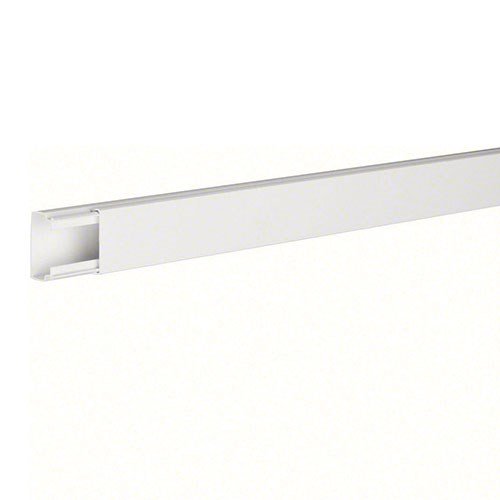
I suspect they are more or less the same as what Jula and Biltema sell.
The one that stands out is this:
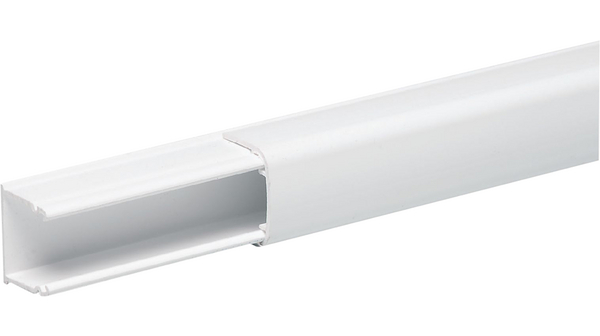
https://www.elfa.se/sv/installation...3=Kabelkanal&page=2&origPageSize=50&simi=98.0
It has a different design, and it's possible that this model is actually better.
In my case, I plan to place the list under the radiator pipes that are 19 mm above the baseboards. I assume 20 mm can be squeezed in, otherwise with a little modification, but one wonders how easy it will be to open the list later. In our case, the list will likely be opened twice a year to put up and take down Christmas lighting.
Maybe it's better to stick with Biltema/Jula anyway, even if they are tricky to work with?
The list I have today is, as mentioned, from Jula/Biltema and right here there is a list that is 15 wide and 12 high, currently only speaker cable runs through it. Since they are somewhat narrower, I have placed them in the middle between the baseboard and the radiator pipe holder, which makes it at least a little easier to open even though it's still quite tricky.
The advantage of going with Biltema and Jula is that there is a model that is even smaller that can be mounted on the wall for the lights.
I suspect they are more or less the same as what Jula and Biltema sell.
The one that stands out is this:
https://www.elfa.se/sv/installation...3=Kabelkanal&page=2&origPageSize=50&simi=98.0
It has a different design, and it's possible that this model is actually better.
In my case, I plan to place the list under the radiator pipes that are 19 mm above the baseboards. I assume 20 mm can be squeezed in, otherwise with a little modification, but one wonders how easy it will be to open the list later. In our case, the list will likely be opened twice a year to put up and take down Christmas lighting.
Maybe it's better to stick with Biltema/Jula anyway, even if they are tricky to work with?
The list I have today is, as mentioned, from Jula/Biltema and right here there is a list that is 15 wide and 12 high, currently only speaker cable runs through it. Since they are somewhat narrower, I have placed them in the middle between the baseboard and the radiator pipe holder, which makes it at least a little easier to open even though it's still quite tricky.
The advantage of going with Biltema and Jula is that there is a model that is even smaller that can be mounted on the wall for the lights.

Schneider's optiline comes in quite a few sizes, there is one that is 12x20 (12 high and 20 wide) and one that is like 12x40 or something (12 high 40 wide)
Then Obo also has a series but I don't think it's as nice looking as Schneider.
Then Obo also has a series but I don't think it's as nice looking as Schneider.

Yes, I could probably fit 20 mm under the element holders but 20x12 is unnecessarily large for running one lamp cable. Probably 12-15 mm would have been enough, which they unfortunately don't seem to have. Otherwise, I agree that their Opto line list looks good.Hojte said:
OBO looks exactly like the one you can buy at Biltema, doubtful if it really is better?
They seem to do more for industry with open sides? I've given up on self-adhesive, tried to attach good self-adhesive on a larger strip but it doesn't hold well, so it will have to be drilling into the concrete walls to attach the strips.hsd said:
![[SH]](https://static.byggahus.se/forum/avatars/s/26/26336.jpg?1496665780)
If drilling and using wall plugs are not appealing, I can suggest a glue gun and hot melt adhesive. I have personally used this method to hang about 10 meters of cable lists in the basement. It holds at least for three network cables. I've also secured an adhesive cable list, installed by the electrician but that came undone, which holds the three-phase supply to the geothermal heat pump. Everything is still in place almost a year later.snowjim said:
They have the lid integrated so you stick on the strip, lay the cable in, and fold down the lid. The glue absorbs unevenness, so it sits firmly even on rough concrete. I've usually secured it with a screw at each end, but it seems unnecessary with these. The series has outer and inner corners, as well as angles. Available, for example, here:snowjim said:
https://www.storel.se/sto/rootCategory/Installationsmaterial-%2811-15%2C-17%2C-18%29/11---Kabelstegar-ellister-kanaler-kabelvagnar/Mini--matarkanaler/Minikanaler/MINIKANAL-2M/p/1170803
Last edited:
Aha, how does this work then? The times I've used hot glue, it sets in about 5-10 seconds, which makes it very difficult to glue larger items (before the glue hardens)?[SH];2638702 said:If drilling and plugging doesn't appeal to you, I can suggest a glue gun and hot glue. I've personally hung up about 10 meters of cable ducts in the basement with this method. It at least holds for three network cables. I've also attached a self-adhesive cable duct, which the electrician put up but came loose, it holds the three-phase power supply to the ground source heat pump. Everything is still in place almost a year later.
Then there's the question of whether they withstand opening and closing the duct twice a year. The ones we've put up so far have been quite stiff to both open and close, which has caused those glued to come loose from the wall immediately.
Yes, I've seen that some strips have an adhesive that's thicker and softer, making it possible to attach them to uneven surfaces like plaster. The previous owner of the house had actually used those, and they left really ugly marks when they were removed. I remember that the adhesive tape with a bit of foam stayed partially on the wall, so I had to clean it off with a special solution, which in turn made the silicate paint yellower, so I ended up having to repaint.hsd said:They have the cover integrated so you stick the strip, place the cable inside, and fold down the cover. The adhesive absorbs irregularities, so it sticks firmly even on rough concrete. I usually secure it with a screw at each end, but it seems unnecessary with these. The series has outer and inner corners as well as angles. Available for example here: [link]
Some strips are really tough to open and close, especially the smaller ones, which means the adhesive tape likely won't work in the long run if you need to open and close them twice a year. This seems to mainly apply to the smaller strips, which I will need in this case.
I've accidentally bought those strips where the cover is integrated, like the one you linked to. For some reason, I didn't like them, but it was probably in connection with poor adhesive tape.
The glue cures quickly, yes.., applied glue on about 20 cm and pressed it against the ceiling, held it for a bit, and then the strip stayed even though it was two meters long. Just continue to glue and press.snowjim said:Aha, how does that work then? The times I've used smällglim it sets in about 5-10 seconds which makes it very difficult to glue larger things (before the glue cures)?
Then the question is whether they withstand opening and closing the strip twice a year. The strips we've put up so far have been pretty stiff to both open and close, causing those that have been glued to come off the wall immediately.
I saw that you open your strips now and then, and in that case, I would go for screws and plugs. The glue probably holds too, but there's a risk that you might have to re-glue at some points occasionally.
![[SKPG]Zamora](https://static.byggahus.se/forum/avatars/s/99/99332.jpg?1361526904)
Renovation rookie
· Östergötland
· 5 354 posts
The tape on Optoline is insanely strong, screws aren't really necessary. I still put in 3 screws but... belt and suspenders.

Only using screws, sure there are adhesives that hold, but if you ever need to remove the trims it's a nightmare.
I helped a friend remove cable trims after a home theater installation.
The trims were mostly in the ceiling/wall angle and corners on painted drywall, either all the foam stayed behind or the paper on the drywall came off.
It took an unreasonably long time to make it perfect again, patching screw holes would have taken fifteen minutes.
I helped a friend remove cable trims after a home theater installation.
The trims were mostly in the ceiling/wall angle and corners on painted drywall, either all the foam stayed behind or the paper on the drywall came off.
It took an unreasonably long time to make it perfect again, patching screw holes would have taken fifteen minutes.
Click here to reply