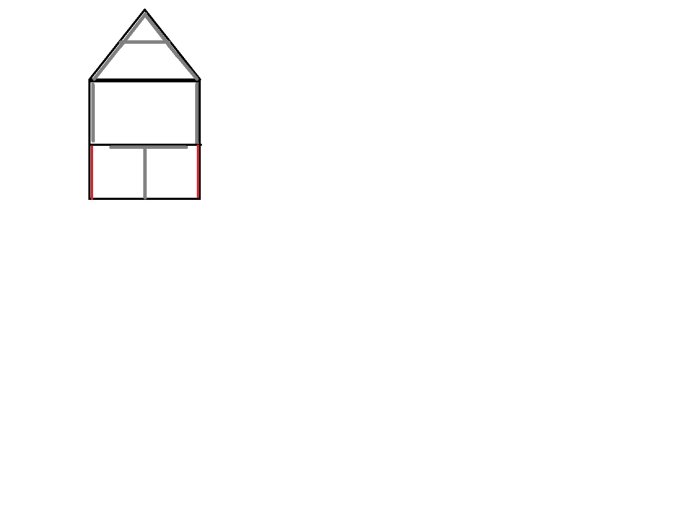
I have a barn that is 10 m wide * 30 m long. It has 2 floors. The ground floor has a low ceiling, which is why I'm considering removing the floor of the second story. The first floor is made of masonry concrete blocks and has a cast surface layer of about 5 cm on top. It's a sturdy wall. The second floor has wooden walls, and the attic is uninsulated. There is a lot of clutter and boards in the attic, so the weight is significant. The floors are made of wood, with slag in between as insulation. On the ground floor, there are load-bearing structures made of iron and 20*20 beams, with supporting pillars in the middle of the 10 m width.
What happens if the floor between the ground floor and the first floor is removed? The rafters in the attic seem to go down into the wall on the first floor, which in turn stands on the concrete wall in the ground floor. The entire barn is to be emptied of loose material and then demolished. Is there a risk that the walls might "collapse" outward at the joint between the ground floor and the first floor?
I realize I need to get a structural engineer to take a closer look, but it would be interesting to hear opinions and tips on what to consider, perhaps costs if someone has a similar experience. The barn was built around 1940.
Hello Korsö, a new forum member from the noble region of Halland
Welcome to the House Building Forum!
Exciting project, it seems like you've acquired an old farm or "horse farm."
How far off am I if I guess it's in the Getinge area?
I think it looks like a risk-free maneuver, as the roof structure is essentially unaffected.
What will the new ceiling height be, and what will you use the barn for?
Great that you're bringing in someone who can look at the construction!
Cost is hard to predict, as it's mostly demolition. And maybe you'll do that yourself.
I screwed on the correct height laminated wood 66x495 to the wall posts, then the old intermediate floor was demolished. This way, one had something to walk on while working on the new floor.
66 x 495 is sufficient for 270 kg / m2 with a 9 m span and C-C 1100 mm (1100 was standard in 1937) Cambering 15 mm.
270 kg is an intermediate between residential and industrial.
I would probably bring in a structural engineer to look at the stability.
There might not be a significant risk of the walls collapsing under pressure from above, but the wind forces from the side can be enormous and then the walls could collapse if there’s nothing supporting from the inside.
A collapse would surely result in death for a person in the building, so err on the side of caution.
Click here to reply
Vi vill skicka notiser för ämnen du bevakar och händelser som berör dig.