
12,658 views ·
33 replies
13k views
33 replies
Casting entrance stairs - hollow/polystyrene/EPS for lower weight?
Hello,
I'm in the process of planning a new staircase, model "pyramid staircase," for a house with a basement foundation, following drainage about 2 years ago. This results in it being a relatively large piece.
What methods are there to avoid casting the whole thing in a large block? Somehow hollow? Styrofoam core? EPS?
Big thanks in advance!
I'm in the process of planning a new staircase, model "pyramid staircase," for a house with a basement foundation, following drainage about 2 years ago. This results in it being a relatively large piece.
What methods are there to avoid casting the whole thing in a large block? Somehow hollow? Styrofoam core? EPS?
Big thanks in advance!

You insulate under the slab you first cast. Then you can build up Leca blocks as mentioned here. Then you form-cast. But there are those who have made a staircase from EPS with steps of granite. An alternative is to skip the form-casting and cover the blocks with finished steps.
How would it be to polish the leca blocks if you go for that solution instead of stair cladding?
I got the slope with, in some cases, tile adhesive and in others with mortar. Not much of a slope is needed, I have maybe 5mm per step or similar. You can even fix the slope by grinding for 30 seconds per step on the concrete block with an angle grinder with a diamond blade.F fredrik_pe said:
Yes, it was smooth. I would do the same thing again if needed. I like that it looks so exclusive, but doesn't cost too many thousands to achieve.
Finja has a simpler description for outdoor stairs. https://www.finja.se/diy/mura-utomhustrappan-av-murblock1
Thank you for all the input!
Another question on this, if one opts for a solution with lecablock, what is the best way to handle the "cavity" that exists in the facade under the door today? Where the old concrete stairs "went in". (See image). Should this be closed off in some way? Or do you build the lecablocks into it?
Another question on this, if one opts for a solution with lecablock, what is the best way to handle the "cavity" that exists in the facade under the door today? Where the old concrete stairs "went in". (See image). Should this be closed off in some way? Or do you build the lecablocks into it?
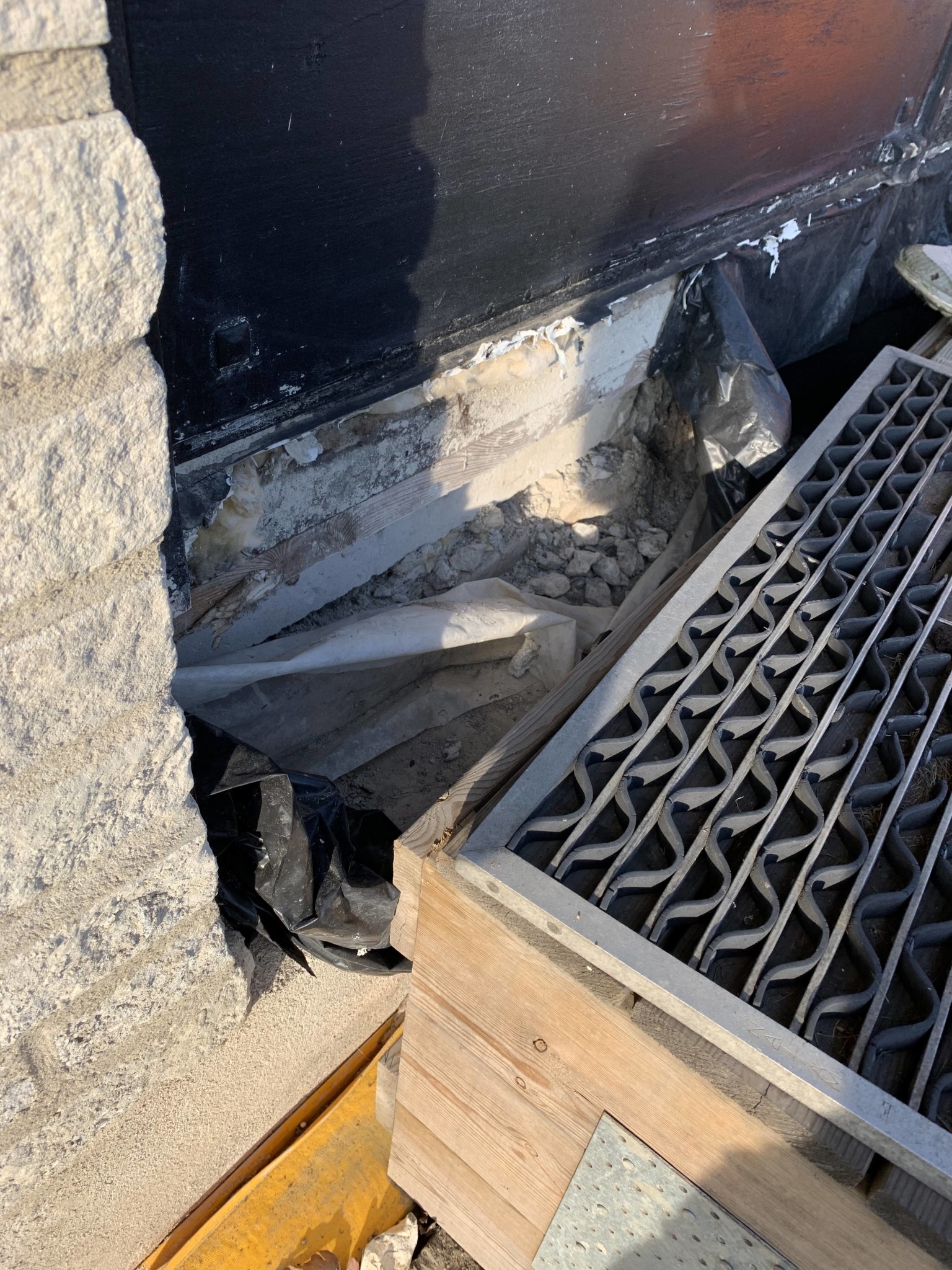
Both yes and no. You should not build without leaving a gap. If you have organic material, you should treat it with silicone first on the outside. Then there must be space on the outside so that snow and other elements do not melt and damage the inside of the threshold. You should not align the steps on the outside with the threshold. The gap you leave on the sides and on the inside against the door side should be sealed. A few centimeters are enough. This is always done where two materials meet to prevent cracks and counteract moisture migration. Then you need a slight slope outward to ensure water flows away from the building rather than towards it. About 1-2 degrees is sufficient. There are also recommendations for step width and how steep the stairs should be. Step height of 150-170 mm. Step depth at least 250 mm, and the total slope of the stairs between 30-45 degrees. However, it's difficult to achieve because you are limited. It is a matter of balance, simply put.
Hi, thanks again for the detailed response - much appreciated!Silver78 said:
Both yes and no. You should not build so there is no gap. If you have organic material, you should treat it with silicone first on the outside. Then there must be space outside so that snow and other things do not melt and damage the inside of the threshold. So you should not align the stairs externally with the threshold. The gap you leave on the sides and inside against the door side you seal. A few centimeters are enough. This is always done where two materials meet to prevent cracks and counteract moisture migration. Then you must have a slight slope outwards so that the water moves away from the building rather than toward it. About 1-2 degrees is enough. Then there are recommendations on step width and how steep the stairs are. 150-170 mm step height. Step depth at least 250 mm and the total slope of the stairs between 30-45 degrees.
However, it's hard to achieve because you are limited. It's simply a trade-off.
I have limited knowledge about this - made a simple drawing (in profile), have I understood it correctly?
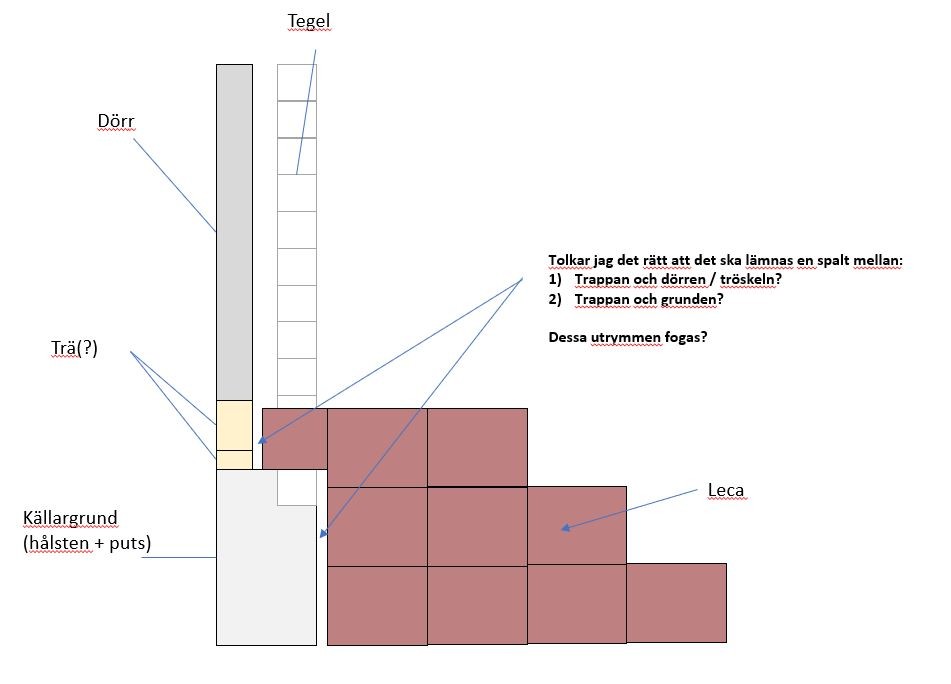
Just the gap below between the wall and the stairs, they used all kinds of methods to make it look as aesthetically pleasing as possible. They had asphalt paint and all sorts of things in between. The best option is obviously an open gap, but if you have a roof over the stairs with an insulated slab, then the moisture coming from above is negligible. That's what you don't want - for the stairs to absorb moisture and transfer it into the wall/foundation.