Surely you only plan to drive the cars just inside the gates? Not all the way in. Or is it intended as a four-car garage, with a few meters for a workshop or storage space at the far end?
If I were in your shoes and wanted to keep the cost down as much as possible, I would probably accept a pillar roughly in the middle of the garage. Then a fairly robust 12-meter long HEB beam resting between the gates, at the other gable and on a pillar 5-7 meters from one gable. Then it can be a relatively ordinary wooden floor on it.
If that pillar absolutely has to go, then we need to consider which path to choose; there have been many interesting suggestions in the thread. But in any case, especially now that I've seen it concerns a split-level house with a basement, if I were you, I'd start looking into the cost of brick or concrete walls, as well as concrete flooring. Technically, it's a very good choice for that house. Particularly since I assume you're planning a concrete slab under the house that will be an extension of the garage roof. Having wooden flooring that then suddenly transitions to concrete might cause some issues.
If you're going to have a pillar in the middle, the floor might need some reinforcement there. Also, reinforced edge beams in the gables where the load from the beam is directed down.
Regarding the floor plan ...
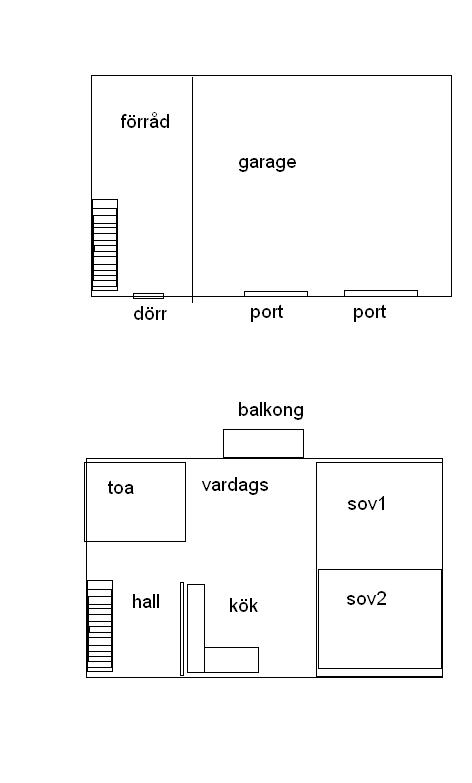
Doesn't it feel a bit odd that there is a staircase right in the middle of the kitchen floor?
But it can work. And done right, it can surely even become an exciting detail.
In the bathroom, the door opens inward, but usually, doors open outward in bathrooms and WC, as you have drawn for the WC.
And I don't quite get where the entrance is ...
You need to figure out what to do with walls and beams before pouring the slab. The loads will be completely different if you choose concrete. I think you need to contact a structural engineer with your questions. He can suggest different types of beams. One option is lättbetongbjälklag.
May I humbly suggest that you also have an architect take a look at your drawings. It's always good to have a second opinion, and an experienced architect can quickly see how certain solutions will work in reality and suggest adjustments. I did that in your situation, and I don't regret it for a second. The cost in the context is quite small.
First and foremost, thank you for the great feedback! There were a couple of responses at the end that I even missed amidst all the construction chaos.
We haven't made much more progress beyond what we've discussed here, except for a few steps that are setting boundaries.
The drawing has been slightly changed, and things have happened along the way. The staircase was moved when we finally found a spot that felt perfect. Because of this, the garage has been widened slightly.
The mistake is that it states the span is 920 cm, but it's "only" about 840. Additionally, there is a small partition wall in connection with the staircase, so for a large part of the room, the garage space is about 750 cm, which can be a crucial reduction for the span.
Half of the house has been built for many years, but it's just the garage slab and what's above it that are the challenges now. The sunroom and deck around it do not exist yet, but that will sort itself out.
The garage slab (the floor) is poured. At least one wall will be masonry (the back wall that is partially underground), and the other walls will likely be built with a wooden frame.
We will not pour a vault above; it became both too expensive and complicated, so we're skipping that.
However, we haven't nailed down the solution. This is on the advice of a structural engineer who determined that pouring a vault is not justifiable in any context unless you have several hundred thousand that you don't want to do something more fun with. Special care must be taken at every underlying stage. Right now, for example, our band beams will not survive a vault.
Currently, we're leaning towards having a beam running the entire depth (12 meters) in the middle to halve the floor joists of about 8m to 4m.
Ideally, we'd like to avoid columns, but it feels reasonable for there to be one or two, preferably just one, which could work well since beams are often 6 meters long.
Then it MIGHT suffice with 45x220 cc60 as floor joists. However, I have had poor experience with that before, so maybe we'll go with cc30 instead, or an alternative material.
The floor joists + underlying ceiling + the floor layer above (which will be kitchen, hallway, bedroom, etc.) must not exceed 30 cm, so you can't play around with just any beams. The reason for this is that we have fixed heights to adhere to since the new and old must blend seamlessly.
I'm very curious about steel beams, but I haven't had the chance to meet anyone with that expertise yet. Where does one call?
Alternatively, Leca beams as mentioned earlier in the thread. http://www.nystromscement.se/uplds/files/leca_bjalklagselement.pdf One or more, depending on direction. Perhaps two or three of this type could be placed in the short direction, with wooden floor joists in between them.
Responses to you:
Kalubah: We've brainstormed a bit with the architect at the technical department. Is there something specific you find odd, or was it just generally?
Mikael_L: The main entrance is in the hall/kitchen area above the garage, on the "left side." Then there is a utility entrance precisely mirrored, on the other side of the house. You can see from door to door.
The bathroom door opens inward, but that's because the bathroom is large enough that it's not annoying, but the hallway is extremely cramped!
It's tricky, all of this... But half the fun of building is figuring everything out—not least with your help.
Check out Kertobalk, I'm working on a garage with an upper floor now and have Kertobalk 45x360 floor joists, the trusses are constructed with this and are placed at cc120, and I have similar beams in between to get cc600. I sought out this solution to avoid having to lay lots of steel crisscross and avoid a pillar in the middle of the garage. Over the doors, I'm using a 7.5m HEA 160 beam that I have cast in place, spanning two doors at 2.5m each, so I get pretty good support on both sides since I only have 60cm between the doors. I have had all parts calculated and they're well within the margins for strength and deflection. I don't have the specific cost for the Kertobalk, but I've seen somewhere online that an 8m beam is just under 2000:- The good thing about kerto is that you handle them by hand and avoid cranes and other costly means to get it in place.
Thanks for the tip, but unfortunately, I can't have such a thick beam, it can only be 30cm high including the ceiling in the garage and up to the finished floor above, precisely because it's an extension that needs to blend with the existing house. Therefore, it might need to have a couple of columns, unfortunately. However, the beam supported by the columns can be a bit higher than the rest of the beams, I can live with that.
Kerto is available in other dimensions, e.g. 45x260.
Check out Beijer. They have so-called RAW laminated beams which are the same thing.
We made an 8cm threshold for the new section when we expanded, due to higher joists. It worked well.
Now we're talking weeks before this structure is in place.
There will be columns in the garage, one or two. We'll live with it, and I don't think they're particularly bothersome if placed smartly (in front of/behind where the cars are parked).
However, it will be 45x220 in 4-meter lengths on each side of the glue-laminated beam. There will be about 6mm deflection if you go with cc30, according to Moelvens’ calculation program. Is this something that might be annoying? Creaking, or the gypsum ceiling joints cracking if someone upstairs jumps?
On the other hand, I'm considering the suspension rod. If you take a beam, like 45x120, and screw it into the structure, then have it go up through an interior wall and then screw it into the roof truss... That specific point will be very stable. The deflection will be approximately 0, I dare guess.
But I don't know what the consequence will be if, let's say 10 beams out of about 40 are mounted on the suspension rod and not the others. It might have negative consequences? Not that I understand what that would be, but it's best to share ideas with folks.
On the other hand, it will be 45x220 in 4-meter lengths on each side of the glulam beam. It will be about 6mm deflection if you use cc30, according to Moelven’s calculation program. Is this something that might be disturbing? Creaking, or plasterboard ceiling joints cracking if someone jumps on the upper floor?
I believe (with some emphasis on believe) that it will be quite good.
In practice, deflection of temporary loads at least dimension a residential floor structure. It has to be stiff enough so that at least the glass in the display cabinets doesn’t clink when you walk across the floor.
There should be a maximum of 1.5mm deflection from a point load of 1kN. http://www.traguiden.se/TGtemplates/popup1spalt.aspx?id=1252
However, first there will be a deflection on the glulam beam of 9mm.
Then the floor structure has a deflection of 6mm.
I assume it's reasonable to view this as a total of 15, even though it's along two different axes, so the center of the house is probably 15 then.
There's a beam in the middle and then flooring extending 4m in both directions from the beam.
A tension rod seems to have a really good effect, but at the same time, the loads on the roof trusses that are impacted are quite significant, which they're not designed for, so it might get a bit too exciting.
Check out Kertobalk, I'm working on a garage with an upper floor now and have Kertobalk 45x360 floor joists, the trusses are constructed with this and are spaced at cc120, and I have similar beams in between to get cc600. I sought out this solution to avoid placing a lot of steel crosswise to avoid a pillar in the middle of the garage. Over the doors, I'm using a 7.5m HEA 160 beam which I've cast in, it spans over two doors at 2.5m each, so I get a pretty good support on both sides as I only have 60cm between the doors. I have had all parts calculated and am well within the margins for durability and deflection. I don't have the specs on the cost of the kertobalk, but I have seen somewhere on the internet that an 8m beam is just under 2000:- The nice thing about kerto is that you can handle them by hand and avoid cranes and other costly things to get it in place
Do you have a bit more info about your build? I'm planning something similar myself.
I can update the thread with how things have gone for me, by the way.
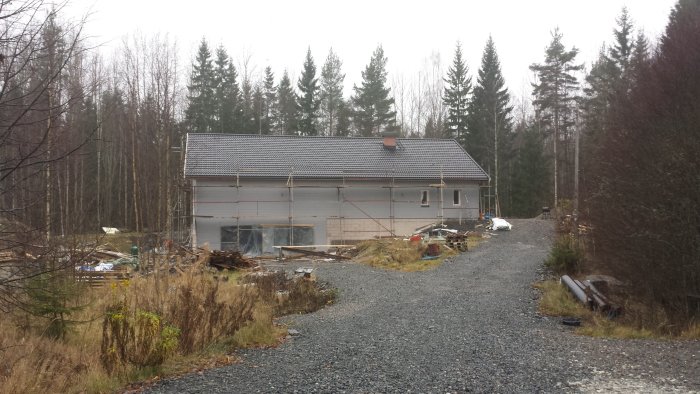
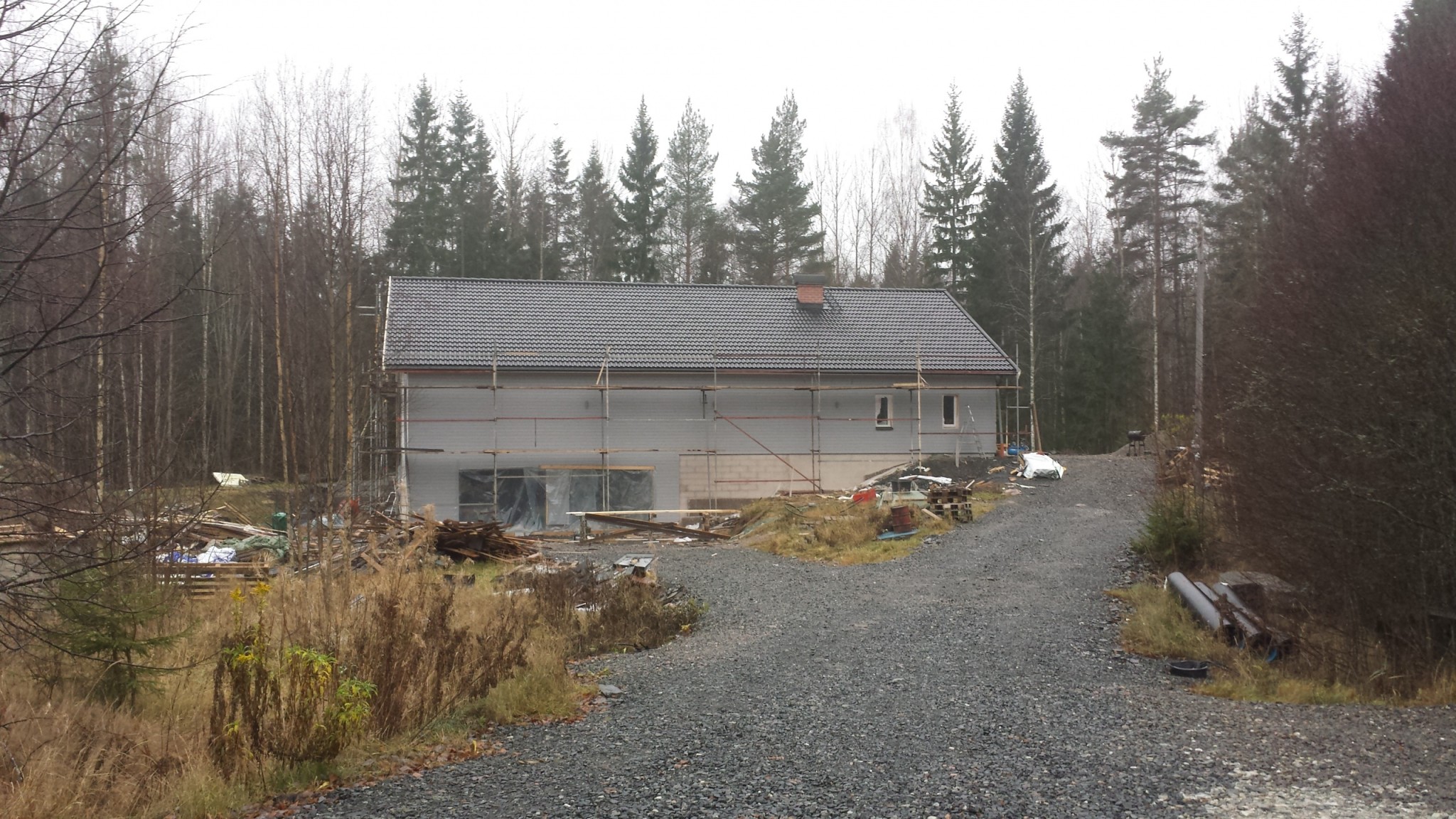
The house's shell is pretty much complete, the garage is in place, and the laminated beams are too. The floor above is currently just one large open space, so there are no inner walls or rooms in any way.
I bought laminated beams 140x405mm, and I have double of them, the entire length. It is about 12 meters long, so it’s 6-meter ones lying parallel, thus 12 in total. In the middle (the joint), I have a wall that is 90 cm long, which works somewhat like a pillar. I chose to make a wall instead of a pillar as the wall can serve many other useful functions. This wall is nothing too extraordinary, just 5 pieces of 45x220 with an OSB+gypsum on each side. The wall runs alongside the beams, to reduce the span further.
These laminated beams go approximately in the middle of the garage, in depth. Then I have 45x220 CC30 on each side going out towards the walls which are attached with joist hangers to the laminated beam. These, together with the laminated beam, form the floor joists on the upper floor.
I came up with the dimensions for the whole thing in conjunction with Moelven’s own beam calculation program, which makes it possible for just about any fool to dimension their constructions.
A picture of what the house looks like. One end of the beam (the double beams) is between the garage door openings, and the other end is 12.5 meters away.
ps: since everyone asks, YES there will be more windows in the future, as there will be rooms behind them!
Do you have any more info about your build? I'm planning something similar myself.
A bit of a bummer to clutter up the thread, but maybe it helps someone?
I'm completely new to this house building thing, even though I work in the construction industry
I was planning to build a garage with the possibility of an overnight apartment above if possible.
My brother-in-law built a large nice garage at 9.5x12m? if I remember correctly. He has two 3m wide doors and 3000? (sounds a bit high. It's probably lower) in ceiling height. No beams that I know of above the doors, just a glulam beam or 3-4 studs above and next to the doors.
At one end, he has a storage room of 9.5x3.5m I think. A stable wall that divides the garage.
The numbers might be a bit off.
I can find more exact measurements.
The way his garage is set up, you can park 4 cars with the doors open or 3 cars tightly across in front of each door. Not a bad thing, even if you collect some tools and stuff.
He only has trusses with cc60? or if it was even more spaced out.
Now, it's the design of the trusses and the number that allows for an apartment above the garage.
I was thinking of building something similar, and I'd prefer not to have a column in the middle of the garage.
The plans are to have a good ceiling height on the upper floor so that you can furnish each wall with, for example, a sofa. The roof can, of course, slope.
The question is if it's possible to cleverly insert some beams where needed and strengthen an upper floor so that you can avoid having a column and instead load off against the outer walls and the only inner wall in the garage.
The upper floor is intended to have a toilet/shower, living room - combined kitchen, 1-2 bedrooms, and a small balcony in the middle of the roof to get some light in the middle of the upper floor.
Something like this. Not to scale by a long shot. Sketching something with a trackball as a pointer isn't always the smoothest.
Last edited:
Vi vill skicka notiser för ämnen du bevakar och händelser som berör dig.