
15,098 views ·
31 replies
15k views
31 replies
Garage with cc1200 on the walls and fire rating
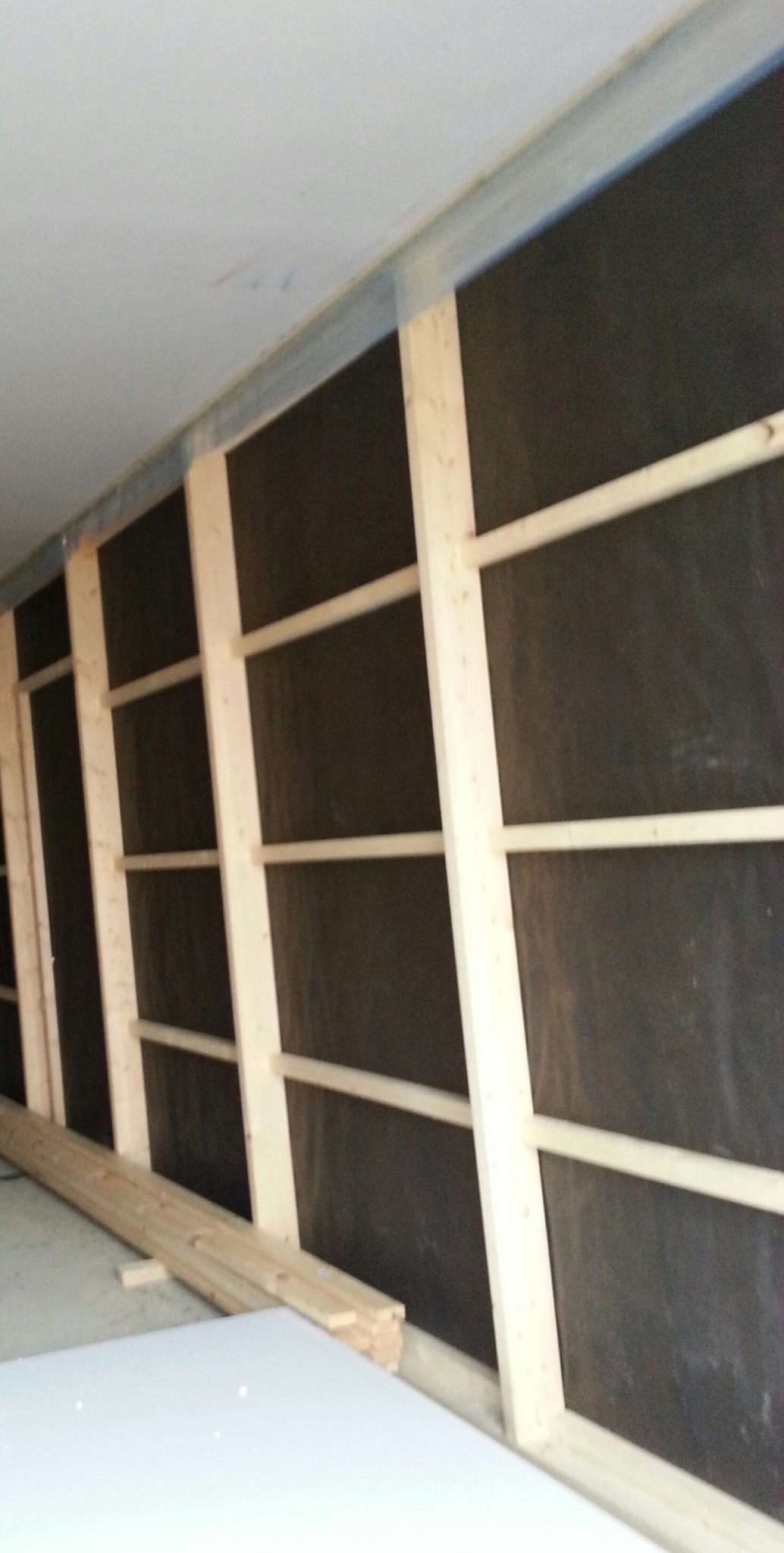
So I have a garage with cc 1200 on the walls. I'm going to insulate this and put up drywall.
My question is, it feels extremely shaky to put drywall on cc1200. Shouldn't it be cc600?
On the wall towards the house, I will need to put double drywall due to fire rating since the garage is less than 4 meters from the house. Can I instead use an OSB and a drywall sheet? Or does drywall have "better" fire rating?
If I then use OSB, is CC1200 sufficient or do I need to add more studs?
I'm wondering, there are already 45x45 running horizontally. The garage is a kit. The studs now are 45x120. How do you solve it if you need to put up more studs? Use 45x120 and cut out for each horizontal 45-stud? There is no stud that measures 75.
My question is, it feels extremely shaky to put drywall on cc1200. Shouldn't it be cc600?
On the wall towards the house, I will need to put double drywall due to fire rating since the garage is less than 4 meters from the house. Can I instead use an OSB and a drywall sheet? Or does drywall have "better" fire rating?
If I then use OSB, is CC1200 sufficient or do I need to add more studs?
I'm wondering, there are already 45x45 running horizontally. The garage is a kit. The studs now are 45x120. How do you solve it if you need to put up more studs? Use 45x120 and cut out for each horizontal 45-stud? There is no stud that measures 75.
Member
· Norrbotten
· 3 390 posts
Feel free to use OSB behind, not only for sheet stability but also for the ability to hang things in a garage (which you often do). Place the OSB sheets horizontally to get staggered joints, lay them in a block bond (staggered by half a sheet).
I assume you are aiming for EI30, which is normally the case in a garage construction. http://www.norgips.se/projektering/trastomme
You thus need single plasterboards on both sides of a 70s stud with insulation in between. There are also alternative solutions http://www.traguiden.se/TGtemplates/popup1spalt.aspx?id=1406
Personally, I would set it from inside out, plaster + OSB + stud/insulation + outside plaster + facade.
I assume you are aiming for EI30, which is normally the case in a garage construction. http://www.norgips.se/projektering/trastomme
You thus need single plasterboards on both sides of a 70s stud with insulation in between. There are also alternative solutions http://www.traguiden.se/TGtemplates/popup1spalt.aspx?id=1406
Personally, I would set it from inside out, plaster + OSB + stud/insulation + outside plaster + facade.
Member
· Norrbotten
· 3 390 posts
Read a little carelessly.
...Or better yet, use plyfa instead of OSB.
Do you now have a 45-rule lying inside the 120s studs and these 45x45s are set at cc 1200? Then I would just complement with additional 45x45s so that you have cc 600, but first tuck in the insulation in the standing frame.
In most cases, you can replace a clad gypsum board with a wood panel, i.e., 1 gypsum + plyfa can suffice to achieve EI30.
For REI30, at least 95s studs are required if using c24 timber, otherwise 120mm:
http://www.isover.se/files/Isover_S...yrer_Bygg/IsoverBoken 200709/konstr_brand.pdf
...Or better yet, use plyfa instead of OSB.
Do you now have a 45-rule lying inside the 120s studs and these 45x45s are set at cc 1200? Then I would just complement with additional 45x45s so that you have cc 600, but first tuck in the insulation in the standing frame.
In most cases, you can replace a clad gypsum board with a wood panel, i.e., 1 gypsum + plyfa can suffice to achieve EI30.
For REI30, at least 95s studs are required if using c24 timber, otherwise 120mm:
http://www.isover.se/files/Isover_S...yrer_Bygg/IsoverBoken 200709/konstr_brand.pdf
Member
· Norrbotten
· 3 390 posts
The picture?

So you don't want to increase the wall thickness (and insulation) inward even a single mm more than absolutely necessary?
Otherwise, the simplest solution would have been to place horizontal studs (45x45) internally (cc 60 cm)?
Cut 3"x2" holds 75x50 mm.
Otherwise, the simplest solution would have been to place horizontal studs (45x45) internally (cc 60 cm)?
Cut 3"x2" holds 75x50 mm.
I want to try to maintain the width of the garage. It is only 3.4 m wide so it is not a gigantic garage.
Then I want to have the smoothest solution possible to be able to meet fire rating EI30. The big problem as I see it is that it is cc1200 and it feels a bit large for the plasterboard to be stable. I would gladly place an osb inside.
Then I want to have the smoothest solution possible to be able to meet fire rating EI30. The big problem as I see it is that it is cc1200 and it feels a bit large for the plasterboard to be stable. I would gladly place an osb inside.

You might want to make a Donald Duck solution.
Place 2 OSB panels lying down one above the other (do you have 240 in ceiling height?) and cut the OSB in length so that it starts and ends in the middle of a stud (i.e., cut it at 240cm, if you have normal cc measurements).
Then place the gypsum standing, across the OSB, screw it with 32mm drywall screws for wooden studs.
This solution is hardly compliant with any building codes and will likely suffer from issues like slightly bulging walls and certain difficulties in hanging very heavy objects.
After all, I might consider doing it myself, but future owners might view it as poorly done and unprofessional, potentially a hidden defect, so it's important to disclose this in advance.
However, depending on how critical the wall is, it’s not entirely unthinkable to do so.
I think you'll meet the fire rating, a wood fiberboard behind gypsum doesn't significantly reduce fire resistance compared to double gypsum. The mineral wool insulation and outer cladding also contribute to fire resistance.
This document should provide all you need to know about it.
http://www.stenull.paroc.se/produktdat/pdf_down/Brand_ljud.pdf
Somewhere towards the end, the addition method is discussed, which can be used for calculating non-standard walls.
Place 2 OSB panels lying down one above the other (do you have 240 in ceiling height?) and cut the OSB in length so that it starts and ends in the middle of a stud (i.e., cut it at 240cm, if you have normal cc measurements).
Then place the gypsum standing, across the OSB, screw it with 32mm drywall screws for wooden studs.
This solution is hardly compliant with any building codes and will likely suffer from issues like slightly bulging walls and certain difficulties in hanging very heavy objects.
After all, I might consider doing it myself, but future owners might view it as poorly done and unprofessional, potentially a hidden defect, so it's important to disclose this in advance.
However, depending on how critical the wall is, it’s not entirely unthinkable to do so.
I think you'll meet the fire rating, a wood fiberboard behind gypsum doesn't significantly reduce fire resistance compared to double gypsum. The mineral wool insulation and outer cladding also contribute to fire resistance.
This document should provide all you need to know about it.
http://www.stenull.paroc.se/produktdat/pdf_down/Brand_ljud.pdf
Somewhere towards the end, the addition method is discussed, which can be used for calculating non-standard walls.


What prevents you from placing 120x45 studs between the existing ones?
So you get the desired cc 600.
Two layers of plasterboard will probably be the simplest and cheapest.
You can hang quite heavy things on that.
And if you mark where the studs are, you can hang extremely heavy items there.
Addition: Sorry, I just saw that the 45x45 studs were recessed.
But splitting some studs so you get down to 75 mm isn't a big job.
So you get the desired cc 600.
Two layers of plasterboard will probably be the simplest and cheapest.
You can hang quite heavy things on that.
And if you mark where the studs are, you can hang extremely heavy items there.
Addition: Sorry, I just saw that the 45x45 studs were recessed.
But splitting some studs so you get down to 75 mm isn't a big job.
Last edited:
Member
· Norrbotten
· 3 390 posts
Exactly what I was thinking, but you write it betterMikael_L said:You could do a Kalle Anka solution.
Place 2 OSB boards lying down above each other (do you have 240 ceiling height?) and cut the OSB lengthwise so it starts and ends in the middle of a stud (i.e., cut it at 240cm if you have normal cc measurements).
Then set the gypsum boards standing, i.e., crosswise over the OSB, screw with 32mm drywall screws for wood studs.

Gypsum+plywood+120mm insulation easily meets EI30 (albeit only one-sided fire). Mikael_L's link was very good, well-packaged information.
Then you can say I have two options. Either split larger beams to the dimensions I need and do it properly, or go with laying OSB and risk it being a bit wobbly. Future buyers are not something I care about. I'm building the house now and plan to live there for many years to come. The ceiling height is 2.5.
