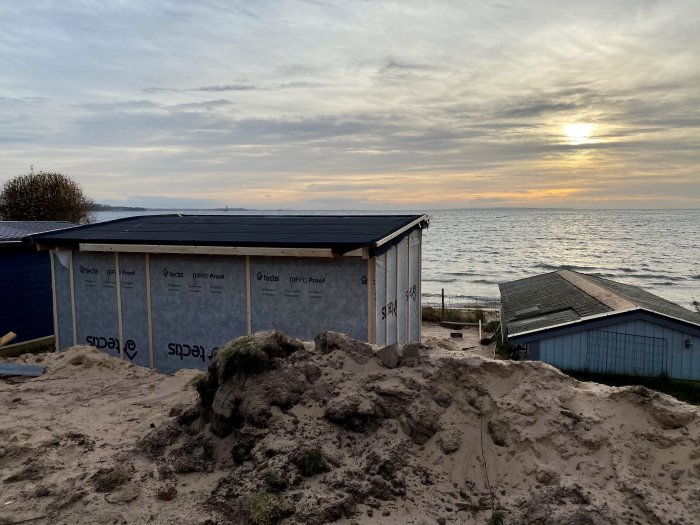
I am building a small shed (15 sqm) on pillars. There will be a small toilet area 140x140 cm and a small sauna 140x140 cm. The rest will be a room with a sliding glass section of 290x200 cm. In the sauna, there will be a large window, and the entrance to it will be from the outside. Outdoor shower next to the entrance to the sauna. The roof will have sedum.
We will (at least for the first 5-10 years) only use the shed from April to October. The rest of the year, we will maintain 8-10 degrees in the building. The sliding section will be a conservatory section with a thermal bridge for year-round use, and the windows are regular 2/3-glazed windows.
The building is located near a large lake, and it is often windy and rainy from the side. I want natural materials that breathe and can withstand getting wet and drying. I plan to use wood fiber insulation (boards).
The frame consists of 95 vents in the walls, 145 beams in the roof, and 170 beams in the floor. My plan is to have 95 mm insulation in the walls and then a vapor barrier and 45 beams/insulation on the inner walls for electrical work, etc. So in total, 95+45 mm insulation. 145 in the roof and 170 in the floor.
Now to my questions that I hope I can get some help with:
1. Do I need to have a diffusion barrier in the walls? Can't wood fiber insulation manage well without one? (there is of course a windbreaker)
2. Is it unnecessary to have the 45 insulation? The inner dimensions would be larger without it, and maybe 95 is enough? How would you do it?
3. Is a diffusion barrier/vapor barrier needed for the insulation in the roof? The floor?
4. Is plastic or a diffusion barrier required for the inner walls of the sauna?
I hope these questions ended up in the right forum.
Tips, thoughts, and ideas are gratefully received.
I'm in the process of building a small garden house (15 sqm) on piers. There will be a small toilet area 140x140 cm and a small sauna 140x140 cm. The rest will be a room with a sliding door 290x200 cm. The sauna will have a large window and the entrance to it will be from the outside. Outdoor shower next to the entrance to the sauna. The roof will have sedum.
We will (at least the first 5-10 years) only use the garden house from April to October. The rest of the year we will maintain 8-10 degrees in the building. The sliding door will be a conservatory part with a broken thermal bridge for all-year use and the windows will be regular 2/3-glass windows.
The building is located near a large lake, and it is often windy and rainy from the side. I want natural materials that breathe and can withstand getting wet and drying. I am planning to use wood fiber insulation (boards).
The framework consists of 95 studs in the walls, 145 studs in the roof, and 170 studs in the floor. My plan is to have 95 mm insulation in the walls and then a vapor brake and 45 studs/insulation on the interior walls for wiring etc. In total, 95+45 mm insulation. 145 in the roof and 170 in the floor.
Now to my questions, which I hope I can get some help with:
1. Do I need a vapor barrier in the walls? Doesn't wood fiber insulation perform well without it? (there is of course a wind barrier)
2. Is the 45 insulation unnecessary? The internal dimensions will be larger without it and maybe 95 is sufficient? How would you do it?
3. Is a vapor barrier/vapor brake needed for the insulation in the roof? Floor?
4. Is plastic or a vapor barrier needed in the interior walls of the sauna?
I hope these questions are in the right forum.
Tips, thoughts, and ideas are gratefully received.
[image]
Strongly suspect this will become yet another dogmatic opinion thread, but here are my thoughts to start with.
1. Do not use plastic in a sauna. Use sauna foil (alu+paper). It aligns with your ideas about natural materials. Outside the sauna room, you can of course use plastic.
2. I would install a vapor barrier to keep moisture away from the insulation, regardless of what type of insulation it is. In a sauna, it can obviously become very humid.
3. Proper ventilation is the most important. If you get this right, you probably won't have problems regardless.
I am in the process of building a small cabin (15 sqm) on pillars. There will be a small toilet section 140x140 cm and a small sauna 140x140 cm. The rest will be a room with a sliding door section of 290x200 cm. The sauna will have a large window and the entrance to it will be from the outside. An outdoor shower next to the entrance to the sauna. The roof will have sedum.
We will (at least for the first 5-10 years) only use the cabin from April to October. The rest of the year we will maintain 8-10 degrees in the building. The sliding section will be a patio section with a broken thermal bridge for year-round use and the windows will be regular 2/3-glass windows.
The building is located near a large lake, and it is often windy and rainy from the side. I want natural materials that breathe and can withstand getting wet and drying. I am planning to use wood fiber insulation (boards).
The frame consists of 95 mm studs in the walls, 145 mm studs in the roof, and 170 mm studs in the floor. My plan is to have 95 mm insulation in the walls and then a vapor barrier and 45 mm studs/insulation on the inner walls for running electricity, etc. In total, 95+45 mm insulation. 145 in the roof and 170 in the floor.
Now onto my questions which I hope I can get some help with:
1. Do I need a vapor barrier in the walls? Doesn't wood fiber insulation manage well without it? (of course, there is windproofing)
2. Is it unnecessary to have the 45 mm insulation? The inner dimensions will be larger without it and perhaps 95 is sufficient? How would you do it?
3. Is a vapor barrier/vapor brake needed for the insulation in the roof? The floor?
4. Is plastic or a vapor barrier needed in the inner walls of the sauna?
I hope these questions are in the right forum.
Tips, thoughts, and ideas are gratefully received.
[image]
And by the way - what a sauna location! Hope we get to see many pictures!
Strongly suspect this will become another dogmatic opinion thread, but here are my thoughts to start with.
1. Do not put plastic in a sauna. Use sauna foil (alu+paper). This aligns with your thoughts on natural materials. Outside the sauna room, you can of course use plastic.
I assume you mean the inner walls of the sauna. What are your thoughts about the outer walls of the sauna and other outer walls?
2. I would install a vapor barrier to keep moisture away from insulation, regardless of what type of insulation it is. In a sauna, it can obviously become very humid.
Vapor barrier in the floor and ceiling as well?
3. Proper ventilation is the most important. If you fix this, you will hardly have any problems regardless.
Click here to reply
Vi vill skicka notiser för ämnen du bevakar och händelser som berör dig.