
5,331 views ·
14 replies
5k views
14 replies
Foundation and wooden joist, opinions on construction.
Renovating prospective bathroom and tore down to the crawl space. It looks as follows from the bottom up: there's a layer of sand in the foundation, dry and fine, no plastic. 30cm above the foundation are 170mm beams, subfloor of 17mm rough-cut planks. 150mm eco-fiber insulation boards in the compartments directly on the rough-cut planks without wind barrier/plastic. Then 22mm particle board. Vinyl flooring on top of the particle board. Visible gaps at obvious drafts, such as near plumbing, are sealed with foam sealant. Any obvious problem building this way besides it not being the warmest solution? The idea of building so open is that any moisture that occurs during other seasons can dry up just as quickly when conditions improve.
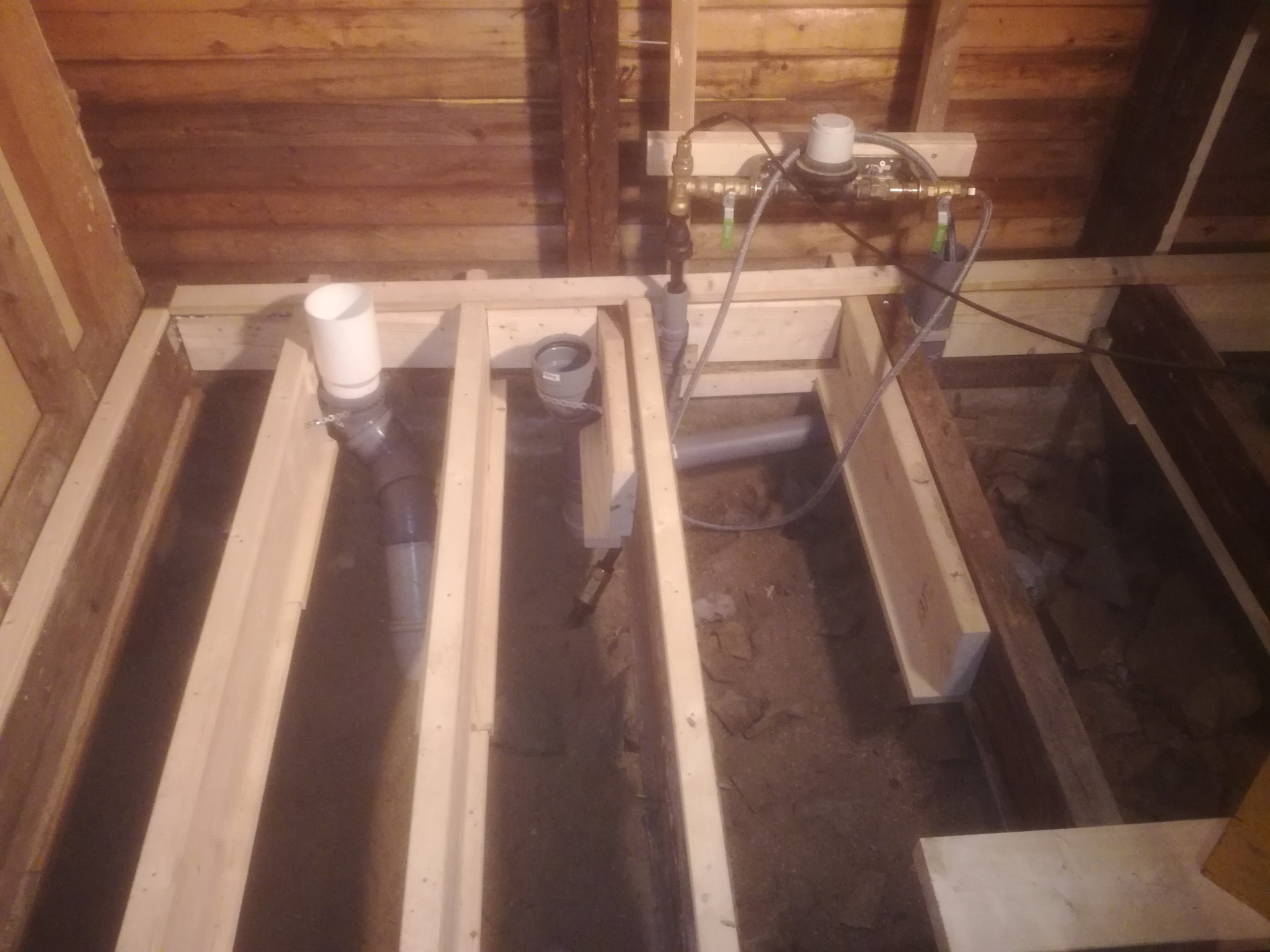

It looks excellent. It will be a good solution. I might possibly add a thinner dry bottom board and increase the insulation to 170mm. It will fit. You don't want 1-2 cm of air between the insulation and the floor chipboards. How did you get the incoming water into the sewer pipe? I was just about to say that you have water pipes coming up from the floor. Not entirely waterproof. I assume the idea is that if the connection to the water meter leaks, it will drain into the sewer? But I've never seen that solution before. Maybe it's the standard today?
It should be Trossbottenskiva....
I am also thinking about incoming water. Consider the distance between pipes and the finished wall. I believe it should be at least 5 cm for the flooring installer to be able to fit the mat. Check that.
I would probably put plastic on the sand anyway. Can't hurt. A hassle to do afterwards if you change your mind.
Member
· Västernorrland
· 12 078 posts
Incoming water probably doesn't go into the drain..........it's probably just a short pipe as protection in the floor. You can see something black under the beam there and it's probably incoming water from the ground.
The sewer pipe is just some extra protection for the water line,P Per i Hamrånge said:
It is a piece of sewer pipe for fastening and protection of incoming water. 10 cm to spare for the sewer to the wall at the shortest place, and the wall will build 2.6 cm. I have been thinking back and forth about putting plastic, but getting it completely sealed wouldn't be the easiest, any moisture that finds its way above the plastic would then also have a harder time getting out, so I went without it, time will tell if it was the right choice. There will be an air gap of about 1 cm between the insulation and the chipboard, could that have any disadvantages?P Per i Hamrånge said:
Now, 1cm isn't that much. But the insulation could settle a bit over time. You don't want an air gap under the floor. If cold air comes in from somewhere, it will circulate there and cool the floor. I would rather have 1cm too much than 1cm too little, so the compartments are really filled. But I don't think this is a huge problem.D D746 said:
Got the wrong text in the quote. Sorry
P Per i Hamrånge said:
It's definitely something to think about since the house is a bit drafty here and there now. Good tip.P Per i Hamrånge said:Now, 1cm isn't that much. But the insulation can settle a bit more over time. You don't want an air gap under the floor. If cold air enters from somewhere, it will circulate there and cool the floor. I'd rather have 1cm too much than 1cm too little to ensure the compartments are really filled. But I don't think this is a huge problem.

In addition to the points previously mentioned in this thread, I think you should line the compartments with some form of diffusion-open windproofing before the insulation. If it is a traditional, outdoor air-ventilated, crawl space, you should not have too much insulation in the joists. Around 15 cm usually provides enough heat leakage downward. It also depends on the temperature you will have in the bathroom.
It is 150mm insulation. Now I used 17mm raw boards as the blind bottom, without fabric or paper, and the chips are glued, so it will be what it will be, but I was thinking of trying paper in the compartments in another space, but wind fabric might be more convenient, better?
I think windduk can be more flexible and easier to seal. If you want to use papp, it shouldn't be too diffusion-tight. Thin asphalt papp like AC 150 might also work.
Click here to reply