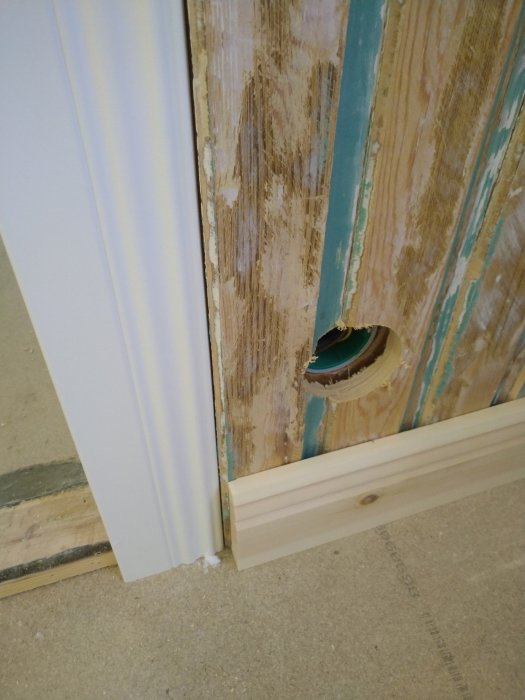
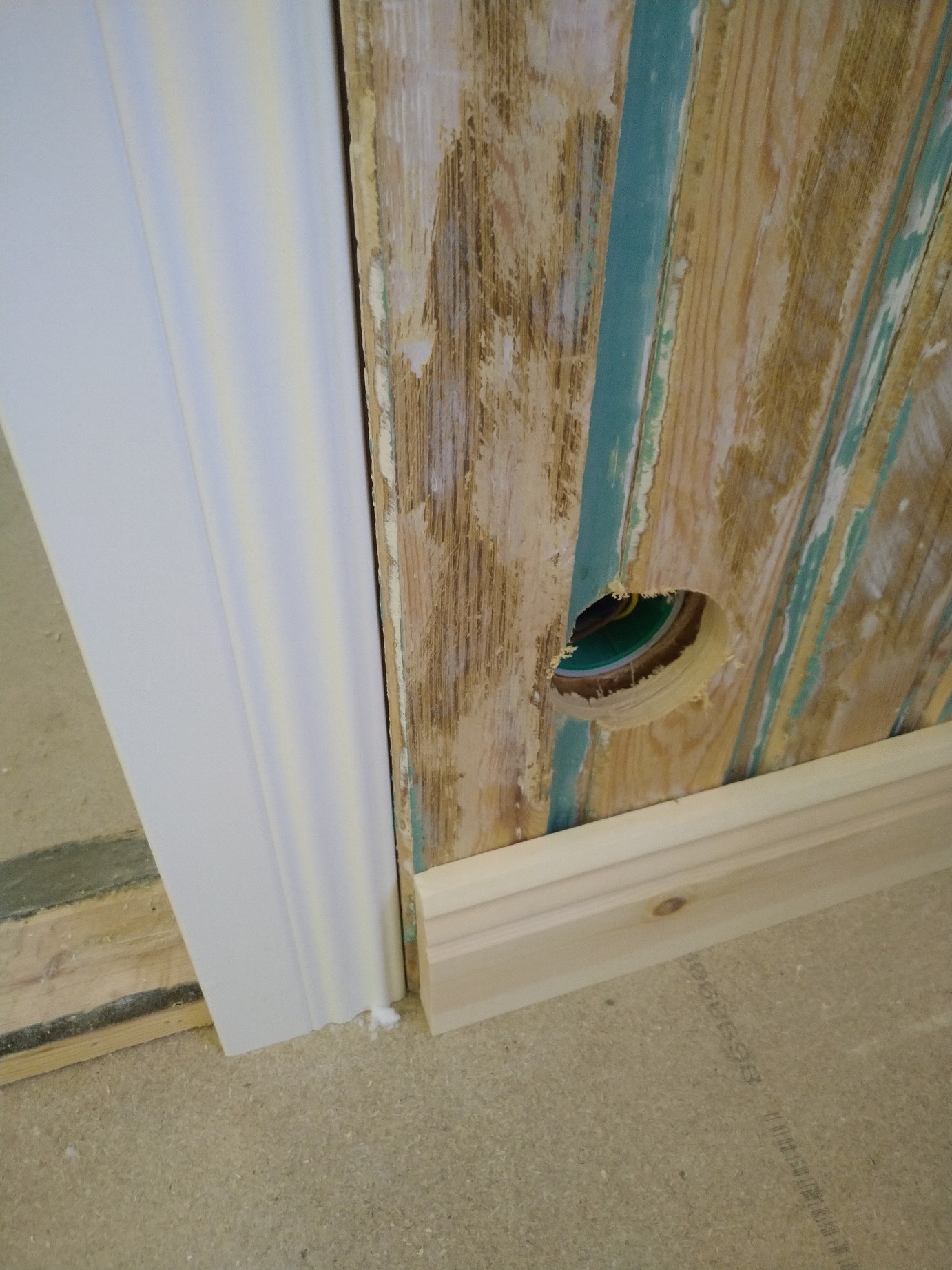
How do you best manage the transition between the door casing and baseboard when you have wainscoting (yes, I know the casing is upside down, this is just an example...)?
The original paneling I've reinstalled is quite thick - Almost an inch. If I place the casing over the wainscoting, I have to build it out almost an inch on the upper half of the door, and that might look strange? But if I place the casing directly on the wall, the baseboard ends up an inch further out instead...
What do you do?
Maybe some kind of compromise and build out the casing by a centimeter so it sits slightly outside the paneling and bevel the baseboard at the end?
Does the panel stick out beyond the lining? If not, I would probably place it flat against the frame and the panel, then put the baseboard outside the panel, and then make a custom corner piece to fit the purpose with the difference you have. But I'm not sure if that's a nice-looking solution either, you would want to check and "try" to see if it looks okay.
You could do as you mentioned too, but again, I'm unsure if that's a neat solution.
Yes, both the panel and the lining are at 'wall level'. Then the panel, as mentioned, is quite thick, so with today's standard lining, the front edge of the panel (and thereby the back of the baseboard) will end up about 5 mm outside the lining. The level difference between the front edge of the lining and the front edge of the baseboard will be about an inch, which feels difficult to magically make disappear with a corner block.
Yes, both the panel and the lining are at 'wall level'. Then, as mentioned, the panel is quite thick, so with today's standard linings, the front edge of the panel (and thereby the backside of the baseboard) will end up about 5 mm outside the lining. The level difference between the front edge of the lining and the front edge of the baseboard will be about an inch, which feels difficult to magically disappear with a plinth block.
Okay, if you had thicker linings that went outside the panel, I think it would be possible to make it work with a plinth block.
Then you must shim out the door lining anyway so it ends up outside the panel?
If I place the trim on top of the panel, it will be almost 5 cm thick above the wainscot. Will it look good?
Well, if for example, the panel is 13mm and the trim is 18mm, then you place the trim against the wall and door frame, resulting in a 5mm difference between the trim and the panel, then a baseboard, which for example is 20mm on top of the panel. This results in a total difference of 25mm, and I think you can make it look nice with a special corner block. But everything assumes first that the trim is thicker than the panel, otherwise, you still need to pad out the trim for it to protrude beyond the panel, and then you might as well do your solution since you'll have to pad it out anyway.
Yes, the problem is that the panel is 24 mm. So the solution might be to place a one-centimeter thick strip behind the casing so that it becomes about 30 mm thick all around. Then one should be able to hide the remaining approximately 15 mm between the front edges of the casing and the baseboard with a block or chamfering.
If I have the energy, I might plane down the baseboard a few mm too. It doesn't involve that many linear meters since there is kitchen cabinetry on a large part of the walls.
Can't you finish the baseboard by mitering it 45' and then cut a piece that is mitered 45' that is as thick as the baseboard? So that it becomes like an outer corner if you understand what I mean? If you make it go out just flush with the casing or a couple of mm out on the casing, it will probably look good.



useless said:
Yes, both the panel and the lining are at 'wall level'. Then, as mentioned, the panel is quite thick, so with today's standard linings, the front edge of the panel (and thereby the backside of the baseboard) will end up about 5 mm outside the lining. The level difference between the front edge of the lining and the front edge of the baseboard will be about an inch, which feels difficult to magically disappear with a plinth block.