We need some help with a technical building question. We are expanding the house, 2 floors.
On the upper floor, there will be a load-bearing wooden floor, but how do you do it technically? Do you lay the floor first and build the walls down to the floor, or do you build the walls first? And if so, how do you deal with the ends of the floorboards? (Considering that they are supposed to be load-bearing).
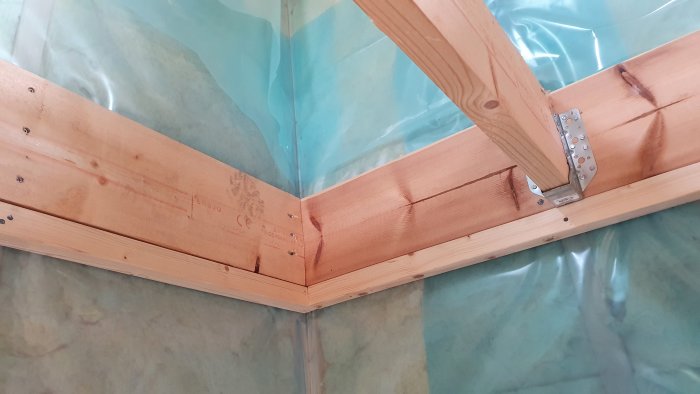
Attached is an image showing how it looks today. It is not framed yet, and the picture is taken from the ground floor looking up to the upper floor.
Easier if you lay floor chipboard before interior walls and floors on the upper floor.
Smart. That would have obviously solved everything. But then there's the little detail that the husband doesn't want floor chipboard unless the floor becomes load-bearing. (In order not to build up the floor too much in height.)
Just as @Jonatan79 writes, the simplest way is to start with the subfloor - then walls - then the intended floor - then moldings. If there should be insulation in between, you start with the "ceiling" first. It's easier to put in insulation than to work upwards.
Then persuade your husband to, for example, take chipboard plus a thinner floor.
Haha, yes we will probably have to "fight" about it at home. It is built with a difference of 30 mm between the new building and the extension, so then it should be pretty perfect with chipboard+floor.
if you want to build that way, I would rather have put up extra studs where the walls are going to stand. And then laid the floor in each room. Like they used to do in the past.
All responding at once (not quite in agreement with the app yet).
We've received some varied advice, and there are pros and cons to everything. We're leaning towards laying the floor first, so it rests against the intermediate floor, then building the walls. Advantage: simpler. Disadvantage: the floor is built under the wall. On the other hand, we're planning to lay a floor that lasts over time, and if it's ever replaced, the new one can be laid on top.
Thank you so much for all the input! It's really needed so you can think in different directions a few times before making a decision
I will do it in a similar way. Solid wood floor first and then the wall. However, there is a joist under the floor where the wall stands so that it is possible to saw off the floorboards along the wall without the wall falling down. In case it might be needed in the future.
Click here to reply
Vi vill skicka notiser för ämnen du bevakar och händelser som berör dig.



Jonatan79 said:

