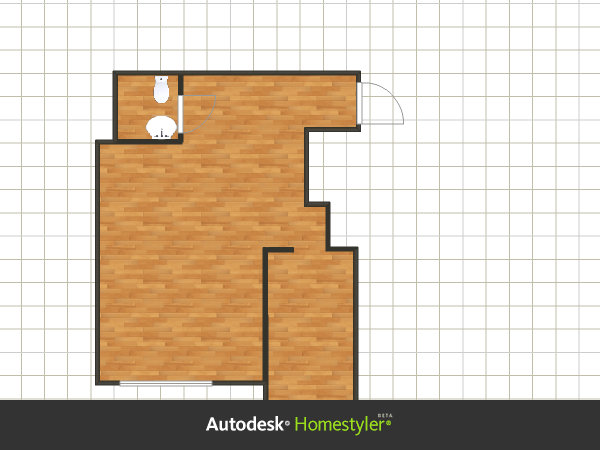
I have recently moved into a condominium according to the floor plan below.
Soon, I will be sharing this apartment with someone, which means there are a few things we want to address – mainly a separate sleeping area. (The bed is currently in the living room).
My idea is to put up a wall in the kitchen and convert the dining area into a small bedroom. The wall should ideally be as soundproof as possible. One idea is to use glass blocks in the middle of the wall (about 90x180cm) to let in some natural light to the kitchen.
The thought is also to make a hole in the wall in the living room and install a sliding door to create an entrance to the bedroom. The wall in question is not load-bearing and similar modifications have been done according to the board.
Current layout:
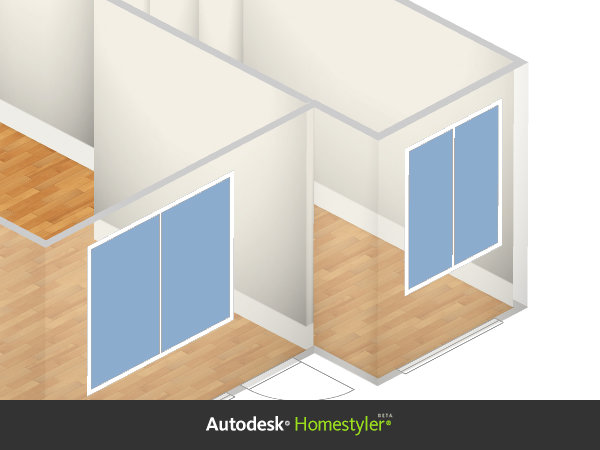
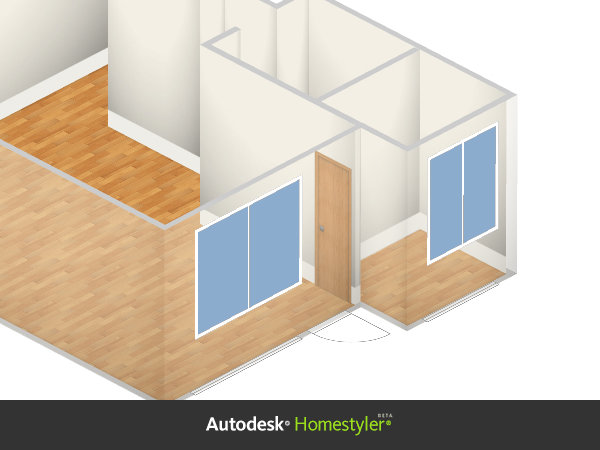
Plan:
(Note, it should be a sliding door, but Homestyler doesn't have any suitable presets)
Now to my question. Since I am completely inexperienced in this area, I wonder:
What could the cost be to:
Have craftsmen make the hole? (i.e. build the wall myself)
Have craftsmen do everything?
Material cost, approximately?
What is the best way to soundproof the wall?
I appreciate any tips I can get. I have tried reading up a bit, and the most challenging part seems to be the hole for the door.
In most countries, including Sweden, there are requirements for how much noise can be heard between apartments. There are also possibilities to classify a building into different sound classes so the market itself can steer construction towards apartments with better sound insulation for those who desire it. Sound insulation can now be a competitive advantage for property owners. Once the measurement is completed, a result is obtained consisting of data at all 1/3-octave bands between 50 Hz and 5 kHz. It is difficult to construct a regulatory framework based on these sound reduction curves; therefore, a standard for obtaining a few single-digit values has been developed. These are then used in the building regulations' requirement levels. The most common value is called the weighted reduction index Rw. Different adaptation terms can also be calculated to more fairly describe the perceived sound insulation. The adaptation terms, C-corrections, have been introduced to account for different spectra such as road and train noise spectra. When measuring sound insulation in ordinary houses, one cannot be completely sure that all sound has been transmitted via the partition wall. Such measurements are therefore called field measurements, and the weighted reduction index is denoted R’w. Reduction indexes conducted in a sound laboratory are denoted Rw.
[h=1]Rockwool[/h]
I know that solution is quite common in Stockholm, but personally, I think it would be better to have a bedroom without a window.
In that case, one could close off the kitchen door (preferably with some sort of window at the top for light), make the opening towards the living room as you planned, and create a small bedroom "behind" the kitchen, that area is somewhat "dead" anyway.
How large will this area be? It seems like you can't even fit a bed in there?
Since the house was built in '39, it's likely a brick wall. It's not a major issue to tear it down yourself if it's not load-bearing. Check if there are any electrical wires, etc., in the wall. Otherwise, just grab a sledgehammer or rent some type of larger cutting model and saw the opening for the door.
Why does the wall need to be soundproofed? Just fill it with mineral wool.
Considering the year it was built, it's probably a slag wall. If it turns out to be load-bearing, then it's brick. That would be more expensive, and a structural engineer must be contacted, among other things. Otherwise, you can just cut it open with a reciprocating saw with the right blade. It creates a lot of dust, so it's an advantage if the apartment is empty. I guess the wall is about ten cm thick. Where is the drainage/water in the kitchen area? Closest to the door? I would build the new wall with 70mm metal studs and insulation. Plywood and gypsum on top of that. Skip the glass blocks and install a window at the top near the ceiling above any wall cabinets. Keep in mind that if you're going to install an inset sliding door, you need to remove about double the door width to make room for the sliding door cassette. If you have a drawing with measurements, it's easier to calculate.
I know that solution is quite common in Stockholm, but I personally think it would be better with a bedroom without windows.
In that case, you could close off the kitchen door (preferably some sort of windows on top for light), make the opening to the living room as you planned, and create a small bedroom "behind" the kitchen; that area is a bit "dead" anyway.
That area becomes a bit too small, about 1m wide there. So unfortunately the only option is to convert the dining area into a bedroom unless you want to take from the living room - which we don't want!
How large will this area be? It spontaneously feels like you won't even fit a bed?
Since the house was built in '39, it's likely a brick wall. There are no major issues in tearing it down yourself if it's not load-bearing. Check if there are any electrical wires and so on in the wall. Otherwise, it's just a matter of grabbing the sledgehammer or renting some larger saw model and cutting out the hole for the door.
Why does the wall need soundproofing? Just fill it with mineral wool only.
The reason I want some sort of soundproofing is that I get up much earlier than my partner. The bedroom/kitchen will be very close, so a bit of soundproofing in the wall is desirable. Now, my partner isn't particularly sensitive, but if it's possible to do something relatively simple, it's very nice not to have to tiptoe in the mornings.
Considering the year of construction, it's probably a slag wall. If it unexpectedly turns out to be load-bearing, then it's brick. That would be more expensive and a structural engineer must be contacted, among other things.
Otherwise, you just need to cut it open with a reciprocating saw with the right blade. It creates a lot of dust, so it's an advantage if the apartment is empty. I guess the wall is about ten cm thick.
Where is the drainage/water in the kitchen area? Near the door?
I would build the new wall with 70mm metal studs and insulation. Plywood and gypsum on that.
Skip the glass blocks and install a window at the top towards the ceiling above any wall cabinets.
Keep in mind that if you're installing a recessed sliding door, you need to tear down about double the door's width to accommodate the sliding door cassette.
If you have a drawing with measurements, it's easier to calculate.
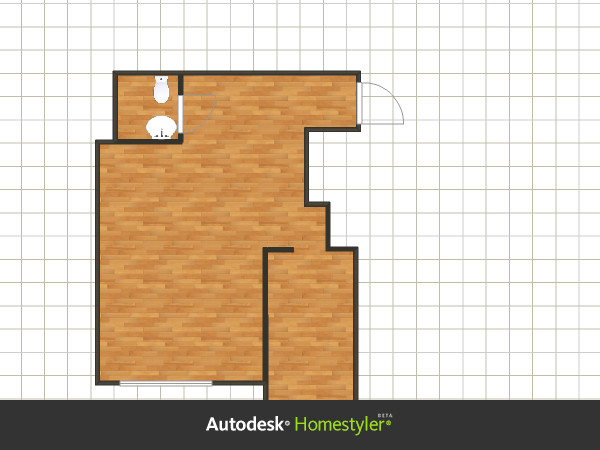
Drawing:
The distances are a bit hard to determine, but the dining area is 200x210 cm. Water/drainage is on the far side of the kitchen, seen from the window, so it shouldn't be a problem.
Glass blocks can look quite nice and hopefully a bit lighter than just a window by the ceiling. Example:
(picture taken from a Hemnet listing)
Regarding the sliding door, it's included in the calculation.
I think it was a completely okay solution with the glass, but I would have started with the glass above the bed so you don't have to look into the side of it. I.e. about 2 blocks higher up.
I meant that you could have used a broader section, not just extended the kitchen wall of course, but I see now that you've posted the actual drawing that the room itself is narrower than in the first drawing you posted.
Vi vill skicka notiser för ämnen du bevakar och händelser som berör dig.