
11,978 views ·
24 replies
12k views
24 replies
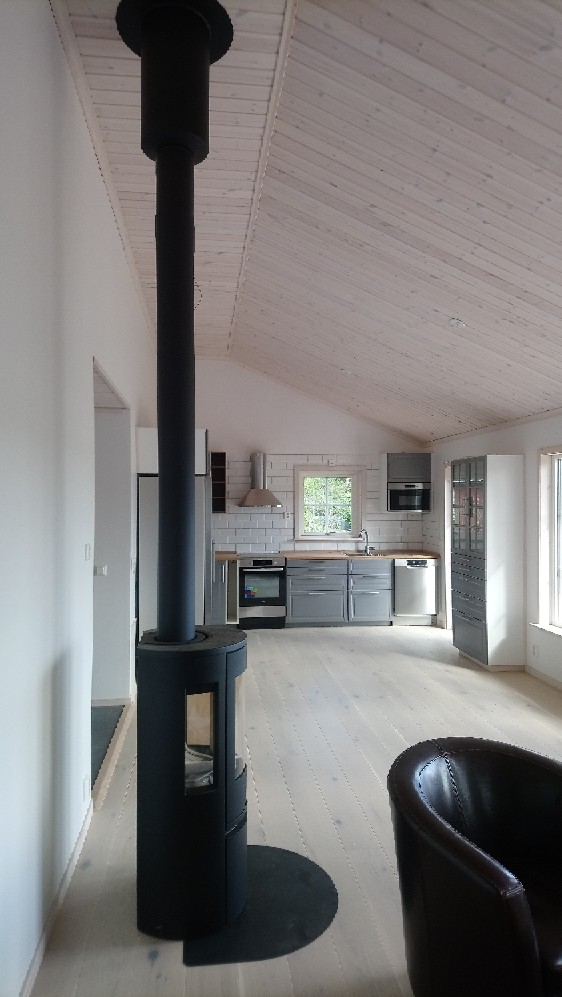
Firewall behind stove
The requirement actually concerns the maximum temperature on the wall during the most intense firing, which is interpreted as a distance to avoid measuring for each installation.S Denis Mahovic said:
We had our Contura stove installation, with partially uninsulated flue, rejected by the chimney sweep despite fulfilling the requirements in Contura's installation instructions. We then contacted Contura, who provided a certificate stating that a temperature measurement with approved values had been done by RISE (formerly SP). The chimney sweep approved based on this.
thanks for the response!F Frasse07 said:The requirement really concerns the maximum temperature on the wall during the hardest firing, which is interpreted as a distance to avoid measuring on each installation.
We had our installation of a Contura stove, with a partially uninsulated flue, rejected by the chimney sweep even though we met the requirements in Contura's installation instructions. We then contacted Contura, who wrote a certificate stating that temperature measurement with approved values had been done by RISE, (formerly SP). The chimney sweep approved it based on this.
The chimney sweep has already been here, he says that as long as I follow the installation instructions, there shouldn't be any danger...
the company doing the installation will do that...
I was thinking about another thing, how important is the air supply?
I was at biltema today, there isn't a pipe that matches the Contura (67mm)..
I'm considering skipping it since I have a crawl space, I would need to run the hose several meters to get the air supply in. Are there other solutions to this "problem" if you realize afterward that it doesn't work properly without the air supply?
I'm thinking about the oxygen inside the house...
with fresh air intake, it will work incredibly much better and you will have a more efficient system as you won't need to use already heated indoor air for burning.S Denis Mahovic said:thanks for the response!
The chimney sweep has already been home, he says as long as I follow the installation instructions there should be no danger…
that's what the company that installs it does…
I was thinking about something else, how important is it to have fresh air intake?
Went to Biltema today, there isn't a pipe that matches the Contura (67mm)..
considering skipping it as I have a crawl space then I would need to extend the hose several meters to get fresh air intake, are there other solutions to this "problem" if you later realize it doesn't work as it should without fresh air intake.
I'm thinking about the oxygen inside the house…
but take the fresh air directly from the crawl space then
but what risks are there with taking air directly from the crawl space, thinking about the embers?…A Aunty said:
I have a dehumidifier down in the foundation that runs constantly
there will not be any problems.S Denis Mahovic said:
someone will surely come soon and say that it will be bad from a moisture standpoint, but you don't need to worry about that.
you most likely won't be burning in the summer
okay,A Aunty said:
My idea is to cast a 110mm drainage pipe into the floor, and use a 100 mm aluminum ventilation hose to make the transition between 67 to 110... is this a good solution?
https://www.biltema.se/bygg/vvs/ventilation/ventilationsslangar/alu-ventilationsslang-2000040328
With a sealed crawl space and dehumidifier, the primary air should be drawn from outside the foundation. Otherwise, the dehumidifier will also have to handle the incoming air when it is more humid than the dehumidifier's limit value.S Denis Mahovic said:
Make the intake pipe with a 110-pipe all the way after the transition from the 67 mm hose. The smooth inside has much lower flow resistance than a corrugated hose, and it's also easy to hang up a pipe. You can fix the transition with a drain transition 70 to 110, seal with tape for ventilation pipes.
thanks for the response!F Frasse07 said:With a closed crawl space and dehumidifier, primary air should be drawn from outside the crawl space. Otherwise, the dehumidifier will also work with the intake air when it is more humid than the dehumidifier's threshold value.
Make the intake pipe with 110-pipe all the way after the transition from the 67 mm hose. The smooth inside has much lower flow resistance than a corrugated hose, and it's also easy to hang up a pipe. You can fix the transition with a drainage transition from 70 to 110, sealed with tape for ventilation pipes.
and being plastic doesn't matter?, now I don't think I'll get any embers in there but I'm asking anyway
No risk of embers falling down, secure construction. The air is drawn up behind the ash drawer through a completely clean area. (Combustible flooring is even okay under the stove, Contura's hearth sheet metal doesn't go under the entire stove just to easily pull a hose through the floor if you want to take air from outside. So plastic pipes are completely fine.S Denis Mahovic said:
Approved installation with maximum heat exchange.F Frasse07 said:No risk of embers falling down, secure construction. Air is brought up behind the ash drawer through a completely clean area. (Combustible floor is even okay under the stove, Contura's hearth plate of metal does not extend under the entire stove just to easily be able to draw a hose through the floor if you want to take air from outside. Completely okay with plastic pipes then.
Click here to reply