The moderator is welcome to move the thread if it ended up in the wrong forum.
Background:
I am planning to install a stove, haven't decided which one yet, but I'm leaning towards a Contura 620T. I have 195 floor beams, cc 60 with about 3.5m span, and have decided to reinforce from underneath the crawl space, just to be on the safe side.
The floor today consists of 22mm chipboard and on top of that a nasty, cheap 7mm click floor. I was planning to saw away the click floor where the stove will be and lay 30x30 tiles. The problem is getting to the right level with the tiles, the 7mm floor will be removed within a couple of years and replaced by oak flooring, probably 12-14mm.
I don't really know how to proceed, one could remove 5mm from the chipboard and skim coat before tiling, but will it hold? You can hardly get reinforcement in then...
Alternatively, you could saw away the entire chipboard where the stove will stand and notch into the floor beams and reinstall with various supports, but that feels like a lot of work.
How would you do it? Is it feasible to just prime the existing chipboard and lay tiles on it with adhesive or setting glue? We're only talking about 1m2.
Possibly it is still attached with sättlim (missed that you mentioned sättlim) but will probably crack at the joints between the boards. I would calculate what the height of the new oak floor would be and lower where the tiles are going to be by cutting into the beams. Possibly cut away a beam where the tiles are going to be and frame and insert new beams at the correct level.
Possibly it remains with setting glue (missed that you wrote setting glue) but it will probably crack at the joints between the boards. I would calculate what the height of the new oak floor would be and lower it where the tiles are to be placed by cutting into the beams. Possibly cut away a beam where the tiles will be and switch it out, installing new beams at the correct level.
Yes, notching into the floor joists is something I have considered might be necessary, but if anyone has other tips, they are gladly received. I am also interested in what someone knowledgeable thinks about milling/sawing out about 5mm from the particle board and self-leveling compound approximately the same amount. Will it hold or will the compound crack from the weight of the stove?
It seems tricky to rout into the chipboard. Wouldn't that mean it would be significantly weakened? I seem to recall that the middle of the chipboard is much more "porous" than the surface layers. Going down into the floor joists, possibly reinforcing for the sake of weight, and then floor gypsum is something to consider.
But what I meant to write is: You will make sure to install a duct for supply air to the stove down to the crawl space and out while you're at it and tearing into the joists.
It seems tricky to mill into the chipboard. Wouldn't that mean it would be significantly weakened?
I recall that the middle of the chipboard is much more "porous" than the surface layers.
Going down into the floor joists, possibly reinforcing for the sake of weight, and then floor gypsum might be something to consider.
But what I meant to write is:
You should take the opportunity to install a pipe for supply air to the stove down to the crawl space and out when you're working and tearing up the joists.
I realize that it might be nearly impossible to succeed, with a good outcome, in milling out the chipboard, but I had hoped someone had tips for shortcuts.
What feels a bit conflicted about making alterations to the joists is that I could potentially scrap the existing joists, make a header, and build up about a 1m Leca frame and mount a solid Tulikivi stove...
Imagine if I had been so unconcerned that I accepted a 15mm level difference in the floor, but if I had done so, I would probably be driven mad by it until I retire.
Can't you saw off the chipboard under the stove, put in some joists and lay a thinner chipboard (18mm)?
Yes, that's a thought, but then the problem with the self-leveling compound returns, is 5mm enough for a stove weighing about 300kg? And can you reinforce it that thinly?
If you cut away the click flooring
Install 6mm renovation gypsum and install thin tiles on this.
Alternatively, remove the click flooring and put a larger stone or metal slab at 13mm or something.
The latter option is obviously an alternative and a simple one. My thought with tiles is that it should match my newly renovated hallway, plus I already have the tiles at home.
The latter option is obviously an option and a simple one at that. My thought with tiles is that they should match my newly renovated hallway; besides, I have the tiles at home.
Now I'm just brainstorming...
One idea is to cast a clear ledge to place the tiles on, maybe 10 cm high that the stove stands on.
If you're going for dark tiles, you can mix in color, etc., which colors the concrete in the same shade and then polish it to a shine, etc
Isn't it possible to saw off the chipboard under the stove, build up and insert a thinner chipboard (18mm)?
I was thinking something similar: Why notch into the floor joists? Remove the chipboard, and double/block the joists. Then add two layers of floor gypsum and tile on top of that. It should be about the right level for the upcoming wooden floor. Would it be strong enough?
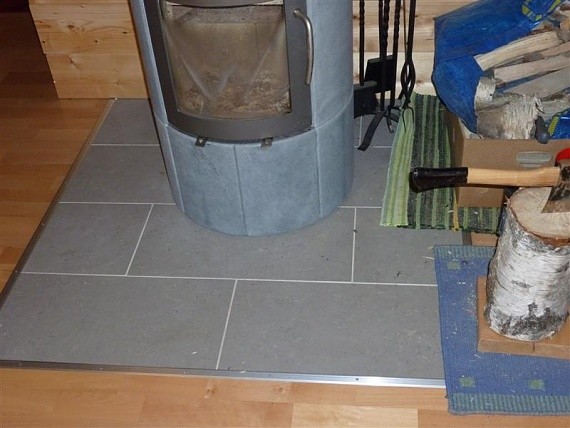
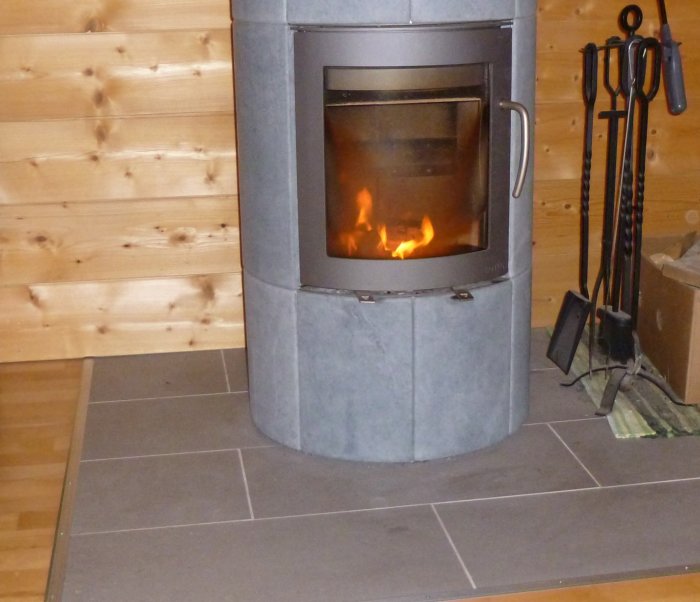
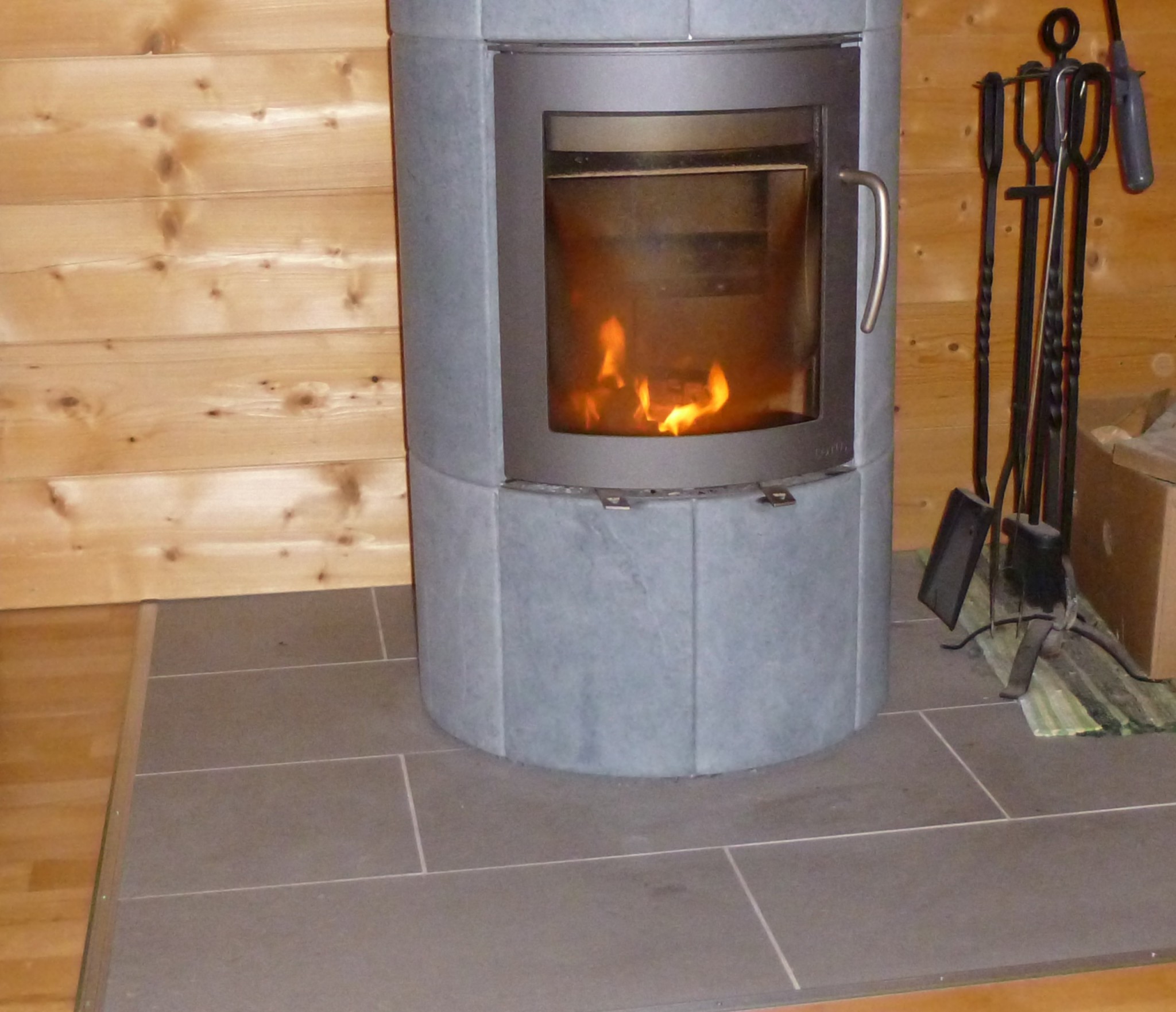
I agree that it's nice with tile under the stove, and it should ideally be on level with the surrounding floor. Like this
In this link, there are some different examples of how you can solve the tile/wood floor connection:
I was thinking something similar: Why notch down into the floor joists? Remove the chipboard, and double/brace the floor joists. Then put down two layers of floor gypsum and tiles on top. It should be roughly the right level for the upcoming wooden floor. Could it be strong enough? I agree that it's nice with tiles under the stove, and it should preferably be level with the surrounding floor. Like this [image] In this link, there are some different examples on how to solve the tile/wood floor connection: [link]
I think you just hit the nail on the head. So simple, why didn't I think of it from the start? But I think floor gypsum, reinforced leveling compound (got it at home), and then tiles would be even stronger, or am I thinking wrong now? Nice picture, is it the answer key here or
Yes, it's the answer key, the stove is still there. Now my wife just lit it for an evening fire the day before Christmas Eve
But I don't understand the thing about float screed and reinforcement.
Others can surely help you with advice and guidance on that.
My 545-kilo stove stands on the concrete slab, which is locally reinforced to 200 mm thickness.
There's probably a little float screed to match the level with the surrounding floor.
I have a Kakelugnspannan (about 1 ton with water) on steel plate treated with stove polish and it is 15 mm just like the surrounding parquet floor, admittedly slab on grade with underfloor heating, but if you go with that option, you place it over at least two beams if it is a wooden beam structure.
Vi vill skicka notiser för ämnen du bevakar och händelser som berör dig.