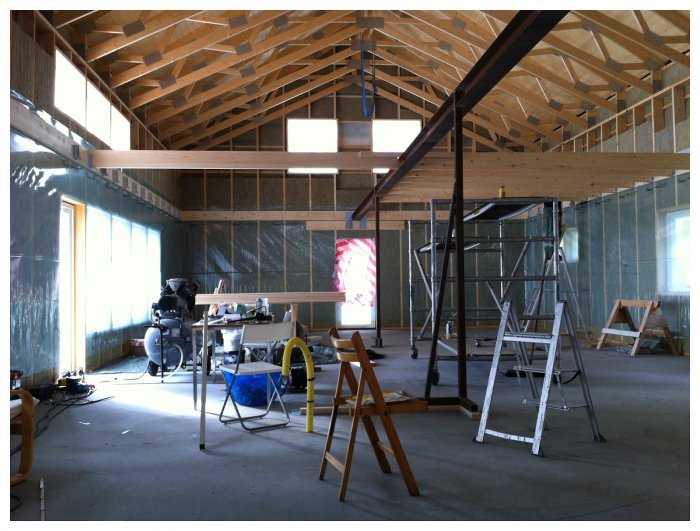
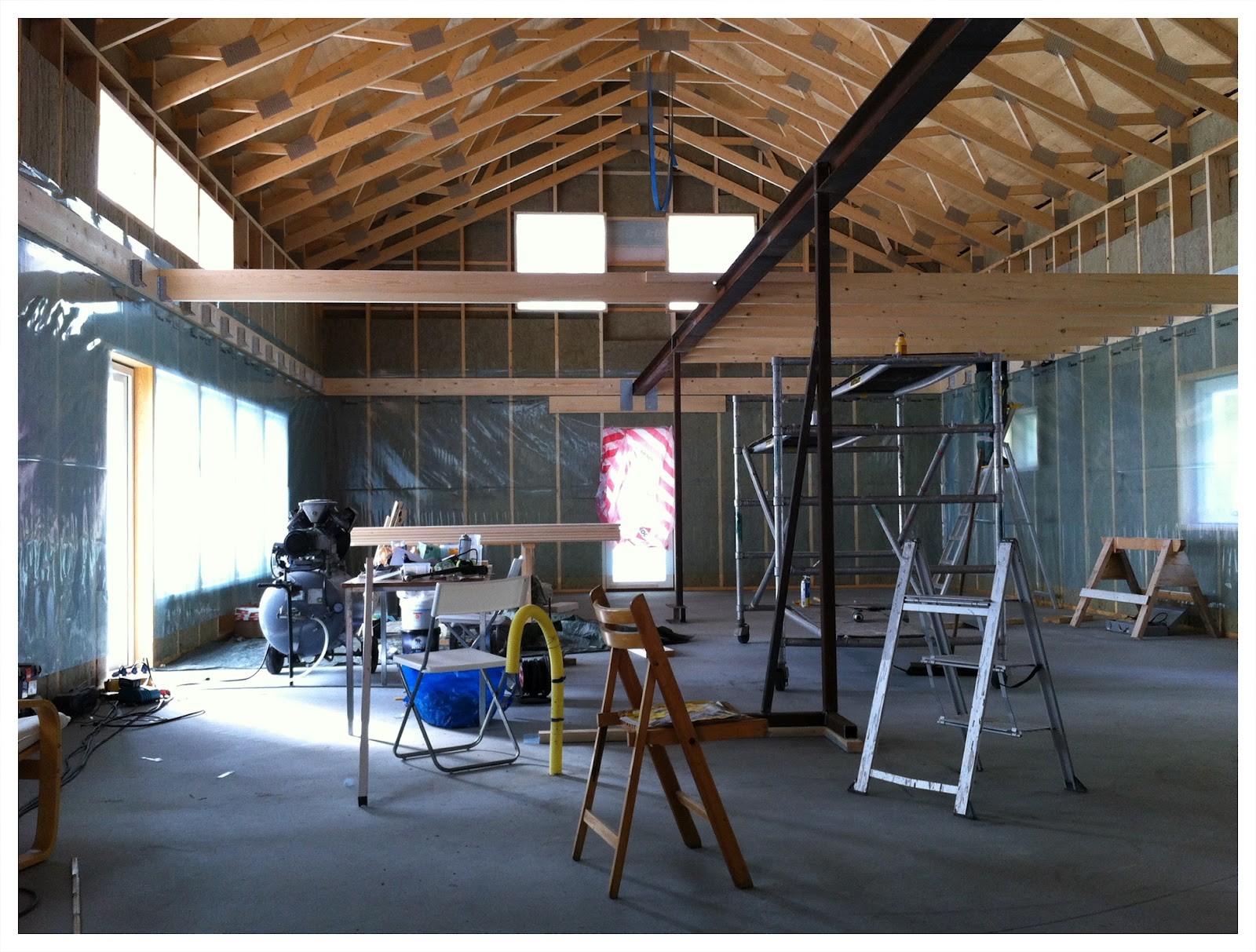
How do you attach the wooden beams to the steel beam if you go with option 1?
Option 2 involves less work on the steel as I see it, a not negligible advantage indeed.
Shoot or weld spike angles to the Hea beam, the joists don't need to be tight as they rest on the beam.
Sure, you can do that, but why not option 2 so you can screw/nail into wood instead? Or does the support become too short then (about 50 mm of wood resting on the beam instead of 100 mm)?
Of course, option 2 works but it seems to be a complicated and poorer solution, you have to bolt a rule against the Hea beam instead of attaching/welding or bolting angles directly to the Hea beam and getting a 100 mm support.
I have built two houses where the floor joists have been loosely placed on a steel beam, and it has worked without creaking. However, I recommend screwing and gluing the two floor joists together with a suitable joist on the top edge, as it provides a bit more stability to the construction and additionally supports the floorboards all the way.
If it is according to the drawing TS posted in post #1, then simple nail angles towards the side of the beam are sufficient. Fasten with self-drilling screws or shoot in place. It is only very minor lateral force, and any tensile force that needs to be absorbed.
...The two intermediate floor beam pieces meet in the middle and have been very carefully nailed together with birch veneer on both sides. This primarily serves the function of holding the intermediate floor beam together until everything else that holds the house together is in place...
Interesting thread with a time perspective of over six years!
You can almost hear the wings of history
But Gustavsson's and Gabbe1's constructions aren't the same, right?
But I'd like to make a small comment. Maybe someone has already mentioned it, if so, I apologize:
It is very important that the half rafters of the truss are connected to each other.
If this is not done, the roof could push the building's long walls apart when the roof weight increases, for example, with snow accumulation.
I have a similar solution to what Gabbe1 shows (Gustavsson's case1) on my house built in 2010.
The trusses were designed by Derome, and they delivered them with perforated strips to connect the split lower frames. They called them beam straps.
But the builder had a different idea: He extended the 220 mm lower frames with a 70 mm stud,
which he screw glued to the lower frames and the intermediate floor beams.
Just as Gabbe1 described.
The floor beam thus became 290 mm (with plenty of room for insulation). The HEA beam is 200 mm.
Oh, the Thread Lift World Championship went into the second round
I should learn to check dates before I reply. Hopefully, TS has gotten their mellanbjälklag and is still waiting for it
But Gustavssons and Gabbe1's builds are not the same?
Nope, my build pictures aren't even a year old.
KnockOnWood said:
But I want to make a small point. Maybe someone has already done it, then I apologize:
It is very important that the undersides of the trusses are connected to each other.
If this is not done, the roof can push apart the long walls of the building when the roof load increases, for example, due to snow accumulation.
In my particular case, the scissors trusses are self-supporting, and the intermediate floor is not required to "hold back" the trusses in cases like heavy snow load.
But if you have a construction where the intermediate floor simultaneously acts as the bottom chord, then it is of course as you wrote.
Old thread. But I'm bringing it up concerning preventing walls from being pushed out. Regardless of whether the trusses are self-supporting or not (who knows what impact strong storms might have on wall structures while the floor has a high load), I would obviously attach the studs on each side of the steel beam, using metal plates right across.
They are thin, so they won't make the floor thicker and you can plane down the floorboards for them, or alternatively, embed them in the beams. I would then place a long one on the underside and a long one on the top side, so they extend 30-40, preferably 50 cm into each beam.
That should reasonably correspond to the beams being "whole"/unjoined, or nearly so.
If you also have walls on the upper floor that run along the beams, I would plan so they are placed directly over the beams if possible, so you can also fasten some of the beams with wood.
Such measures should bind everything together so well that it would probably take a tornado class F5 to tear it apart
Old thread again, but the tip might be worth something to someone in the future
Click here to reply
Vi vill skicka notiser för ämnen du bevakar och händelser som berör dig.