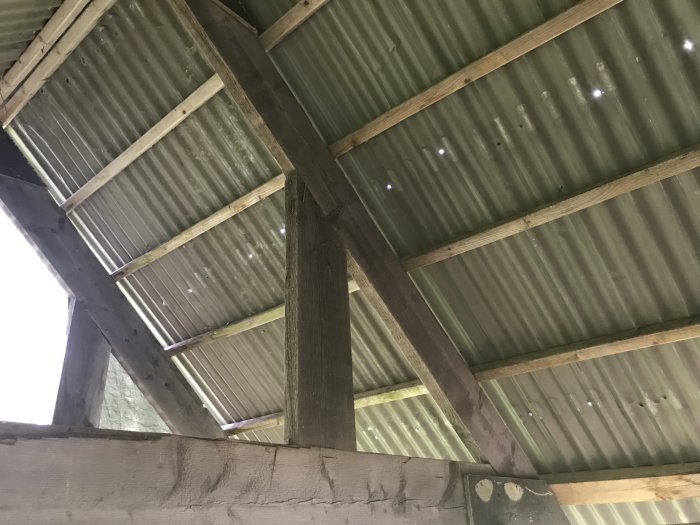
1200 mm is common because it is 2x600 mm. Before the advent of modular thinking, the standard truss c/c was more around one meter, adapted to the available dimensions of timber. From a construction point of view, 45 degrees is certainly the optimal roof pitch. Not only considering the snow loads but also due to various mechanical considerations. It is no coincidence that most old barns, which have stood since the early 1800s, have a 45-degree roof pitch. If there is a need to build high and with a larger span, there are many interesting solutions that do not rely on conventional trusses, even without using steel. But it requires some knowledge in what is often called "structural design", i.e., building construction.
Start with 1800 to begin with. If it then becomes ugly after one or a few years, you'll be motivated to add another truss between each so that it becomes 900 (which I happen to have on my house from -63).
Not an unreasonable thought if it works, and a plan B. But if the risk that 1800 is too far is high (which it likely seems to be), it will result in three extra roof trusses. These would then need to be retrofitted and installed, which means two extra trusses against a "normal" 1200-build, plus it likely means having to take down the roof to fit the trusses.
So, gamble plus plan B. Sounds tempting, but boo for plan B...
Could one option be that you don't place one of your trusses in the gable but build a gable that you cover with panel, which should make it sufficiently strong (maybe panel is required on both sides though), then you should be able to get a CC measurement of 135 cm to achieve a length of 5.4 m. It is at least a significantly smaller deviation from 120 cm CC.
If you want to increase the distance, you will need to increase the size of both the rafters and the purlins. I have an old barn with 1600 cc with rafters measuring 225x75, roof pitch of 35 degrees with shingle roofing and metal. Snow zone 2. It still stands, reasonably straight despite being over 100 years old. The metal was added in the 1960s.
The trusses are made of 45*195 studs (rather two-by-eight, but same difference) and the battens are 45*45 and are set as close as cc 500. The roof angle is 45 degrees.
When I measured the truss distances now, they were already at cc 1500 and 1400, so I would be far from the first in the farm's history to take some liberties and deviate from standard measurements.
We'll see how it turns out (if it becomes anything), but right now it feels tempting to put something together with cc 1600 and a few decimeters of overhang so that it becomes a carport just over five meters. The vertical posts would fit quite well in relation to normal car doors then as well if one were to choose to leave one long side open.
I like the question and would also like to learn more about large cc on trusses. After all, most churches are stone buildings with roofs supported by wooden constructions, often with a span of well over 10 meters and arched. I doubt they are at a mere 1200cc...
Then a practical, or perhaps rather an economic question: do you really gain that much (in terms of labor and money) by "avoiding" nailing one more truss compared to having to increase the dimension on everything else with just three trusses and 1800cc?
No, I don't think I'll win that much, if anything at all. It mostly started as a surprise that it was so difficult to find anything written on the subject. And then I was curious about where the issue might go with what I thought was an almost optimal example of when the construction should be able to withstand sparser rafters.
I simply like both hypothetical reasoning and unusual solutions if the circumstances allow it.
It is fascinating that modular thinking is so strong even in the DIY construction of simple outbuildings.
All the building materials you buy are adapted to the 600-measurement, so it's not that surprising. You can build with any measurements you want, but then nothing ready-made will fit... I would assemble one more truss, precisely because the ones you already have are adapted for the "standard module measurement" whether you like it or not, they are designed to be 1200 apart. The alternative, besides building completely new trusses, is to reinforce them, but it's probably easier to just put another one together, you already have a template.
The discussion becomes a bit scattered when we talk about very different conditions at the same time. Barn roofs are a topic of their own, even though one can learn a lot from them. I guess the c/c distance for the rafters in a barn of skiftesverk was around three or four alnar. Longitudinal purlins were placed on the rafters with a c/c suitable for laying the roof shingles. The really big deal was the roof slope. With 45 degrees, the snow load is halved. Additionally, you only need to account for 71% (cos 45°) of the distributed load on the rafters. But these were not roofs one would run around on, and insulation was not used.
The discussion becomes a bit fragmented when we talk about very different conditions at the same time. Barn roofs are a topic of their own even though there is much to learn from them. I guess the c/c distance of the trusses in a log cabin barn was around three or four alnar. On these trusses were placed longitudinal beams with a c/c suitable for laying roofing shingles. The real big deal was the roof pitch. With 45 degrees, the snow load is halved. Additionally, you only need to account for 71% (cos 45 °) of the distributed load on the high beams. But these were not roofs designed for walking on and insulation was not used.
That's how my grandfather's Småland barn roof was constructed! Oak posts with horizontal planks. Strong beams and a thatched roof laid on top, rye straw at the ridge. It was tight and fine for over fifty years and held up well to the snow, which could be plentiful on the highlands. Later, they put metal sheeting on it.
Barn roofs are a topic of their own even though you can learn a lot from them. I guess the c/c distance for the trusses in a timber-framed barn was around three or four alnar. On the trusses, there were longitudinal purlins with c/c that was suitable for laying the roofing shingles. The really big deal was the roof pitch. With 45 degrees, the snow load is halved. Additionally, you only need to account for 71% (cos 45 °) of the distributed load on the rafters. But these were not roofs you would walk on, and insulation was not present.
I think the analogy has quite high relevance since the conditions with the roof angle and non-insulated roof are the same. What I've called battens so far are actually purlins, and perhaps it is their dimension and density rather than the trusses one should consider when reasoning about this type of roof. If you now want to continue entertaining the idea that there may be more practical measurements than the standard offers.
It's not without wanting to get some thoughts from people like @heimlaga and @DennisCA who both adjust based on circumstances from time to time.
I probably know nothing about structural calculations and such, but I have received recommendations on the thickness of the rafters from heimlaga to use (6-8 inches) and the storage shed I plan to build is only 5x5 meters, so there will only be trusses on each gable. I haven't even thought of them as trusses, just a part of the gable. I chose rafters to avoid the requirements that exist around trusses.
But I haven't even taken the first step on that project...
Click here to reply
Vi vill skicka notiser för ämnen du bevakar och händelser som berör dig.