
2,559 views ·
9 replies
3k views
9 replies
Exterior wall with fire protection
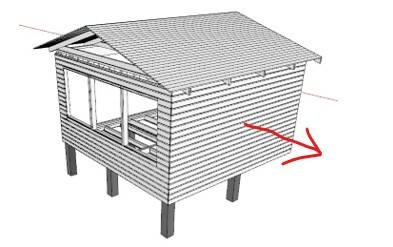
Hi, I am planning an extension that on the marked side will be 5.5 meters away from my outbuilding, which means the exterior wall must be built with fire rating EI30 or EI60, which is unclear to me in the attached table.
Does 0-8 m or 5-7 m apply?
Do I also need to modify the existing outbuilding from 1974?
The exterior wall is a simple stud wall 45x120 (see attached image) with horizontal siding. How should it be modified to meet EI 60 or EI 30?
Does 0-8 m or 5-7 m apply?
Do I also need to modify the existing outbuilding from 1974?
The exterior wall is a simple stud wall 45x120 (see attached image) with horizontal siding. How should it be modified to meet EI 60 or EI 30?
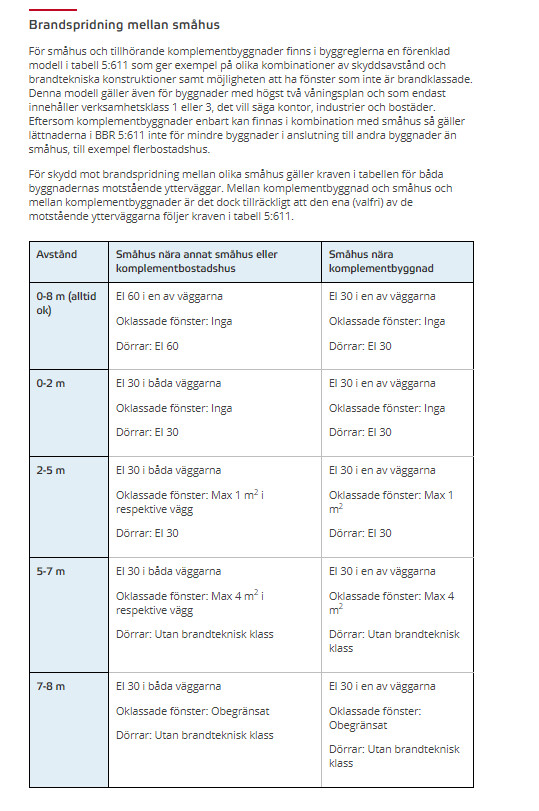



I'm checking on the same issues with an extension near a garage (garage=complementary building, not complementary residential building since no one lives there). I interpret the table as saying that if you make a wall in EI60, it doesn't matter what the other is, but windows are not allowed, and there are requirements for doors. In your case, you have 5-7m to an outbuilding (unclear if complementary residential building or complementary building), and then there are relaxations saying that you can have unclassified windows up to a certain size, and doors do not need to be classified. Here, it matters whether your outbuilding is a residence or not; if it is, you must change the outbuilding to EI30 or follow the 0-8m rules.
9mm is probably exterior plasterboard (or?) so it's probably better with regular plasterboard, or wood board also works for ei3.H Haz6909 said:
I have no idea how to calculate with wood paneling, so the easiest for dumb me is just to count it as zero and build with stuff I know is enough.
In my case, I have >7 m to the garage, and then I imagine that I can have unlimited window area, unclassified doors, and one wall must be EI60. Since I don't know what classification the garage wall has (I assume no classification), I make my exterior wall class EI30 or better and thus everything is dandy...
edit EI 30 in the first sentence... sorry...
edit EI 30 in the first sentence... sorry...
Yes, I've seen that but an EI 60 wall seems to become much thicker than a regular wall, it becomes asymmetrical with other walls so you have to make it equally thick... maybe I've misunderstood.E el_palpo said:
I interpret the table as saying you don't need EI 60, the outbuilding isn't a residence, right?H Haz6909 said:

Click here to reply