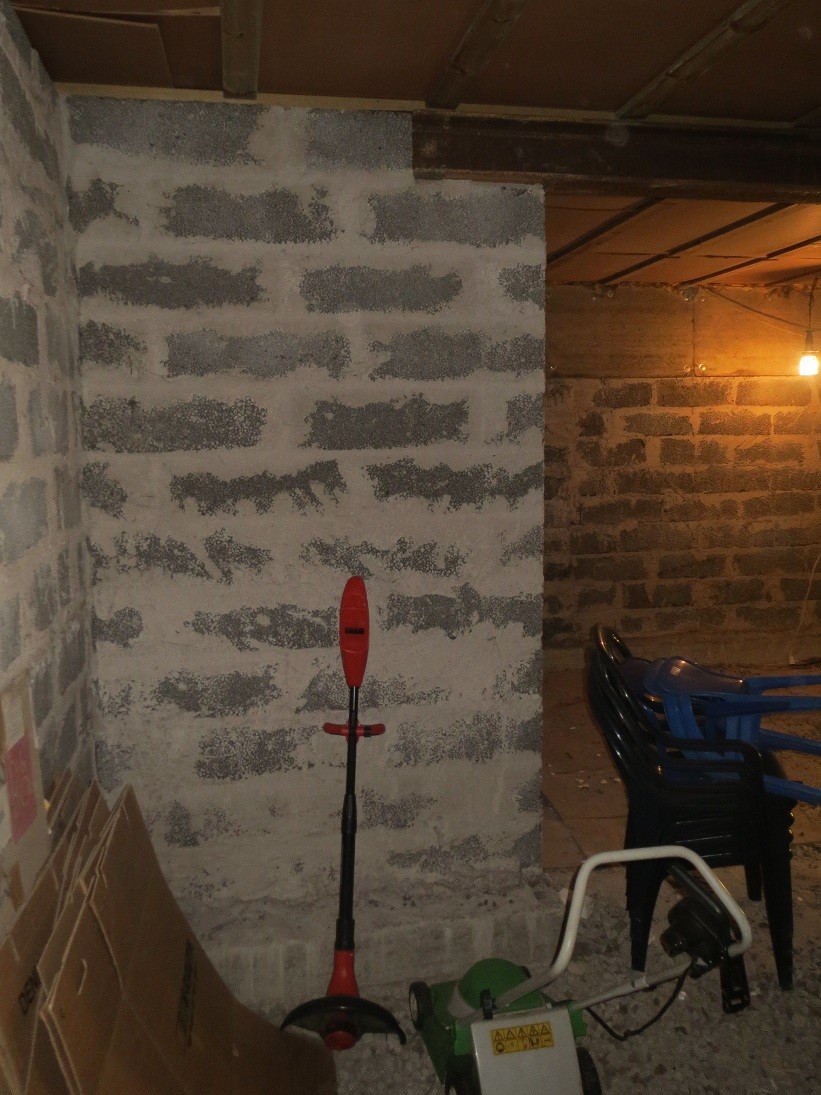
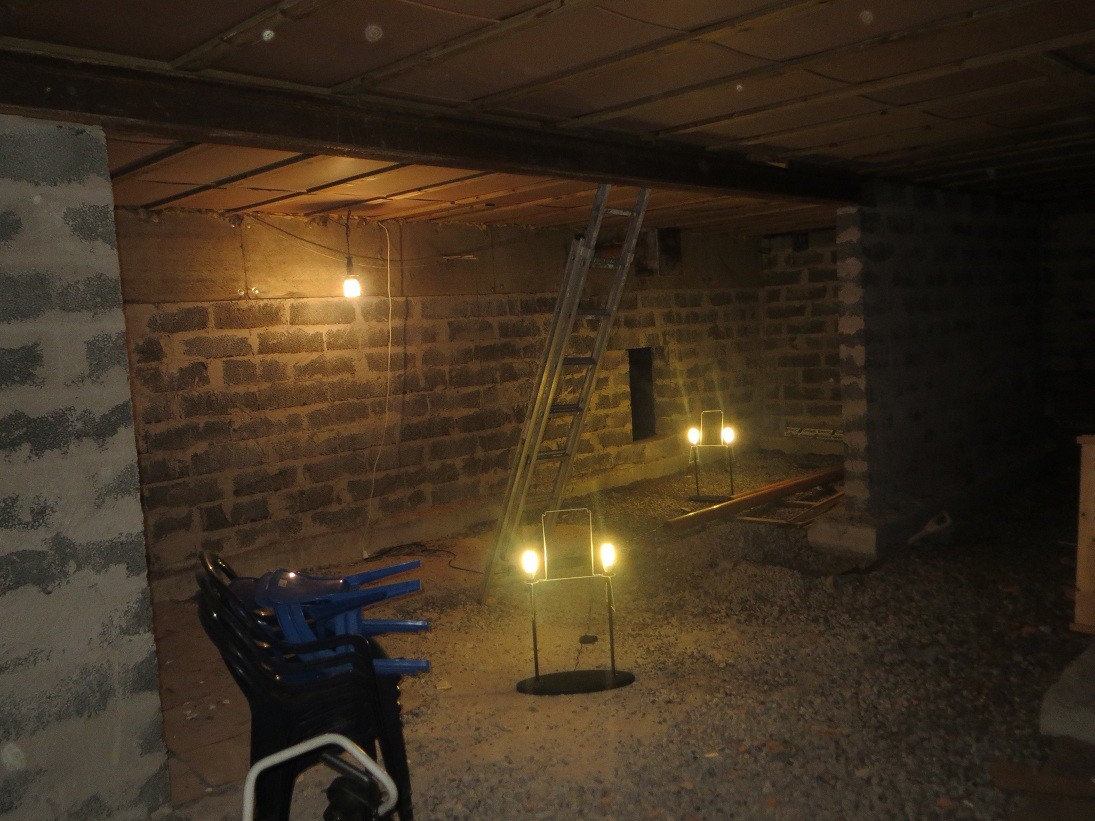
I'm planning to furnish my unfinished basement in the "new" house. Since it's unfinished, I have the opportunity to make sure it's done right from the start. It is unfinished in the sense that there is a gravel floor and raw concrete block walls.
The space is ~ 65 square meters and is divided in the middle by a load-bearing concrete block wall. The concrete block wall is broken in the middle where there is a steel beam. The steel beam is 180mm high and spans a 5m opening. I would like to increase this span to about 6.2m. How much higher does a replacement need to be?
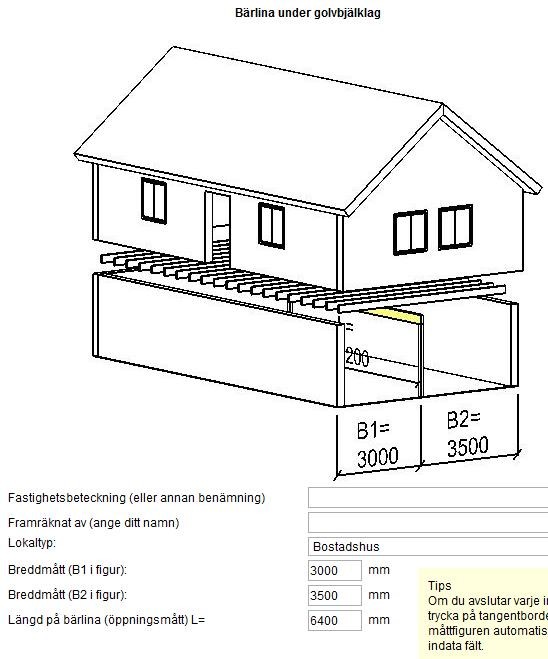
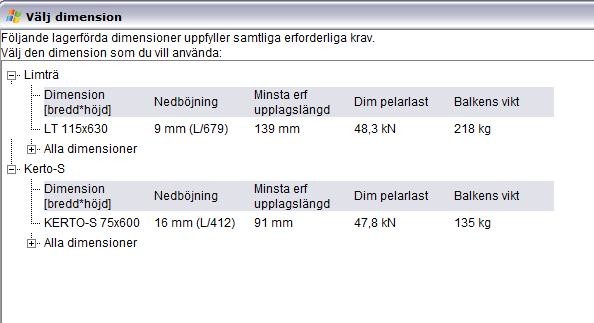
This is what the "drawing" looks like when I input it into Moelven's calculation program. Can anyone help me "translate" it to a HEB or another suitable beam?
Above where I am supposed to have the beam, there is just a large room, no wall at all.
I know too little about it, but I have seen the drawings for the roof trusses and believe that they are built to support the entire length from exterior wall to exterior wall.
You need to have someone (construction engineer) who looks at whether your support points can also bear the load. This applies to both the wall where you attach the beam and the floor underneath. There will be quite a significant point load there.
Thanks for the help! You increase the beam thickness by 33% to extend the span by 25%. I will check how much height I have to play with so it doesn't become a beam you hit your head on, but there isn't much choice really. The only other option is to reduce the span. It's all compromises as usual.
When it comes to the support points, I can choose how I want it myself since nothing is essentially fixed. The beam I am going to replace is mounted on 20cm lecablock walls which in turn rest on a concrete footing 200x500 that lies on gravel. There is about a meter of lecawall I want to remove, so the plan was to let the new beam also rest on these walls, but I'll double-check that with someone I hear (thanks for that tip!).
Now I have measured a little more, what is there today is a HEB180 which spans 5.1m.
As it is today (since there is no concrete floor yet) it seems like I will have "clearance" to it of just over 2.1m.
HEB240 should be okay, but damn they are heavy I see after having looked it up. It will probably be a big job to get one in place (it will span about 6.1m and will thus be approximately 6.5m long).
Raising the span from 5.1m to 6.5m roughly doubles the deflection, assuming you have a uniformly distributed load on the beams. You would then need to switch to a beam with at least double the current moment of inertia, and an HEB 220 (71.5kg/m) would suffice. However, have an engineer take a proper look at this.
Thank you for your input! I will increase from 5.1m to 6.1m (maybe 6.2m), i.e. not quite to 6.5m (as you indicated). HEB220 will be a bit more manageable anyway.
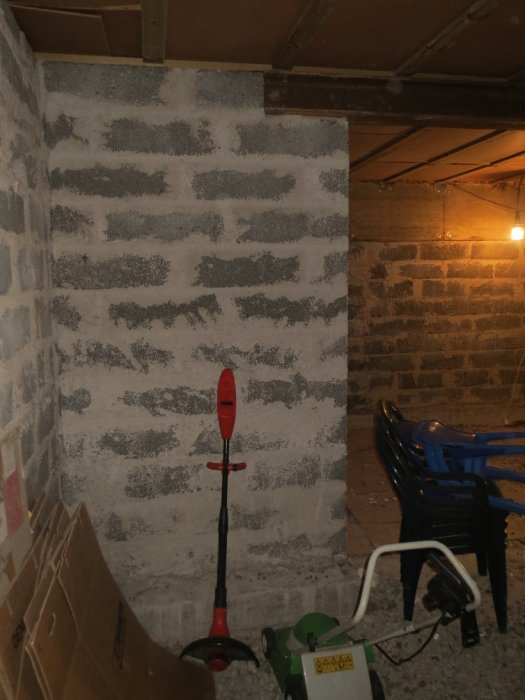
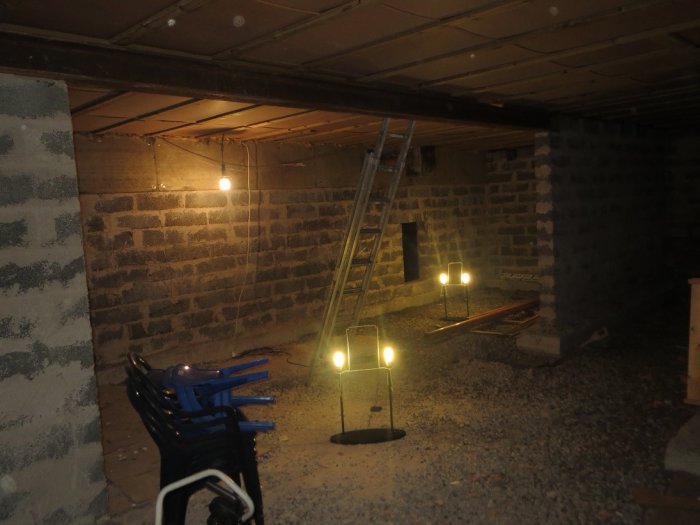
For the clever ones with ideas, here's what it looks like. The first picture is the piece of the wall that needs to be removed (or not the whole thing, it's 1.4m but it would be good if it became only 0.3-0.4m). The second picture is the entire span today.
I had a building contractor over today to look at it and he was going to talk to a structural engineer. His initial thought was to extend the existing beam, but then you haven't considered the increased total weight on the beam... Maybe it could be welded and a "thin" beam placed underneath (although it might not even exist)?
I don't know how he planned the extension, but I don't think it's the simplest and cheapest solution. It places certain demands on the welder, but if you want to splice, you do it as follows: Plate is attached on both sides of the web, it can be screwed with friction screws or welded. Plate should also be attached to the top and bottom flange: They can be screwed into one beam piece but should be welded into the other. I can't say offhand what plate size, weld size, and number of screws are needed, but something like 400 x 200 x 10 for the top and bottom flange, maybe 6 M16 in the top and bottom flange (in each beam piece). In the web, maybe a 200x200x10 plate with 4 M16 (in each beam piece). If you want to weld, a 6mm fillet weld is certainly required, depending on how long the welds are, and a welder who knows what he is doing. Someone must, of course, calculate this properly.
Vi vill skicka notiser för ämnen du bevakar och händelser som berör dig.